Thursday, May 21, 2015

Guinness Storehouse -- Dublin, Ireland

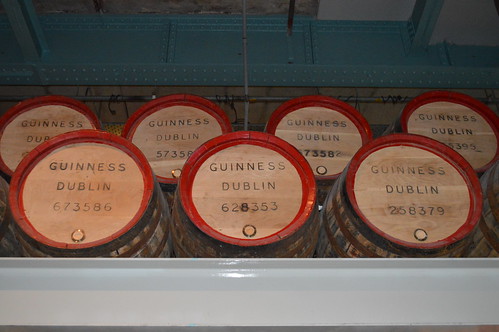
Barrels of Guinness Beer
One simply cannot think of Dublin without envisioning a traditional Irish pub…and a dark pint of Guinness that inevitable is associated with it.  All that bubbly brew is produced right in the heart of Dublin at the St. James’s Gate Brewery…one of the largest (and most famous) breweries in the world.

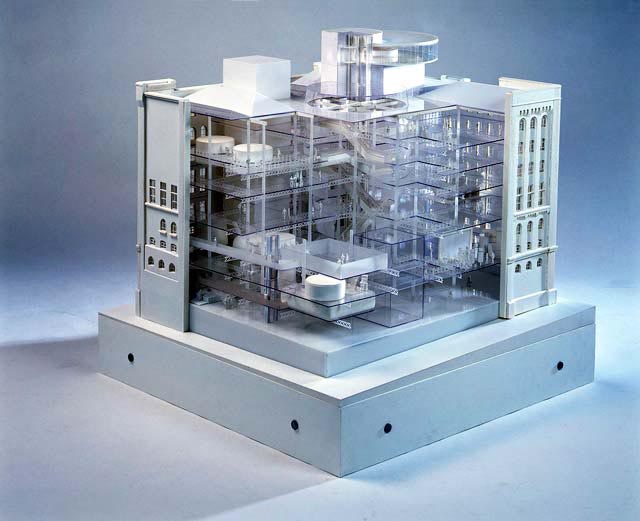
The Guinness Storehouse is the seven-story building located at the center of the brewery that has been remodeled inside to resemble a giant pint of Guinness where all floors are designed around a central glass atrium mirroring the shape of the famous pint.  If full the ‘atrium’ pint would hold 14.3 million glasses of the black brew.

The storehouse was once the fermentation plant, but today entertains visitors by acquainting them with every aspect of the famous stout’s production; from making the beer barrels in the cooperage to the creation of the world famous brand.  It is a rich history indeed.

One will even learn how to properly pour a beer.  (A ‘perfect’ pour of Guinness should take 199.5 seconds at a 45-degree angle.)  Watch this video to see how a master brewer pours a pint—How to Pour a Perfect Pint of Guinness (2:22)

Guinness's signature dark brew
Guinness stout is made from four natural ingredients—water, barley, hops and yeast.  The interactive self-guided experience allows visitors to view the brewing process first-hand, smell the hops, touch the barley, hear the waterfalls, and learn every aspect of the brewing process from recipe to marketing.  Inside the Guinness Storehouse – Ingredients and Waterfall (0:30)

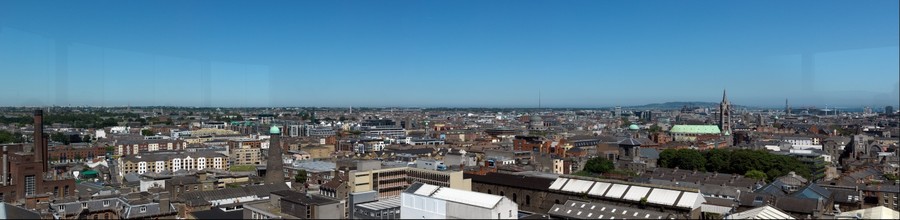
The highlight of the tour for many is the opportunity at the end of the tour to partake in a freshly-brewed pint of world-renowned Guinness beer at the Gravity Bar and the 360-degree panoramic views across Dublin from the top floorInside the Guinness Storehouse – The Gravity Bar (0:35)

Founded in 1759 by Arthur Guinness, the operation has expanded over the years down to the River Liffey and across both sides of the street and at one point had its own railway.  A giant gate once stretched across James Street…hence the name of the brewery.

Guinness was originally called Porter and then Stout Porter, before its name changed in the 18th century.  In the 1930s, Guinness employed over 5,000 workers.  With industrialization of the process, the company employs about 600 people, but still produces 2.5 million pints of stout every day.

Join National Geographic as they explore Guinness Beer (45:33) in this documentary.

What to Expect

Guinness Storehouse Gravity Bar
Upon entering the pint glass-shaped building, visitors find themselves in the Atrium on the ground floor.  Here they find the extensive retail store and the beginning of the interactive exhibit, including the company’s 9,000 year lease.

After getting familiar with the main ingredients in Guinness, people are directed to the next level to learn about the brewing process and the different variations of Guinness that are on the market.  Floors 2 through 6 take visitors on an interesting journey back in time to discover the history behind Arthur Guinness, the company and the Guinness Storehouse itself.

By the time visitors reach the 7th and final floor, they will be caught back up to the present and ready to enjoy their pint of the legendary brew in the Gravity Bar.

Saturday, May 16, 2015

Dublin Castle -- Dublin, Ireland

Round Tower at Dublin Castle
Dublin Castle, currently a working Irish government building, has served as a prison, the treasury, a military fortress, and court of law over the last 700 years.  In addition it served as the seat of administration of the English government in Ireland until the formation of the Republic of Ireland in 1921

Today the sprawling complex of historic buildings is used for important state receptions and Presidential Inaugurations every seven years.  Every ten years, the castle serves as the central base as Ireland hosts the European Presidency.  On occasions, Dublin Castle may close on very short notice for state business.

Located in the heart of historic Dublin, it was built in the 13th century on a site originally settled by Vikings and has been remodeled numerous times over the centuries.  It includes the State Apartments (built as the residential quarters of the Viceregal court), Undercroft (where portions of the Viking fortress and the 13th century castle are on view), Chapel Royal, the Chester Beatty Library, the Revenue Museum, Craft Shop, Heritage Centre, and restaurant.

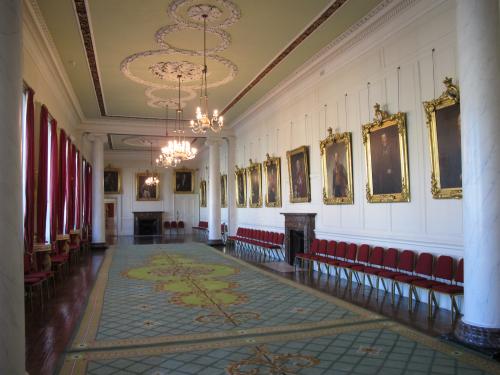
Dublin Castle Drawing Room
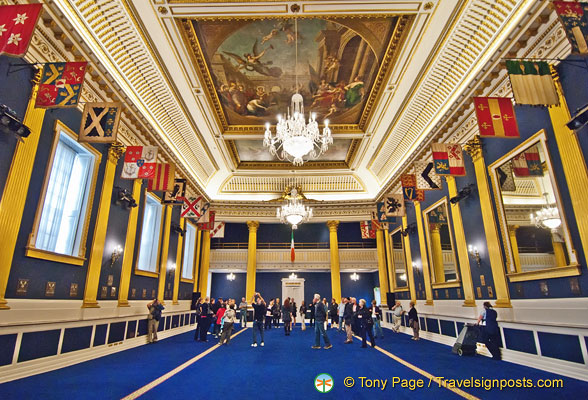
The castle features amazing architecture, as well as intriguing exhibits, artifacts, and state treasures.  Places of note inside the State Apartments are the State Corridor, the State Drawing Room, the Throne Room, the Picture Gallery or State Dining Room, the Bedford Tower, and the beautiful St. Patrick’s Hall, the grandest room in the State Apartments used for presidential inaugurations.

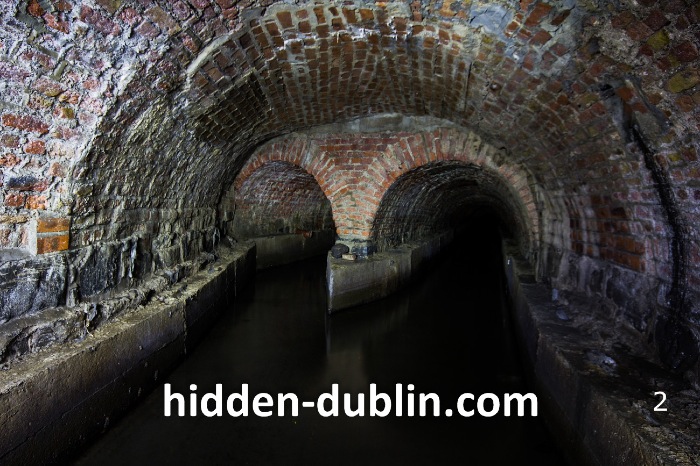
The castle stands on the rim of a strategic site at the junction of the River Liffey and its now underground tributary, the River Poddle, where an original fortification may have been an early Gaelic ring fort.  The Great Courtyard today corresponds with these early fortifications and with the Record Tower as the last intact medieval tower in Dublin.

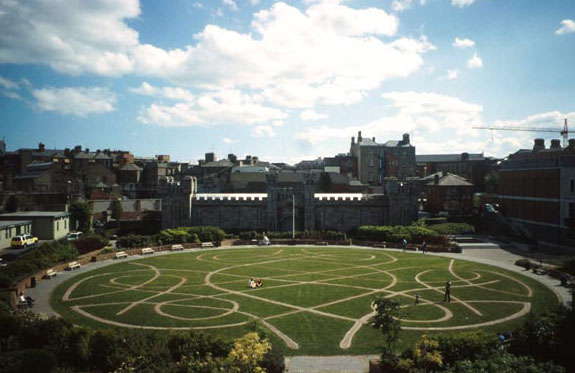
The city gets its name from Gaelic ‘Dubh Linn,’meaning Black Pool or Black Water, which was on the site of the present Castle garden.  Of note, the Irish crown jewels were stolen from the castle in 1907 and have never been recovered.

Dublin Castle Throne Room
Dublin Castle has appeared in numerous films including Barry Lyndon, Michael Collins, Becoming Jane and The Medallion, as well as the television series The Tudors, where it doubled as the Vatican in the pilot.

Roll your mouse over this interactive map of Dublin Castle to learn more about its various buildings.  Click on the links to the left on this site to learn more about specific areas.  Read Dublin Castle’s complete history.

Watch these videos to get an overview of the Dublin Castle complex:

Irish National Anthem at Presidential Inauguration—Dublin Castle (1:14)  'Amhrán na bhFiann' played out in St. Patrick's Hall at Dublin Castle as Michael D. Higgins is inaugurated as the ninth President of Ireland in 2011.


Saturday, May 9, 2015

Book of Kells--Dublin, Ireland

The Book of Kells -- Christ Enthroned
The Book of Kells is Ireland’s most treasured medieval artifact.  It is recognized as possibly the finest illustrated manuscript from medieval Europe.

It is generally accepted that the document was produced in the scriptorium of a monastery on the Isle of Iona, Scotland, to honor Saint Columba in the early 8th century.  It was later moved to Kells, Ireland, by the Columban monks after a Viking raid in 806 AD.  It is possible the monks may have worked on the manuscript at both locations.

The document was then stolen in the 11th century and the cover, which likely was covered in gold and precious jewels, was torn off and the manuscript thrown into a ditch.  Although the book suffered some water damage it is still in remarkable condition.  The cover has never been found.

In 1541, at the height of the English Reformation, the book was taken by the Roman Catholic Church for safekeeping, but was returned to Ireland in the 17th century.  It was in the collection of Archbishop James Ussher when he died and given to Trinity College by his nephew Henry Jones where it remains today in the Old Library on campus.

Since 1953, the manuscript has been bound in four volumes.  On any given day, Trinity College Library will display two of the volumes, one opened to a fully illuminated folio while the other is opened to typical text pages.
The Book of Kells on display at Trinity College, Dublin

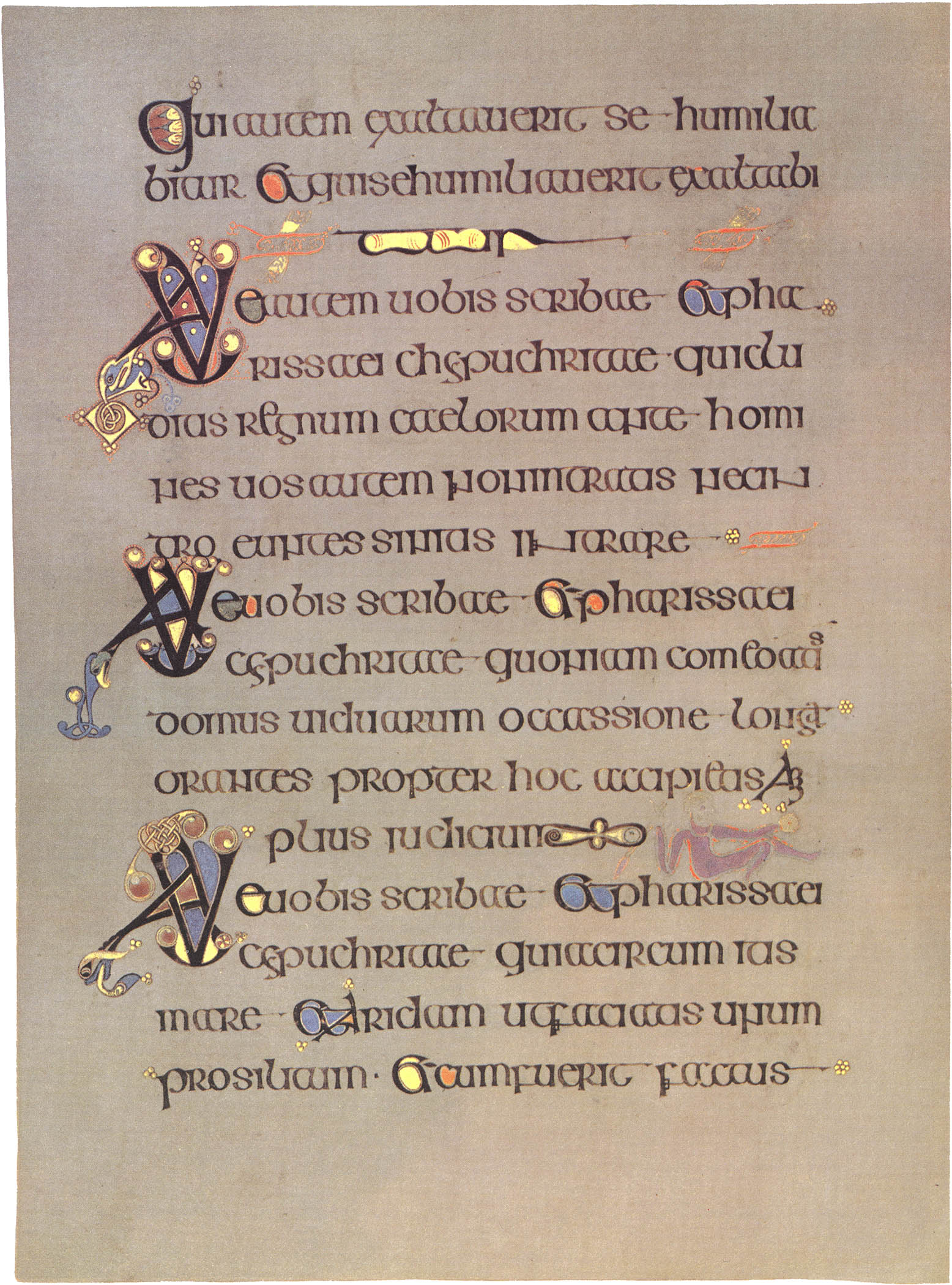
The Book of Kells is an illuminated manuscript which contains the four Gospels in Latin according to the Vulgate text which St. Jerome completed in 384 AD, intermixed with readings from the earlier Old Latin translation. 

The Gospel texts are prefaced by other texts, including “canon tables,” or concordances of Gospel passages common to two or more of the evangelists; summaries of the gospel narratives (Breves causae); and prefaces characterizing the evangelists or authors (Argumenta)—Matthew, Mark, Luke, and John.

The book is written on vellum (prepared calfskin) in a bold and expert version of the script known as “insular majuscule.”  It contains 340 folios (680 individual pages), now measuring approximately 330 x 250 mm.  Over the years the pages have been severely trimmed, and their edges gilded, in the course of rebinding in the 19th century.

Ten different colors were used in the illumination using Celtic motifs and Christian symbolism, some of which cover entire pages while other pages have illuminated characters.  Only two of the pages have no illumination at all. 

Some of the colors are rare and had to be imported from the continent, and some of the workmanship is so fine that it can only clearly be seen with a magnifying glass. 

To learn more about the Book of Kells, watch this 7-part documentary.
Part 1 (9:56)
Part 2 (9:57)
Part 3 (9:56)
Part 4 (9:57)
Part 5 (9:57)
Part 6 (9:51)
Part 7 (8:25)

Trinity College Library Dublin has made the Book of Kells free to view online in its entirety through its Digital Collection.   

In 2009, an animated feature, The Secret of Kells, was released depicting a mystical tale of the making of the book.  It was nominated for an Academy Award for Best Animated Feature.
Old Library at Trinity College

Friday, April 24, 2015

Glendalough -- Ireland

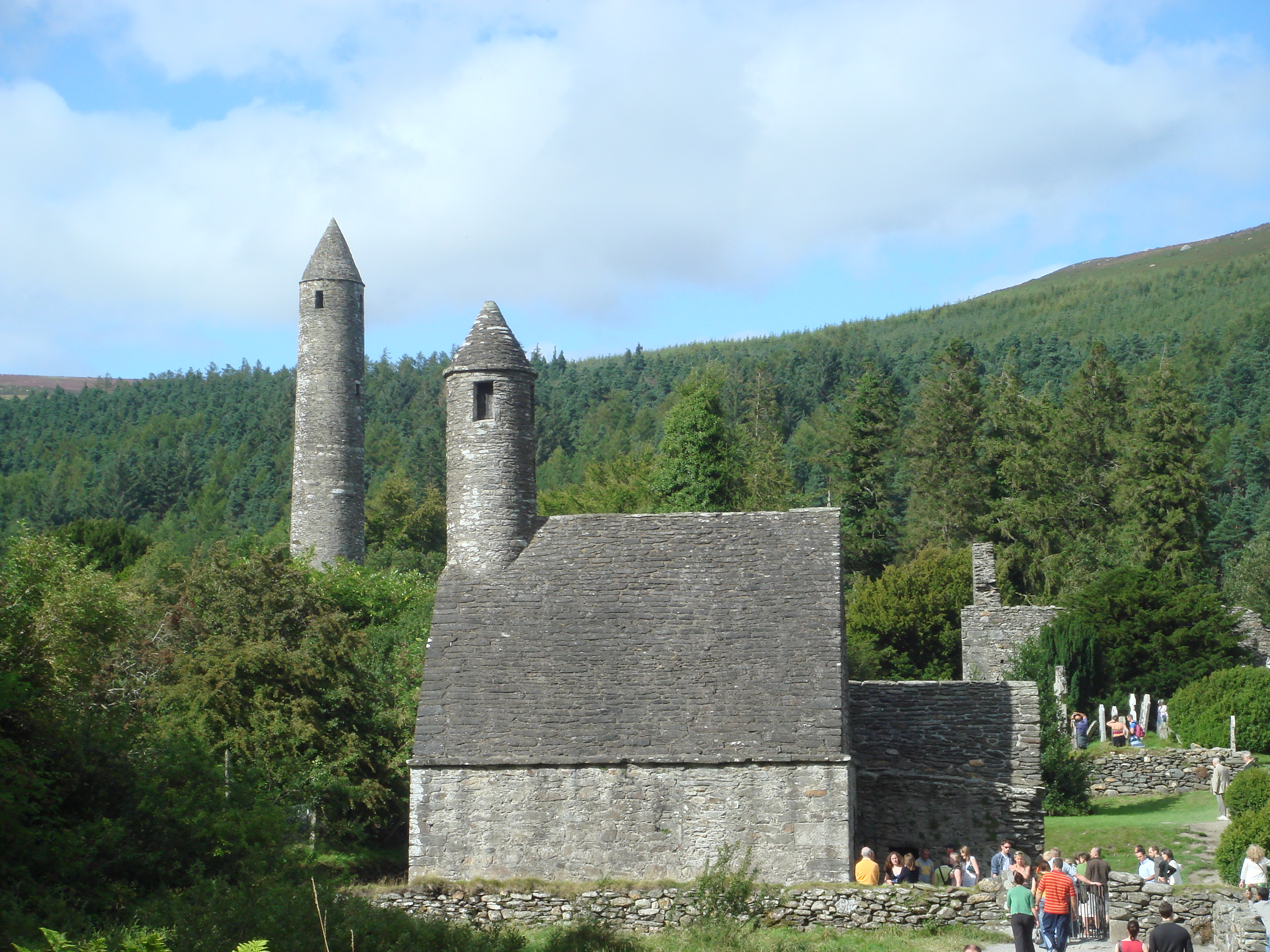
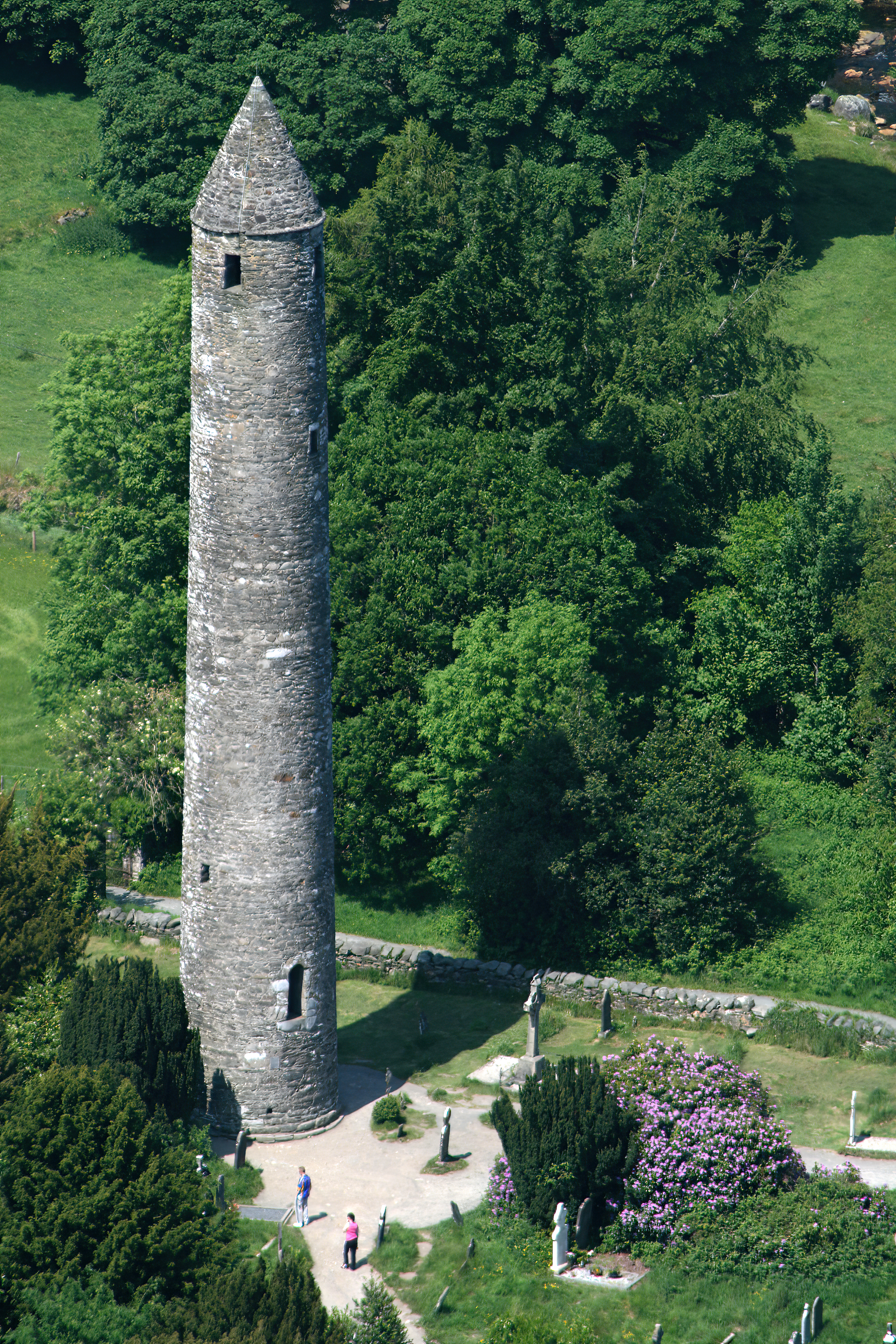
Glendalough Round Tower
Glendalough represents iconic Irish countryside.  Nestled in a glaciated valley in the heart of County Wicklow, this serene valley boasts two lakes, monastic remains with a superb round tower, stone churches, and decorated crosses in an historical graveyard. Literally the name, Gleann Dá Loch, means “Valley of the Two Lakes.”

History
The early Christian ecclesiastical settlement was founded in the 6th century by St. Kevin, a hermit monk who died about 618 A.D.  A descendant of one of the ruling families of Leinster, he came to live at Glendalough (pronounced ‘glenda-lock’) as a young man.  According to legend, he lived a life of sleeping on stones, wearing animal skins, barely eating, and making friends with birds and animals.

By the 9th century, Glendalough rivaled only Clonmacnoise as one of the leading monastic cities in Ireland.  In its heyday, the settlement not only featured a monastery and monk cells, but also an infirmary, workshops, areas for manuscript writing and copying, guesthouses, farm buildings and houses.  Most of what survives today is from the 10th-12th centuries.

In 1214, the dioceses of Glendalough and Dublin were combined and the settlement fell into ruin destroyed by English forces in 1398.  The Feast of St. Kevin is celebrated on June 3.

Glendalough is currently a titular see in the Catholic Church.  It is used for bishops who hold no ordinary power of their own and thus are titular bishops.

Visiting Glendalough
Upper Lake at Glendalough
The two lakes at Glendalough are known as Upper Lake and Lower Lake, where the main entrance from the parking area, a visitor centre, the main monastic dwellings, and a hotel are located.  Walking trails connect the two lakes and other monastic sites.

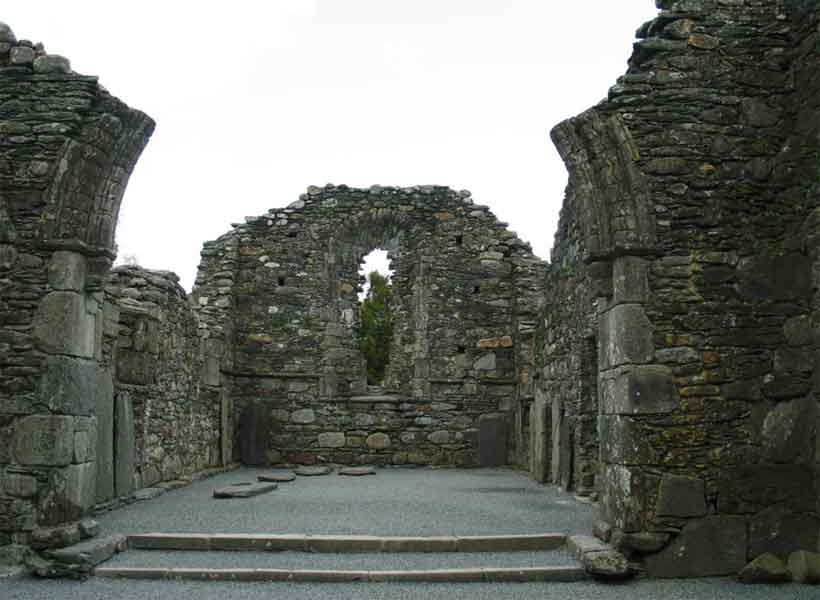
Visible at Lower Lake are the double-arched medieval gateway; the Cathedral, the largest building; St. Kevin’s Cross with an unpierced ring; the reconstructed priests’ house; St. Kevin’s Church (or Kitchen) with its distinctive round belfry; foundations of St. Kieran’s Church; and the iconic round tower.

The round tower possibly served as a belltower, a place of refuge when under attack, and/or a storage facility.  It originally had six timber-floored stories with the doorway to the tower 3-1/2 meters above ground to protect those inside from intruders.

Small windows at the top face the four points of the compass, and stories were accessed by internal wooden ladders.  The conical roof was replaced in 1876 from original stones.

Additional monastic structures – St. Mary’s Church, the CaherReefert Church, and St. Savior’s Church – can be visited on the hike to Upper Lake. Temple-na-Skellig and St. Kevin’s Bed, a cave, are only accessible via boat.

Crosses of Glendalough
There are nine marked walkingtrails in Wicklow Mountains National Park ranging from a short half hour walk to a four-hour hillwalk.  The park is host to a wide diversity of wildlife including red deer, sika deer, fallow deer, feral goat, red fox, mink, and over 100 species of birds.  The common lizard is the only reptile in the park, as there are no snakes in Ireland.

The visitor center located nearby hosts an interesting exhibit and a 17-minute film entitled “Ireland of the Monasteries.”


Join Rick Steves in this video: “Glendalough, Ireland: Exploring the Wicklow Mountains.”  (Watch only the first 1:55 minutes.)
For a unique birds eye view, enjoy this video: “Glendalough.” (3:40)


Friday, April 17, 2015

Irish National Stud and Gardens -- Ireland

Thoroughbreds at the Irish National Stud
The Irish National Stud and Gardens located in County Kildare, Ireland, is where horse racing legends are born and the only one in Ireland open to the public.  Also located on the grounds are the world famous Japanese Gardens, the Horse Museum, and St. Fiachra's Garden, created to celebrate the Millennium.

The thoroughbred horse racing facility, which now belongs to the people of Ireland, is located on the 1,000-acre Tully Estate, home to some of the finest thoroughbreds in the world including these living legends who live(d) out their days in retirement at the stud:  “Beef or Salmon,” “Kicking King,” “Hardy Eustace,” “Rite of Passage,” “Moscow Flyer,” and “Vintage Crop.”

Tully’s famous stud farm where racehorses are conceived, born, and raised was bought from the Fay family by Colonel William Hall-Walker in 1900.  He became one of the most successful breeders of his time.  His finest hour came when King Edward VII led “Minoru,” born and raised at Tully, into the winner’s circle at the 1909 Derby.

The Horse Museum features a life size skeleton of “Arkle,” the famous steeplechaser who raced in the sixties.  He was a three-time winner of jumping’s ultimate prize, the Cheltenham Gold Cup.  Watch “Arkle” win the 1964 Gold Cup here (2:20).  “Sea the Stars” is the stud’s most modern champion and the museum houses much of his memorabilia.

Japanese Gardens
The Japanese Gardens were devised by Col. Hall-Walker (later Lord Wavertree), a wealthy Scotsman from a famous brewery family, and laid out between 1906 and1910 on four acres of woodland and lakeside walks by Japanese master horticulturist Tassa Eida and son Minoru (for whom the famous horse is named).

The natural habitat, carefully preserved as part of Ireland’s heritage, was planned to symbolize “The Life of Man,” tracing a soul from birth to death and beyond.  In addition to the flora, there are ponds, waterfalls, rock structures, bridges, and a tea house.  (For a complete description of the symbolism of the gardens, go here and scroll to read “The Japanese Gardens.”)

St Fiachra's Garden
In 1999, Saint Fiachra’s Garden was created to honor the patron saint of gardeners.  Designed by Professor Martin Hallinan, an award winning landscape architect, this natural environment was created to simulate the spirituality of the monastic movement in Ireland in the 6th and 7th centuries.  It features unique water spots and replicas of monastic ruins.

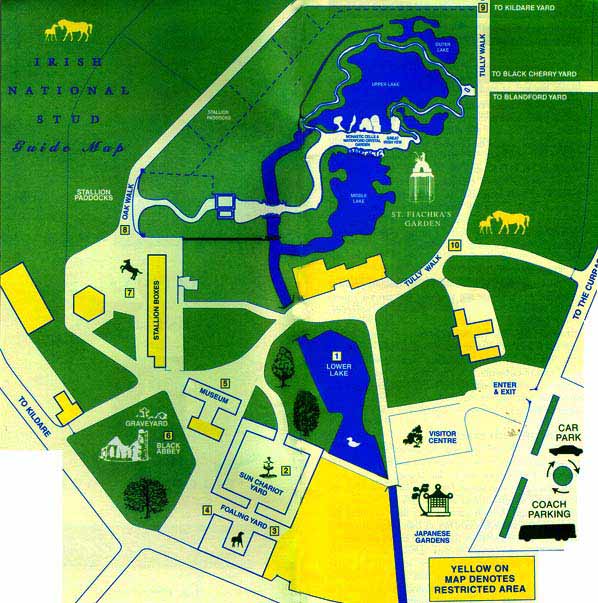
Consult this guide map to plan your visit and consider the following suggested time schedule for touring:
National Stud: 1 hour
Japanese Gardens: 20 minutes
St. Fiachra’s Garden: 45 minutes
Horse Museum: 20 minutes

Enjoy these related videos.
For a mini tour of the horse pastures: Irish National Stud (2:55)
For a peaceful tour of the Japanese Gardens: Japanese Gardens County Kildare (8:41)


Tuesday, April 14, 2015

Corcomroe Abbey -- Ireland


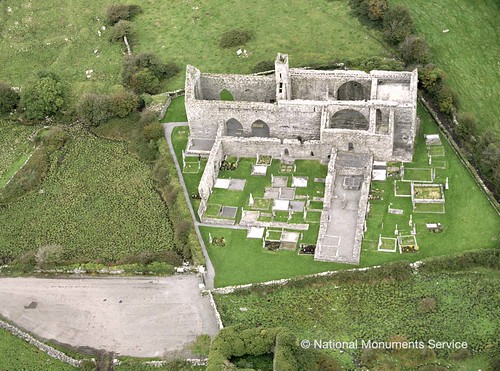
Corcomroe Abbey in The Burren
Located in a fertile green valley of the Burren, County Clare, Ireland, the ruins of Corcomroe Abbey are remarkably well-preserved.  Uniquely picturesque in its isolation on the Burren, the abbey is situated close to three small deserted Christian churches dedicated to St. Colman and nestled in the pass of Oughtmana.

Early monks sought out isolated areas to settle and became self sustained.  The abbey became known as “Sancta Maria de Petra Fertili”—St. Mary of the Fertile Rock, as the Burren provided all the monks needed to maintain a Cistercian community through cultivating the surrounding fertile lands.

Corcomroe Abbey is said to have been established by Donal Mór Ua Briain in the late 12th century and continued to function for the next 400 years.  The last abbot named was John O'Dea, a Cistercian from the Irish College at Salamanca, in 1628.

The abbey is noted for its beautiful architectural detail still visible in its ruinous state and not found in other structures of this period.   It features a typical cruciform church facing east, with a small chapel in each transept. 

Magnificent arches still reign over chapel entries, although one entrance has been sealed off for burials—both ancient and modern.  Parts of the remaining roof still bear some finely carved rib vaulting in the Romanesque style.

Capital details - human masks and floral detail
The capitals are decorated with lotus leaves and other botanic detail, while some carved human masks and dragon heads are visible in the transept chapels.

The choir is constructed with high quality stonework and in the north wall can be seen a tomb-niche holding a recumbent effigy of King Conor na Siudaine Ua Briain who died in 1267, one of the very few examples remaining of an Irish Chieftain.  He was a benefactor of the abbey and grandson of the founder. 

Effigy of King Conor na Siudaine Ua Brianin
The English Reformation led to the dissolution of Catholic monasteries in England and Ireland. In 1554, the abbey was granted to the Earl of Thomond

The site is under state care and a National Monument of Ireland.  The graveyard surrounding the abbey is still in use, so care must be taken not to disturb the site.

Look for the ring fort dissected by the road on the way out, identifiable by the raised circular mound topped by hawthorn trees.

Wednesday, April 1, 2015

Travel Smart--Packing Tips

Rule #1 (Actually it's the ONLY packing rule!) – Pack light! In general, you can have one checked bag and two carry-on bags, but I don’t recommend any large suitcases because you have to porter your own luggage during the tour. You should plan on one average size suitcase (rolling is your best bet) and a backpack or under the airplane seat size bag. I do not plan to check my bag but use the smaller size and carry on both bags…your call.

BAGGAGE:
--United Airlines baggage policy
--British Airways baggage policy

As required by U.S. Department of Transportation regulations, baggage service charges for your entire itinerary are determined by the marketing carrier for the first segment of your itinerary. Your originating marketing carrier is the airline whose flight number is assigned to the first segment of your itinerary.

If you plan to check a bag, it must not weigh over 50 pounds.  Anything over that will impose an
Dimensions for a carry on bag
overweight fee.  If you check a bag, one carry on bag such as a backpack or bag whose total dimensions do not exceed 45 inches (length + height  + width, such as 9x14x22 and can be stowed in the overhead bin) AND one personal item such as a purse or laptop not to exceed 36 inches (9x10x17 and can be stored under the seat).

A coat or jacket, reading material, and food bought in the airport do not count towards carry on.

If you decide not to check a bag, then your purse or laptop must be stowed in one of the two carry on bags and the same dimensions apply.  You may be surprised at what you can pack in a smaller bag and what you can live without for a short travel time!

Consider packing a day bag in your luggage, something a bit smaller to carry just the essentials you need for the day (camera, water, itinerary, notes, tissues, etc.)  You won’t want to carry a backpack full of all your toiletries and extra items around all day as all that will be stowed in the bus baggage compartment.

PACKING TIPS:
Roll clothes to save space
--roll clothes to prevent wrinkles and save space or put a day’s set of clothes in 2-1/2 gallon Ziploc bags and squeeze out the air before sealing.
--consider wearing slacks twice with different shirts each day to save space. Then 2 days clothes can be packed in one of those large Ziploc bags.
--put toiletries, camera, and a change of clothes in your carry on…going and coming.
--pack extra camera batteries and memory cards.
--prescriptions need to be in original bottles. Ask your pharmacy if they can provide you with smaller bottles with labels.  If not, transfer complete labels on larger containers to smaller ones.
--pack some extra garbage bags for dirty or wet clothes. Pack extra different sizes of Ziploc bags for a variety of reasons.
--pack easy traveling snacks (not ones that crumble or melt). Sometimes dinner or lunch is late depending on the schedule.
--consider collapsible refillable water bottles.
--keep your actual passport inside your clothes in a neck or waist pouch.  Also keep the majority of your money in this same safe place. Just take out the daily amount of cash. Also watch out for pickpockets!  Read these practical reviews on wearing neck or waist (and other) pouches.
--make sure that any day visiting a religious site that shoulders and knees should be covered (if you’re in shorts, wrap a shawl around your waist or slip on wind pants)
3-1-1 rule for carry on liquids
--always carry an umbrella or a breathable, waterproof rain jacket.
--toiletries should be packed 3-1-1….gels, aerosols, liquids in containers of no more than 3.4 ounces in only one bag that is no larger than one quart. Try to get as many in travel size as possible. This bag will need to be out and go through the security scan outside your luggage. Too many toiletries or health and beauty aids in too large sizes is the number one way to take up a lot of space in luggage.  And you only need to put liquids in this 3-1-1 bag.  Other toiletries can be packed in a separate bag in your luggage.
--wear comfortable shoes!! Don’t bring new ones you haven’t broken in yet—UNDER ANY CIRCUMSTANCES.  I don’t care how cute they look with that new jacket! Bring a spare pair in case a strap breaks or they get wet. I like Teva brand, and I've bought them on clearance racks, Ross at a discount, and on Amazon.
--pack a journal and write, write, write. Remember the fun!
--bring a light jacket…expect some cool weather.
--might even pack some light weight gloves and scarf.  Evenings could be cool.
--expect unpredictable weather…layer, layer, layer…it could be warm to downright cold—all in the same day!
--prepare for both kinds of weather and bring sunscreen also.
--avoid packing valuable jewelry. Less is more.
British type plug adaptor
--will need an electric voltage converter and a plug adaptor for the countries we are visiting as European electrical outlets are different from US. They are 220v instead of 110v. I recommend getting a universal adapter and converter kit available at Walmart or Target. View more information about plug and socket types for various countries.
--pack a travel alarm or make sure the one on your phone works. There are wake up calls, but sometimes they don’t always go through.
--wear a watch or use a phone clock to make sure you are where you need to be on time.
--share some things with roomies (i.e. hair dryer, curling irons, etc.) and save space.
--wear your most bulky shoes and pack the lighter ones.
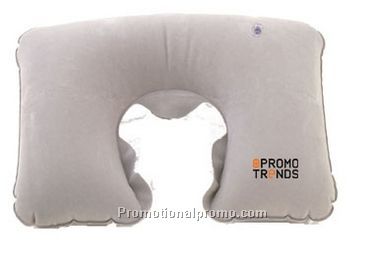
--It’s an overnight flight so try to get sleep in flight. A neck pillow really helps! There are inflatable ones that save space in luggage and those comfy, cushy ones that I just drape on the outside of my luggage handle and don't pack.
--throw in a fabric softener sheet to keep your suitcase fresh.
--pack a flat duffel or backpack that you could use as a second carry on to hold souvenirs on the return flight if you check your larger bag.
--always have some tissue in your pocket…just in case there is no toilet paper at a pit stop.
--bring your own washcloths or bath sponges.  European hotels typically do not provide washcloths.  Or you could use those disposable dish cloths and just throw them away after each use.
--don’t forget your passport, driver’s license (for another form of ID), travel documents/flight information, copies of passports (in both bags, one at home and email to yourself), and any insurance paperwork other than EF.
--information on this blog is meant to be printed and used as your travel guide, so you only need to print the parts you want. However, if you want a published guide, I recommend the Dorling-Kindersley Eyewitness Travel Guides. They are detailed, lots of pictures and diagrams, and my favorite...but they are heavy! If you are buying used travel guides, make sure the copyright date is the most current as they are updated regularly.  Here are the most recent for Scotland and Ireland.
--checked bags should not be locked for possible security checks, so use a twist tie on the flight. You can lock them during the trip. Also if you check your bag, tell the airport check-in attendant to check your bag all the way to our final destination..and then make sure the tag they attach says so BEFORE they put it on the conveyer belt!

Here are a few tips that some of you contributed:
--wear support stockings on both plane trips for circulation.  [Note: we have had a lot of people who have had problems with swollen legs and ankles.  Maybe this will help.]
--wear a comfortable OLD dress or slacks on the plane and leave at the first hotel freeing up packing space.  Spring is the time to clean out your closets!  I have had a traveler who packed all old clothes she planned to discard and just left them behind at each hotel.  She came home with a suitcase full of souvenirs!
--since it is rainy much of the time at our destinations, packing pocket disposable raincoats takes up no space and costs a $1 at the dollar store.  Toss them when you are through.  [Note: I wouldn’t leave your regular rain jacket at home, but it wouldn’t hurt to have one or two for emergencies in your backpack.]
--pack a travel size Downy Wrinkle Releaser spray.  [Note: I have had more than one person tell me it works, although I have not tried it myself.]

For additional information on packing, refer to a previous blog posting that I wrote after having a meeting for a previous tour.  It has detailed information about packing light and other tips.  You might pick up a few more packing tips from this earlier blog posting too.

Although these three Rick Steves European Travel Skills videos cover a lot more than packing, they give a lot of practical travel tips and are worth watching.  And be sure to check out Rick Steves suggested packing list.
Part 1 (24:57)
Part 2 (24:57)
Part 3 (24:57)

Here are some interesting Pinterest boards on packing: