Showing posts with label castle. Show all posts

Saturday, May 16, 2015

Dublin Castle -- Dublin, Ireland

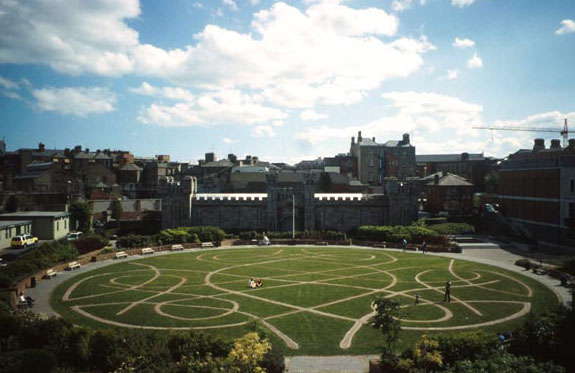
Round Tower at Dublin Castle
Dublin Castle, currently a working Irish government building, has served as a prison, the treasury, a military fortress, and court of law over the last 700 years.  In addition it served as the seat of administration of the English government in Ireland until the formation of the Republic of Ireland in 1921

Today the sprawling complex of historic buildings is used for important state receptions and Presidential Inaugurations every seven years.  Every ten years, the castle serves as the central base as Ireland hosts the European Presidency.  On occasions, Dublin Castle may close on very short notice for state business.

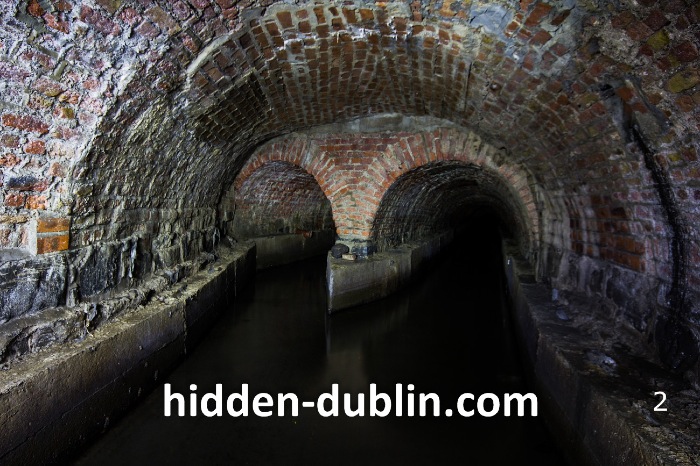
Located in the heart of historic Dublin, it was built in the 13th century on a site originally settled by Vikings and has been remodeled numerous times over the centuries.  It includes the State Apartments (built as the residential quarters of the Viceregal court), Undercroft (where portions of the Viking fortress and the 13th century castle are on view), Chapel Royal, the Chester Beatty Library, the Revenue Museum, Craft Shop, Heritage Centre, and restaurant.

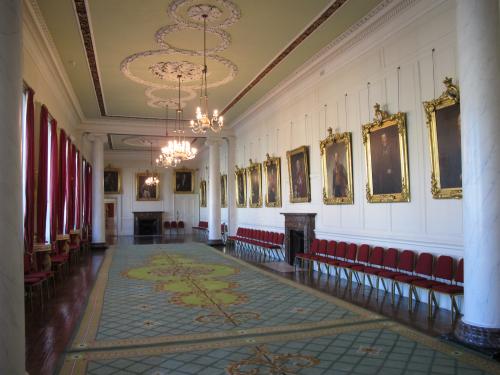
Dublin Castle Drawing Room
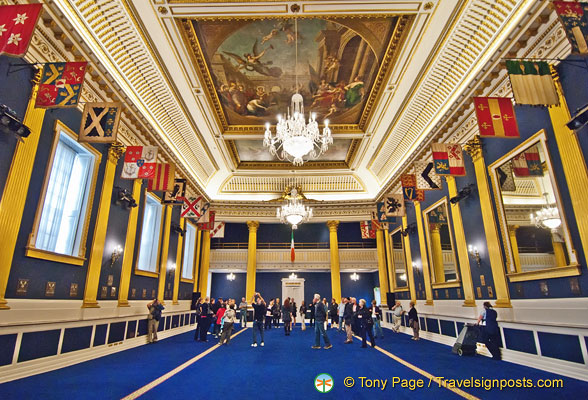
The castle features amazing architecture, as well as intriguing exhibits, artifacts, and state treasures.  Places of note inside the State Apartments are the State Corridor, the State Drawing Room, the Throne Room, the Picture Gallery or State Dining Room, the Bedford Tower, and the beautiful St. Patrick’s Hall, the grandest room in the State Apartments used for presidential inaugurations.

The castle stands on the rim of a strategic site at the junction of the River Liffey and its now underground tributary, the River Poddle, where an original fortification may have been an early Gaelic ring fort.  The Great Courtyard today corresponds with these early fortifications and with the Record Tower as the last intact medieval tower in Dublin.

The city gets its name from Gaelic ‘Dubh Linn,’meaning Black Pool or Black Water, which was on the site of the present Castle garden.  Of note, the Irish crown jewels were stolen from the castle in 1907 and have never been recovered.

Dublin Castle Throne Room
Dublin Castle has appeared in numerous films including Barry Lyndon, Michael Collins, Becoming Jane and The Medallion, as well as the television series The Tudors, where it doubled as the Vatican in the pilot.

Roll your mouse over this interactive map of Dublin Castle to learn more about its various buildings.  Click on the links to the left on this site to learn more about specific areas.  Read Dublin Castle’s complete history.

Watch these videos to get an overview of the Dublin Castle complex:

Irish National Anthem at Presidential Inauguration—Dublin Castle (1:14)  'Amhrán na bhFiann' played out in St. Patrick's Hall at Dublin Castle as Michael D. Higgins is inaugurated as the ninth President of Ireland in 2011.


Saturday, December 27, 2014

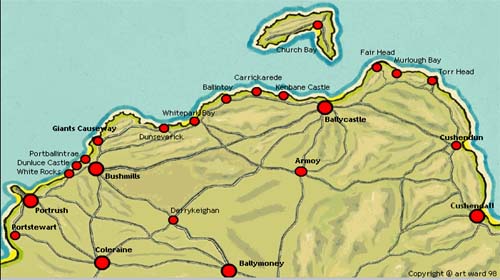
Dunluce Castle, Northern Ireland

Aerial view of Dunluce Castle
Thought by many to be the most romantic and picturesque of Irish castles, the ruins of medieval Dunluce Castle sit atop a rocky outcrop overlooking the Irish Sea on the Antrim coast of Northern Ireland.  It is joined to the mainland by an arched walkway, or bridge, over a 20-foot chasm.

The 17th century mainland courtyard, containing domestic buildings, leads downhill to a narrow crossing to the rock, formerly protected by a drawbridge to the gatehouse. The buildings on the rock are from the16th and 17th century.

The earliest mention of Dunluce Castle is in the fourteenth century, and it is believed to have been built by Richard de Burgh on the site of an old fortress.  It was later occupied by the McQuillans around 1513.

Dunluce Castle
Forty years later, Sorley Boy McDonnell, a Scottish chieftain who controlled the northeastern coast of Ireland, claimed the castle for the McDonnell clan.  But in 1584 Queen Elizabeth I ordered Sir John Perrott to take the castle for England.  Sorley Boy fled but was able to retake the castle with help from inside. 

It is he who mounted the four cannons on the gatehouses obtained from the Spanish galleass Girona which foundered on Lacada Point near the Giant’s Causeway in 1588.  Funds obtained from selling the recovered cargo from the ship was used by Sorley Boy’s son to modernize the castle.

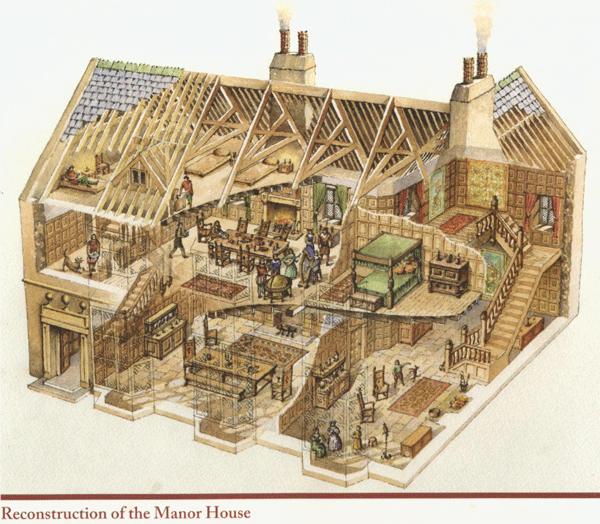
McDonnell’s son, Randal, is credited with restoring the castle and building a lavish manor inside the castle walls.  Randal married the widow Lady Katherine Manners and the Earl and Countess of Antrim set about appointing the castle with the finest of decorations.  An inventory of the period shows fine tapestries and curtains, including one set that had belonged to Cardinal Wolsey of Hampton Court.

The inventory lists over sixty elaborately upholstered chairs, a library of books, saddles worked with gold and silver, fine cabinets, and priests’ vestments.  The Countess is also credited with establishing St. Cuthbert’s Church near the castle.
Dunluce Castle 

The village which grew up around the castle around 1608 was a thriving merchant town as evidenced by the headstones in St. Cuthbert’s graveyard.  Currently there is an archaeological project being conducted to unearth the village ruins destroyed in the 1641 rebellion when it was besieged by the Irish army. 

Most of the Scottish residents escaped to Scotland before the village was burned to the ground.  The village was revolutionary for its age as it boasted indoor toilets and cobblestone streets laid out in a grid. These 21 videos, Discovery of a Lost Town: Dunluce, (1 hour, 8 minutes total) chronicle that dig.

During the 1641 rebellion, the Earl was captured by Scottish General Robert Monro. After his release he lived in Dunluce Castle until his death in 1683.  After the Battle of the Boyne in 1690, Dunluce was abandoned and Ballymagarry became the principal residence of the McDonnell clan until 1745.

Diagram of Dunluce at its peak
The castle was given to the Northern Ireland government in 1928 to be preserved as a National Monument.

Many legends surround Dunluce Castle…some true, some just myth.  Below the castle is Mermaid’s Cave where legend says a lost soldier was dragged to the depths by a beautiful mermaid.  Other stories tell of smugglers and Spanish treasure hidden in the depths of the cave.

One of the most famous stories is purported to have occurred during a storm in 1639 when the kitchen, along with seven servants, fell into the sea. 

And just for fun…here are 50 things you probably never knew about Dunluce Castle. (Note: I guess #1 is still up for debate!)

The Castle in Popular Culture

The castle is thought to be the inspiration for Cair Paravel in C.S. Lewis’ Chronicles of Narnia.  In 1973 the castle appeared on the inner gatefold of the multi-million selling Led Zeppelin album Houses of the Holy.  The castle appeared as Snakehead’s hideout, called Ravens Keep, in the 2003 Jackie Chan movie The Medallion.  Dunluce Castle also represents the House of Greyjoy, ruler of the Iron Islands, in the TV series Game of Thrones.

Visiting Dunluce Castle

Audio/visual guides are available on site that allow visitors to view animations of the castle’s structures rebuilt before their eyes to create an engaging and immersive visitor experience.   However there are lots of information boards throughout the ruins to keep visitors informed. A video is also available in the discovery room. 

An app for iphone and android devices has been developed for Dunluce Castle. This is now available, free of charge, from the App Store and Google Play.

To reach the castle, there is a short, casual walk from the carpark across a wooden bridge to the castle.  The bridge spans the chasm which separates the castle from the mainland.  There is also a walk down steps to the cave underneath the castle.

For some beautiful scenery, try this 360 tour from the bridge to the castle.

These videos provide a good background for visiting Dunluce Castle:
Dunluce Castle, County Antrim, Northern Ireland (1:05) shows the stairs to the cave.

Here you can print off your own Guide Card to Dunluce Castle for the most complete information on the ruins.


Thursday, July 26, 2012

Krakow - Wawel Cathedral and Castle


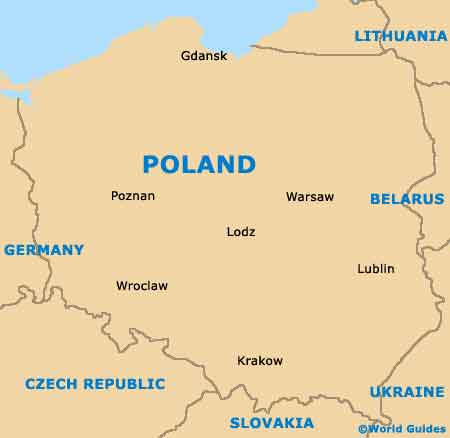
In the 16th century, Poland was one of the few countries to resist change from the Reformation to become one of the most prominent countries in Europe in the early 17th century.  But less than 200 years later, Poland had ceased to exist swallowed up by Prussia, Russia, and the Austro-Hungarian Empire.

While soldiers lived in the royal palaces, the crown jewels were melted down.  From 1797 until the Warsaw Pact was dissolved in 1991, Poland celebrated only two decades of independence from 1921-1939.

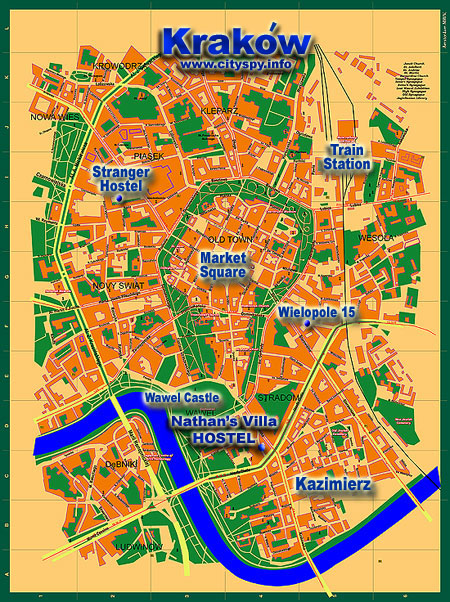
Throughout its tumultuous history, only two entities served to stabilize and unite Krakow – the second oldest university in central Europe and Wawel Cathedral and Castle atop Wawel Hill (pronounced Vavel).  Both serve as iconic symbols of all that is Poland. 

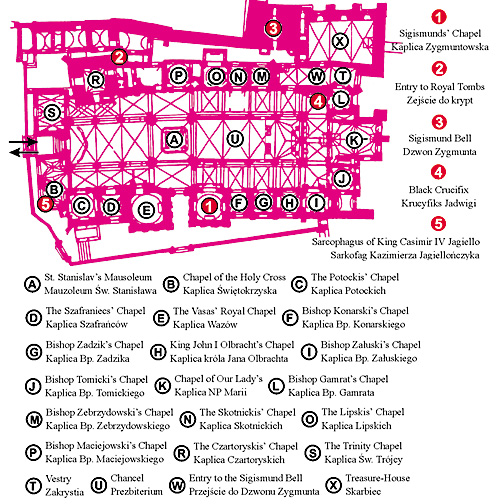
Wawel Cathedral overlooks the River Vistula and is the burial place of 41 of the 45 Polish monarchs, and the cathedral is a shrine to Stanislaw, an early bishop of Krakow who was executed in 1079 for his part in a rebellion against King Boleslaw.  His silver coffin held up by four silver angels lies beneath a black marble canopy at the main altar

Most of the buildings in the complex date from the 14th century, although the 18 elaborate side chapels were added later and it is there where the majority of the memorials to the monarchs are located including those of the two responsible for the cathedral’s creation: Wladyslaw the Short and Kazimierz the Great (made of red marble.)

One of the most interesting stories is of the most magnificent chapel – the Zygmunt, or Sigismund, chapelKing Sigismund, designed the chapel as a mausoleum for his Jagiellon dynasty, which ruled Poland for over 200 years.  However, his wife poisoned the first two wives of their only son before they could produce an heir.  Even though their son, Sigismund Augustus II, remarried, he was so distraught that he never consummated the marriage.  King Sigismund’s daughter, Anna, became the last of the Jagiellon dynasty.

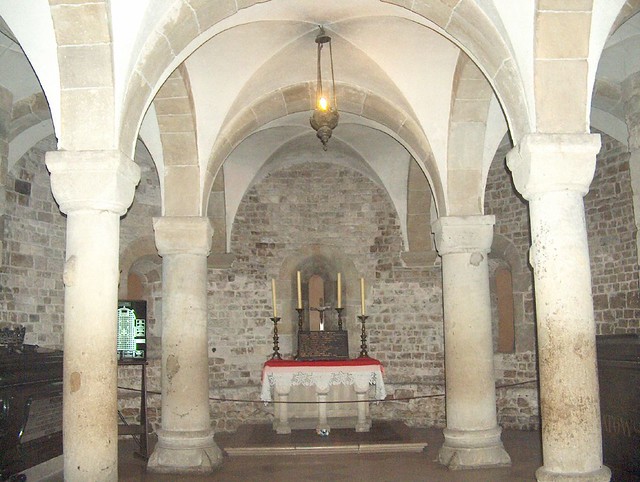
The underground Saint Leonard’s Crypt is a mausoleum for royals and national heroes.  This brief history of the Wavel Cathedral from the official web site is excellent and has great photos.

The cathedral roof boasts three towers, one containing the great Zygmunt Bell from 1520, still rung on special occasions.  This video “Krakow – Royal Sigismund Bell” (0:44) gives you a short tour in the bell tower.  For a wonderfully complete guide to print to use while touring Warwel Cathedral, go here as it describes each chapel in detail.

Father Karol Wojtyla, later to become Pope John Paul II, said his first Mass in the crypt of Wawel Cathedral on 3 November 1946.  Seventeen years later, he took over the cathedral as Archbishop of Krakow.  Fifteen years after that, he led the entire Roman Catholic world as Pope.

Also atop Wawel Hill is the gothic castle which is heavily influenced by Italian Renaissance style.  The three tiers of galleries enclose a courtyard where one can see the noted Hen’s Foot Tower and the Danish Tower.

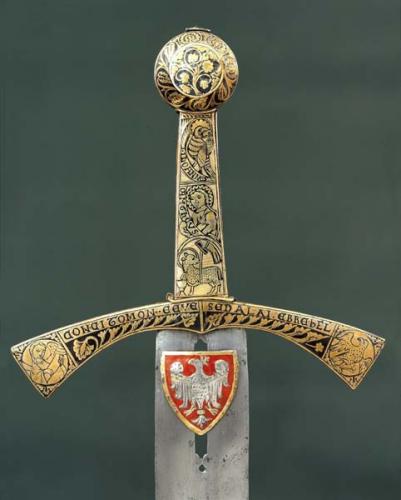
Very little is left of the crown jewels, but the most important is the sword of state, or Szczerbiec, used since the 13th century in coronation ceremonies in Wawel Cathedral.  This site will tell in detail the various rooms and exhibitions in the royal castle.  Click on each of the tabs for more information.  This might be a good guide to print to use on tour.   This site also has some very nice photos.

Legend says that a fierce dragon once lived in a lair at the foot of Wawel Hill and was slain by the hero Krak, the founder of Krakow

This video of “Wawel Castle in Krakow  - Crakow Life” (1:40) gives a brief overview of outside the castle and cathedral.

Saturday, April 11, 2009

Château d'Amboise

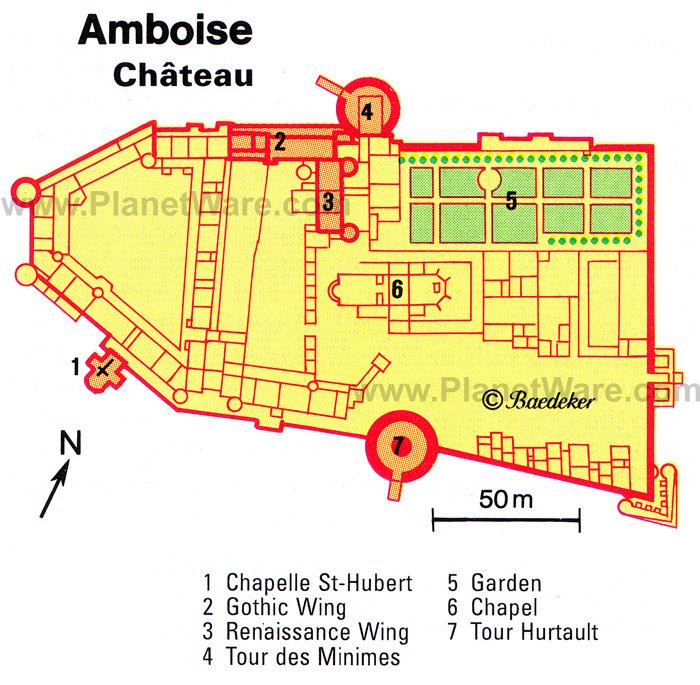
Built high above the Loire River in central France, the Château d'Amboise was a favorite castle of many kings. It was here that Leonardo da Vinci was a guest of King Francis I while he worked at nearby Clos Lucé, connected to the château by an underground passage. Da Vinci's tomb is in the chapel of Saint-Hubert.

The castle dates back to the 1400s and much was destroyed during the French Revolution. Today one can see about one-fifth of the original palace built by Charles VIII, the grand towers, the beautiful gardens, and a panoramic view of the lovely Loire Valley.

Only part of the Amboise Château, which was originally four times its present size, has been preserved. On the north side, facing the river, the building is supported by massive buttresses, above which rises the richly articulated facade of the Château with the iron railings of the balcony, flanked by two imposing round towers, the Tour des Minimes (with a spiral ramp up which horses could be ridden) and the Tour Hurtault.
See all points of interest on this map of Amboise Château. Watch this slideshow video to get an overall view of the chateau and the area.

Tuesday, March 17, 2009

Windsor Castle

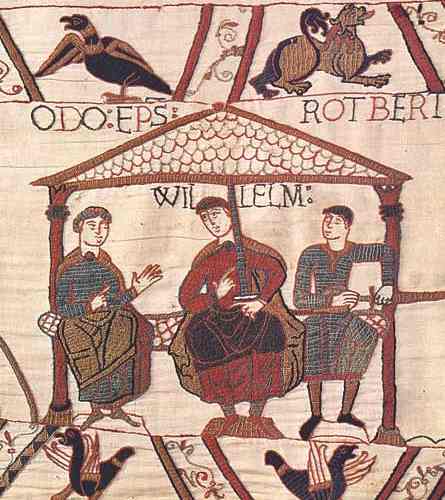
Windsor Castle outside London, the largest inhabited castle in the world, is one of the homes of Queen Elizabeth II. It dates back to 1070 when William the Conqueror defeated England in the Battle of Hastings (remember the story from the Bayeux Tapestry in France?). It was originally a wooden structure until the 15th century when the current stone structures were built.

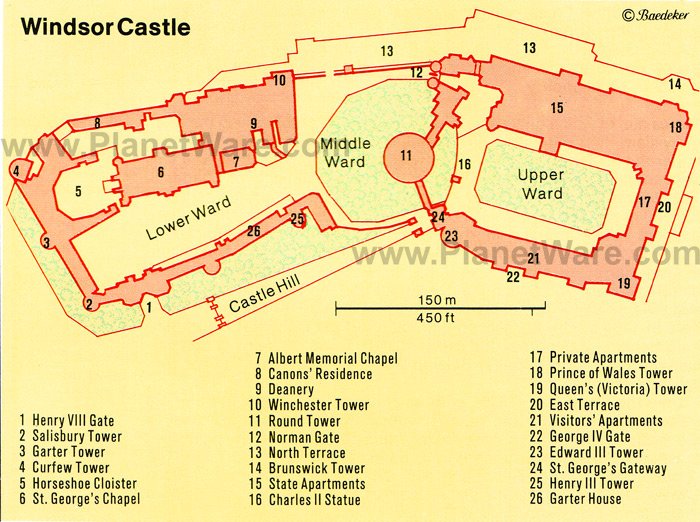
The castle complex is actually made up of several landmarks. The most well-known of these are the The Round Tower, St. George's Chapel, the State Apartments, and the Long Walk. Windsor was the site of the wedding of the Queen's eldest grandson Peter Phillips and Autumn Kelly in 2008.

Many kings and queens are buried in St. George's Chapel including King Henry VIII 1547 and his favorite wife Jane Seymour 1537 (in the choir) and Queen Elizabeth, the Queen Mother 2002(near her husband in the King George VI Memorial Chapel). It is also the spiritual home to the Order of the Garter.

You might want to print this annotated map to guide you on our tour. Or this map is good also.

This narrated video of Windsor Castle is excellent for showing the grounds and giving a bit of history. This second narrated video in addition to outside views shows views of the inside of buildings and gives detailed information on the Queen Mary's Dollhouse, a working replica built to 1/12 scale. This third video is solely about the dollhouse, has clearer pictures, but is not narrated.

You can download a free eBook from the Gutenberg Project called "Windsor Castle" by William Harrison Ainsworth (1805-1882), a fiction book about Anne Boleyn and the Tudors here. You might also check your library for the PBS 4-episode documentary "Windsor Castle." You can download the Windsor & Marlowe podcast here.
_

Monday, February 9, 2009

Versailles


Le Chateau de Versailles is the opulent palace outside Paris that was once home to French kings Louis XIII, Louis XIV, Louis XV, and Louis XVI. In 1624, Louis XIII began building a hunting lodge in the small village of Versailles.

Then Louis XIV, the Sun King, enlarged the old lodge, turning it into the great Chateau we know today. In 1837, Louis-Philippe converted the entire site into a museum of French History. World War I was ended here with the signing of the Treaty of Versailles in the Hall of Mirrors.

The infamous Marie Antoinette, queen of Louis XVI, was beheaded for her part in the French Revolution. But she is also known for the little lakeside village she had built near the Trianon where she liked to play shepherdess. An excellent PBS overview of Versailles complete with short video clips and diagrams can be found in Marie Antoinette and the French Revolution.

For an unbelievable aerial view take a look at this satellite map. Zoom in all the way and actually see the people on the sidewalk! The intricate palace gardens are absolutely fabulous from this view.

View some beautiful photographs of Versailles at Images of Versailles and photos of Versailles. If you would like a map of the palace, this shows both floors. Click on "Plan Your Visit", then "How to Visit."

Note: Versailles is one the featured tours in the "Rick Steves France Audio Tour" podcast mentioned in the article on Travel Pocasts. Also there are printable maps of the the chateau and the entire Versailles complex in this podcast download.

Tuesday, December 16, 2008

Clos-Luce

The Chateau du Clos-Luce, located near the Amboise Chateau in Amboise, France, was the last home of Leonardo da Vinci. Although da Vinci was born in Florence, Italy in 1452, he rejoined the Court of the King of France in Amboise after the death of his Italian protector, Guiliano de Medici, in 1516. He died there in 1519.

Leonardo da Vinci is most famous as an artist, but the man was so much more. To learn about his varied disciplines, including anatomy, philosophy, science and technology, architecture, sculpture, town planning, and mathematics, go here.

Clos-Luce had a long history even before da Vinci. The original building was built between 1107-1115, but the watchtower is all that remains. The later castle became a royal estate in 1490 under Charles VIII and housed many artisans, of whom the most famous is da Vinci.

For a virtual tour of the chateau, under Our Visit, click on Tour Route on the left, then click on each of the three areas – The Chateau, Landscape Tour, and The Hall – for information and photos of what we will see.

Play the video below to view the inside and gardens of Clos-Luce by someone who visited there recently. If a video box does not appear below, go to the YouTube video direct here.

Thursday, September 11, 2008

Chateau de Chenonceau

The romantic château, or castle, of Chenonceau in France's Loire Valley has a rich history. Begun in the 16th century, it is often referred to as the château des femmes as it was traditionally a castle for women as reflected by its many female residents.

It was built in 1513 by Katherine Briçonnet. The castle was eventually sold to the crown and Henry II gave it to his older mistress, Dianne de Poitiers. She is responsible for expanding Chenonceau Castle over the set of arches spanning the River Cher, giving the appearance that the château is floating on water.

After Henry's death, his wife Catherine de Medici took over the château and developed the beautiful gardens. In turn Catherine bequeathed Chenonceau to her daughter-in-law Louise of Lorraine. The castle was later saved from the ravages of the French Revolution by another woman, Louise Dupin. Chenonceau was restored to its original glory in 1950.

An audio tour can be downloaded to your ipod at the official web site. Under "Chateau & History" in the top menu bar, click on "Tour of the Chateau". This provides an unbelievable 360 degree tour of several rooms! You can zoom in and out with + and - at lower left of photo. Click on any of the arrows in the lower left under "Tour" to go to different rooms and floors. But above all, in each room, place your cursor over the picture and drag it around for that 360 degree view! Don't forget to go up and down to see the entire ceiling and floor.

Do the same 360 degree tour for "Parks & Gardens" and see the entire chateau and garden area. If you would like to "see" all those women of Chenonceau, go to the "Galerie des Dames" in the top menu bar of this web site. And of course you need to know how to correctly pronounce Chenonceau. Click on "Standard Pronunciation" beside the blue arrow. Now you're a pro!