Showing posts with label ruins. Show all posts

Friday, April 24, 2015

Glendalough -- Ireland

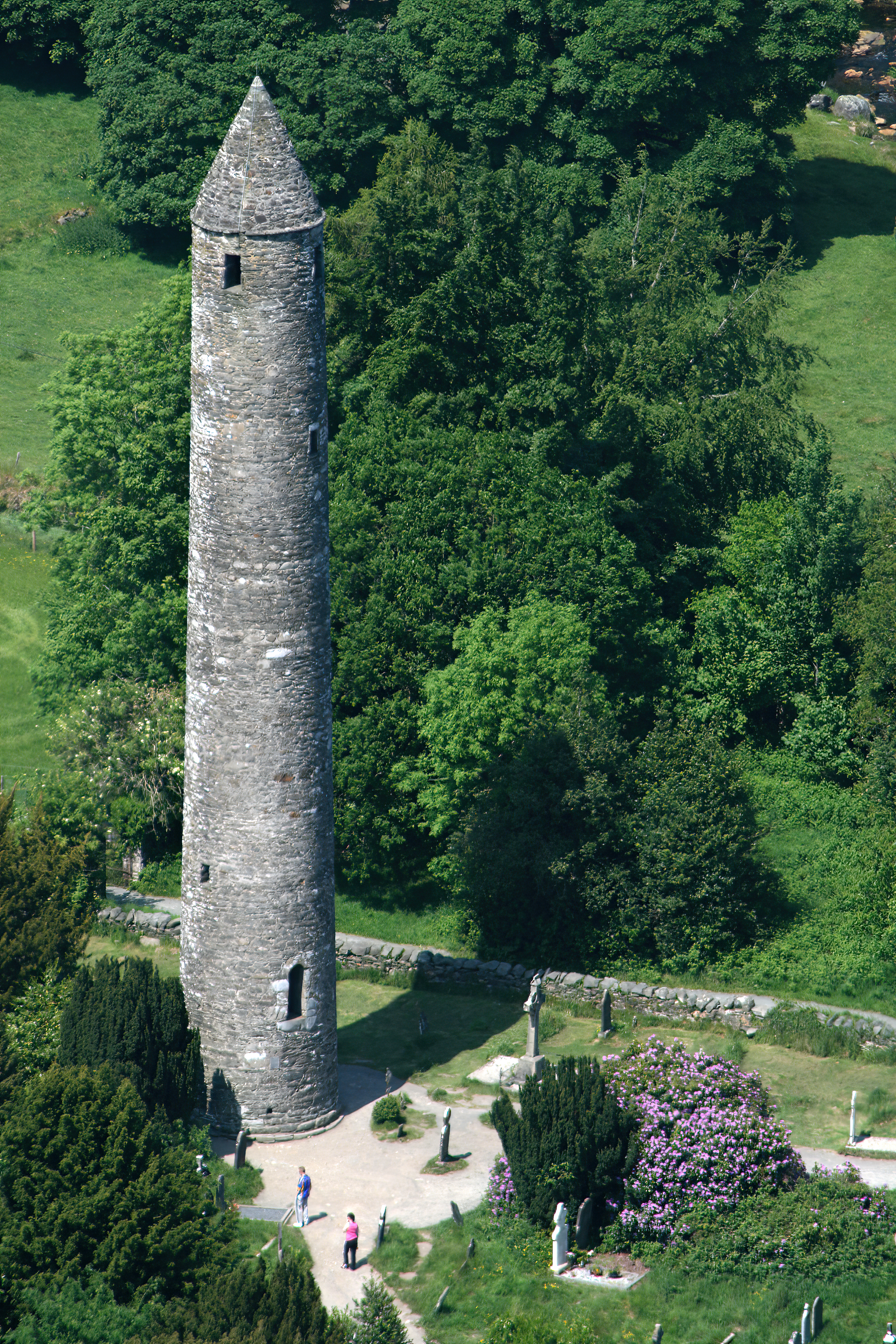
Glendalough Round Tower
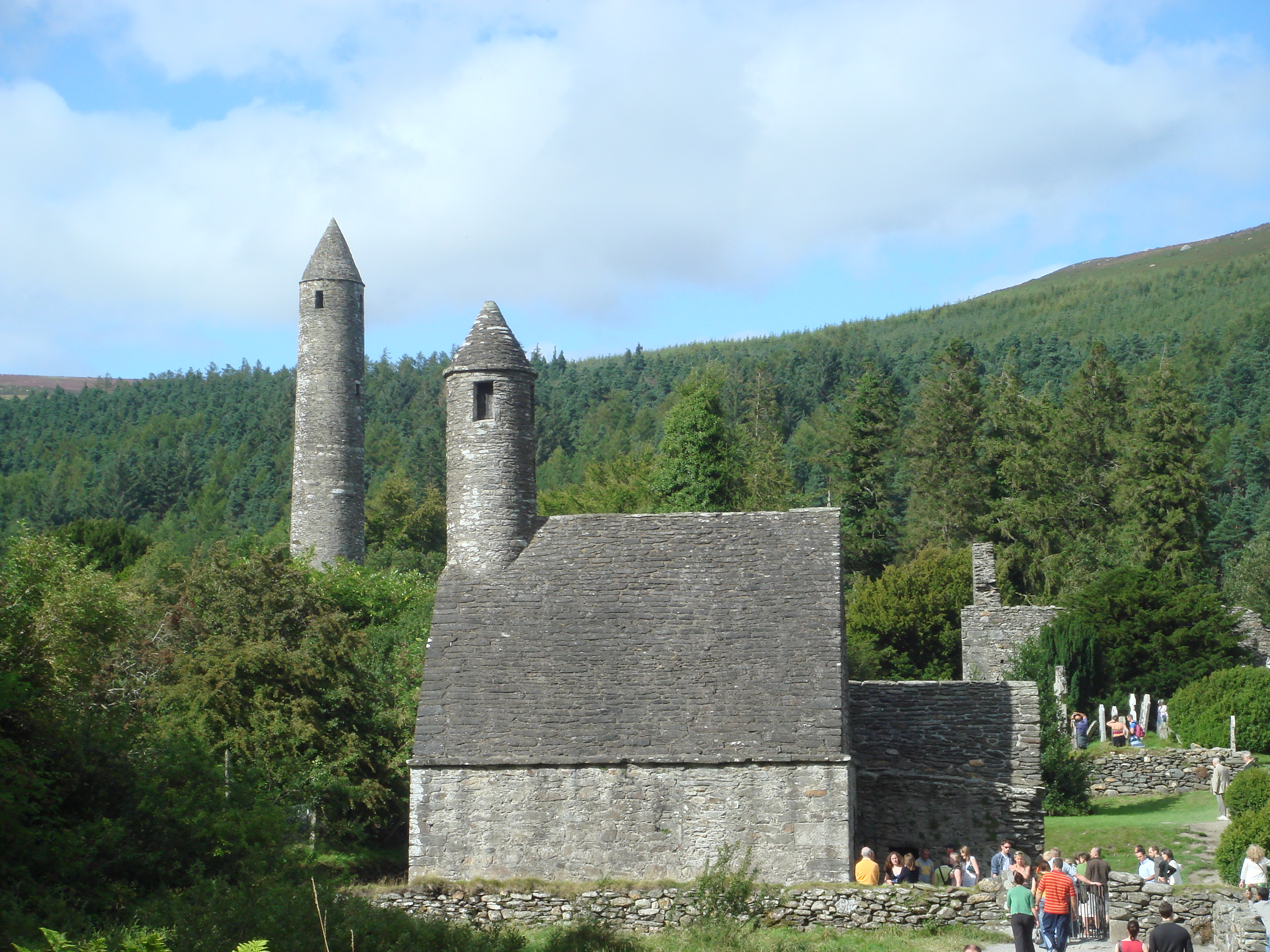
Glendalough represents iconic Irish countryside.  Nestled in a glaciated valley in the heart of County Wicklow, this serene valley boasts two lakes, monastic remains with a superb round tower, stone churches, and decorated crosses in an historical graveyard. Literally the name, Gleann Dá Loch, means “Valley of the Two Lakes.”

History
The early Christian ecclesiastical settlement was founded in the 6th century by St. Kevin, a hermit monk who died about 618 A.D.  A descendant of one of the ruling families of Leinster, he came to live at Glendalough (pronounced ‘glenda-lock’) as a young man.  According to legend, he lived a life of sleeping on stones, wearing animal skins, barely eating, and making friends with birds and animals.

By the 9th century, Glendalough rivaled only Clonmacnoise as one of the leading monastic cities in Ireland.  In its heyday, the settlement not only featured a monastery and monk cells, but also an infirmary, workshops, areas for manuscript writing and copying, guesthouses, farm buildings and houses.  Most of what survives today is from the 10th-12th centuries.

In 1214, the dioceses of Glendalough and Dublin were combined and the settlement fell into ruin destroyed by English forces in 1398.  The Feast of St. Kevin is celebrated on June 3.

Glendalough is currently a titular see in the Catholic Church.  It is used for bishops who hold no ordinary power of their own and thus are titular bishops.

Visiting Glendalough
Upper Lake at Glendalough
The two lakes at Glendalough are known as Upper Lake and Lower Lake, where the main entrance from the parking area, a visitor centre, the main monastic dwellings, and a hotel are located.  Walking trails connect the two lakes and other monastic sites.

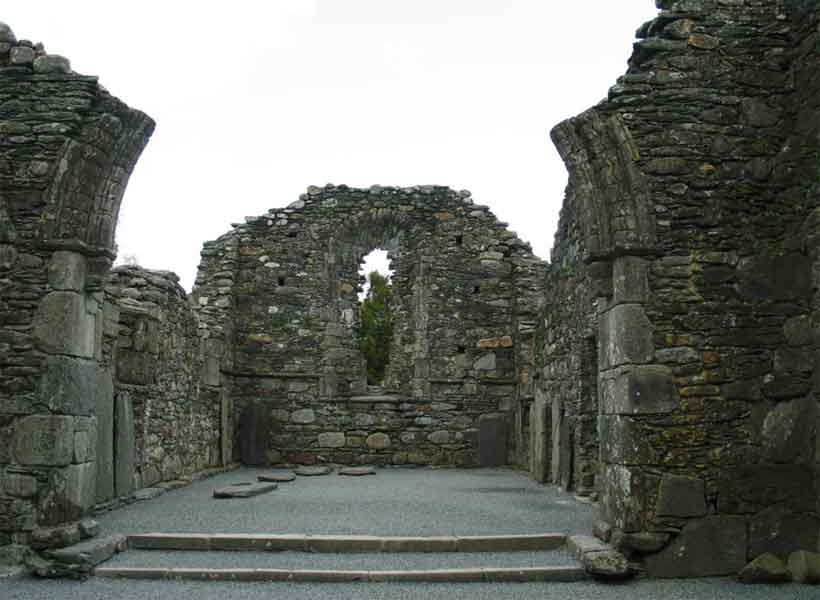
Visible at Lower Lake are the double-arched medieval gateway; the Cathedral, the largest building; St. Kevin’s Cross with an unpierced ring; the reconstructed priests’ house; St. Kevin’s Church (or Kitchen) with its distinctive round belfry; foundations of St. Kieran’s Church; and the iconic round tower.

The round tower possibly served as a belltower, a place of refuge when under attack, and/or a storage facility.  It originally had six timber-floored stories with the doorway to the tower 3-1/2 meters above ground to protect those inside from intruders.

Small windows at the top face the four points of the compass, and stories were accessed by internal wooden ladders.  The conical roof was replaced in 1876 from original stones.

Additional monastic structures – St. Mary’s Church, the CaherReefert Church, and St. Savior’s Church – can be visited on the hike to Upper Lake. Temple-na-Skellig and St. Kevin’s Bed, a cave, are only accessible via boat.

Crosses of Glendalough
There are nine marked walkingtrails in Wicklow Mountains National Park ranging from a short half hour walk to a four-hour hillwalk.  The park is host to a wide diversity of wildlife including red deer, sika deer, fallow deer, feral goat, red fox, mink, and over 100 species of birds.  The common lizard is the only reptile in the park, as there are no snakes in Ireland.

The visitor center located nearby hosts an interesting exhibit and a 17-minute film entitled “Ireland of the Monasteries.”


Join Rick Steves in this video: “Glendalough, Ireland: Exploring the Wicklow Mountains.”  (Watch only the first 1:55 minutes.)
For a unique birds eye view, enjoy this video: “Glendalough.” (3:40)


Tuesday, April 14, 2015

Corcomroe Abbey -- Ireland


Corcomroe Abbey in The Burren
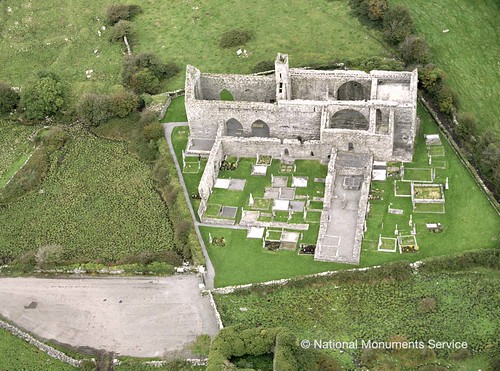
Located in a fertile green valley of the Burren, County Clare, Ireland, the ruins of Corcomroe Abbey are remarkably well-preserved.  Uniquely picturesque in its isolation on the Burren, the abbey is situated close to three small deserted Christian churches dedicated to St. Colman and nestled in the pass of Oughtmana.

Early monks sought out isolated areas to settle and became self sustained.  The abbey became known as “Sancta Maria de Petra Fertili”—St. Mary of the Fertile Rock, as the Burren provided all the monks needed to maintain a Cistercian community through cultivating the surrounding fertile lands.

Corcomroe Abbey is said to have been established by Donal Mór Ua Briain in the late 12th century and continued to function for the next 400 years.  The last abbot named was John O'Dea, a Cistercian from the Irish College at Salamanca, in 1628.

The abbey is noted for its beautiful architectural detail still visible in its ruinous state and not found in other structures of this period.   It features a typical cruciform church facing east, with a small chapel in each transept. 

Magnificent arches still reign over chapel entries, although one entrance has been sealed off for burials—both ancient and modern.  Parts of the remaining roof still bear some finely carved rib vaulting in the Romanesque style.

Capital details - human masks and floral detail
The capitals are decorated with lotus leaves and other botanic detail, while some carved human masks and dragon heads are visible in the transept chapels.

The choir is constructed with high quality stonework and in the north wall can be seen a tomb-niche holding a recumbent effigy of King Conor na Siudaine Ua Briain who died in 1267, one of the very few examples remaining of an Irish Chieftain.  He was a benefactor of the abbey and grandson of the founder. 

Effigy of King Conor na Siudaine Ua Brianin
The English Reformation led to the dissolution of Catholic monasteries in England and Ireland. In 1554, the abbey was granted to the Earl of Thomond

The site is under state care and a National Monument of Ireland.  The graveyard surrounding the abbey is still in use, so care must be taken not to disturb the site.

Look for the ring fort dissected by the road on the way out, identifiable by the raised circular mound topped by hawthorn trees.

Saturday, December 27, 2014

Dunluce Castle, Northern Ireland

Aerial view of Dunluce Castle
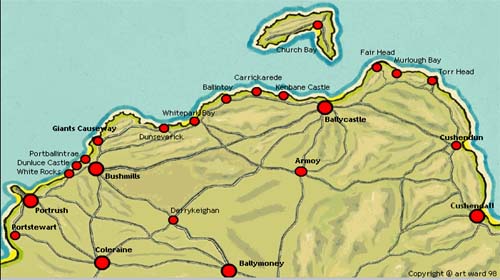
Thought by many to be the most romantic and picturesque of Irish castles, the ruins of medieval Dunluce Castle sit atop a rocky outcrop overlooking the Irish Sea on the Antrim coast of Northern Ireland.  It is joined to the mainland by an arched walkway, or bridge, over a 20-foot chasm.

The 17th century mainland courtyard, containing domestic buildings, leads downhill to a narrow crossing to the rock, formerly protected by a drawbridge to the gatehouse. The buildings on the rock are from the16th and 17th century.

The earliest mention of Dunluce Castle is in the fourteenth century, and it is believed to have been built by Richard de Burgh on the site of an old fortress.  It was later occupied by the McQuillans around 1513.

Dunluce Castle
Forty years later, Sorley Boy McDonnell, a Scottish chieftain who controlled the northeastern coast of Ireland, claimed the castle for the McDonnell clan.  But in 1584 Queen Elizabeth I ordered Sir John Perrott to take the castle for England.  Sorley Boy fled but was able to retake the castle with help from inside. 

It is he who mounted the four cannons on the gatehouses obtained from the Spanish galleass Girona which foundered on Lacada Point near the Giant’s Causeway in 1588.  Funds obtained from selling the recovered cargo from the ship was used by Sorley Boy’s son to modernize the castle.

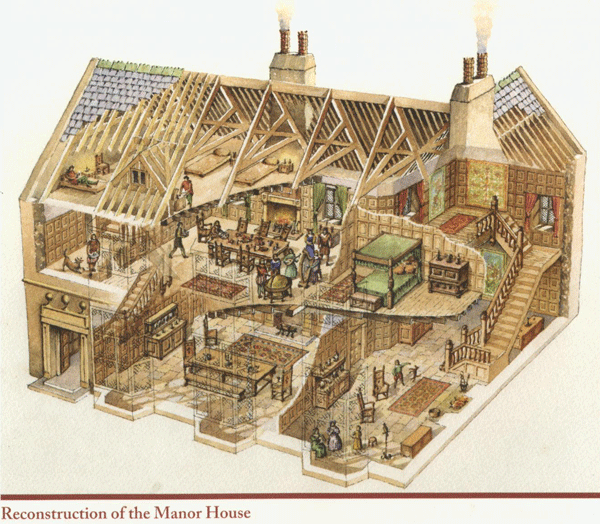
McDonnell’s son, Randal, is credited with restoring the castle and building a lavish manor inside the castle walls.  Randal married the widow Lady Katherine Manners and the Earl and Countess of Antrim set about appointing the castle with the finest of decorations.  An inventory of the period shows fine tapestries and curtains, including one set that had belonged to Cardinal Wolsey of Hampton Court.

The inventory lists over sixty elaborately upholstered chairs, a library of books, saddles worked with gold and silver, fine cabinets, and priests’ vestments.  The Countess is also credited with establishing St. Cuthbert’s Church near the castle.
Dunluce Castle 

The village which grew up around the castle around 1608 was a thriving merchant town as evidenced by the headstones in St. Cuthbert’s graveyard.  Currently there is an archaeological project being conducted to unearth the village ruins destroyed in the 1641 rebellion when it was besieged by the Irish army. 

Most of the Scottish residents escaped to Scotland before the village was burned to the ground.  The village was revolutionary for its age as it boasted indoor toilets and cobblestone streets laid out in a grid. These 21 videos, Discovery of a Lost Town: Dunluce, (1 hour, 8 minutes total) chronicle that dig.

During the 1641 rebellion, the Earl was captured by Scottish General Robert Monro. After his release he lived in Dunluce Castle until his death in 1683.  After the Battle of the Boyne in 1690, Dunluce was abandoned and Ballymagarry became the principal residence of the McDonnell clan until 1745.

Diagram of Dunluce at its peak
The castle was given to the Northern Ireland government in 1928 to be preserved as a National Monument.

Many legends surround Dunluce Castle…some true, some just myth.  Below the castle is Mermaid’s Cave where legend says a lost soldier was dragged to the depths by a beautiful mermaid.  Other stories tell of smugglers and Spanish treasure hidden in the depths of the cave.

One of the most famous stories is purported to have occurred during a storm in 1639 when the kitchen, along with seven servants, fell into the sea. 

And just for fun…here are 50 things you probably never knew about Dunluce Castle. (Note: I guess #1 is still up for debate!)

The Castle in Popular Culture

The castle is thought to be the inspiration for Cair Paravel in C.S. Lewis’ Chronicles of Narnia.  In 1973 the castle appeared on the inner gatefold of the multi-million selling Led Zeppelin album Houses of the Holy.  The castle appeared as Snakehead’s hideout, called Ravens Keep, in the 2003 Jackie Chan movie The Medallion.  Dunluce Castle also represents the House of Greyjoy, ruler of the Iron Islands, in the TV series Game of Thrones.

Visiting Dunluce Castle

Audio/visual guides are available on site that allow visitors to view animations of the castle’s structures rebuilt before their eyes to create an engaging and immersive visitor experience.   However there are lots of information boards throughout the ruins to keep visitors informed. A video is also available in the discovery room. 

An app for iphone and android devices has been developed for Dunluce Castle. This is now available, free of charge, from the App Store and Google Play.

To reach the castle, there is a short, casual walk from the carpark across a wooden bridge to the castle.  The bridge spans the chasm which separates the castle from the mainland.  There is also a walk down steps to the cave underneath the castle.

For some beautiful scenery, try this 360 tour from the bridge to the castle.

These videos provide a good background for visiting Dunluce Castle:
Dunluce Castle, County Antrim, Northern Ireland (1:05) shows the stairs to the cave.

Here you can print off your own Guide Card to Dunluce Castle for the most complete information on the ruins.