Showing posts with label tower. Show all posts

Tuesday, April 4, 2017

The Round Tower -- Copenhagen, Denmark

Completed in 1642, The Round Tower, or Rundetaarn, is the oldest functioning observatory in Europe.  It was used by the University of Copenhagen until 1861, but today anyone can view the night sky through the astronomical telescope in the observatory at the top of the tower.  

The Round Tower attached to the church and library
The Round Tower was the first building in the Trinitatis Complex built by King Christian IV linked to the University Church built especially for the scholars and students of Copenhagen’s University.

Building of the tower was inspired by Denmark’s astronomical achievements thanks to the astronomer Tycho Brahe, who died in 1601.

The 40-meter tall tower was built with a unique interior 210-meter long spiral ramp which leads to the top platform.  The whitewashed spiral ramp winds itself 7.5 times around the hollow core of the tower.

On the uppermost façade there is a gilded inscription, like a rebus, which may be interpreted: Lead God, the right teaching and justice into the heart of the crowned King Christian IV, 1642.  The original draft of this written in King Christian’s own hand is housed in the Danish Record Office.

One of Hans Christian Andersen’s fairy tales, The Tinder Box, written in 1835, tells the story of the soldier who meets the dog sitting on the money chests whose eyes are as big as the Round Tower. 

The spiral ramp to the top of the tower and the observatory
The ramp leads also to the library hall (its only entrance), which once housed the entire book collection of the university.  Andersen would visit here for inspiration for his works.  In 1861, the collection had outgrown the library and moved to its present location.  Restored in 1987, it is now used for exhibitions and concerts.

The two original privies still exist – one at the top and the other by the library, which has been restored but no longer in use.  You can actually go in, sit down, and have a look around the smallest room!

Although the spiral ramp is wide enough for an automobile, or horse and carriage in earlier times by Russian Tsar Peter the Great, today it ascended by foot – or by bicycle or unicycle at the annual race!  It is considered an easy climb with places to stop and rest along the way.

Today, a new attraction allows visitors to view the hollow core of the tower by walking on a floating glass floor 25 meters above ground.  The glass is 50 mm thick and can carry up to 900 kg per square meter. 

The center of the tower is from where all distances are measured in Copenhagen.  And the panoramic views are incredible!  Now enjoy a short video tour.

Friday, April 24, 2015

Glendalough -- Ireland

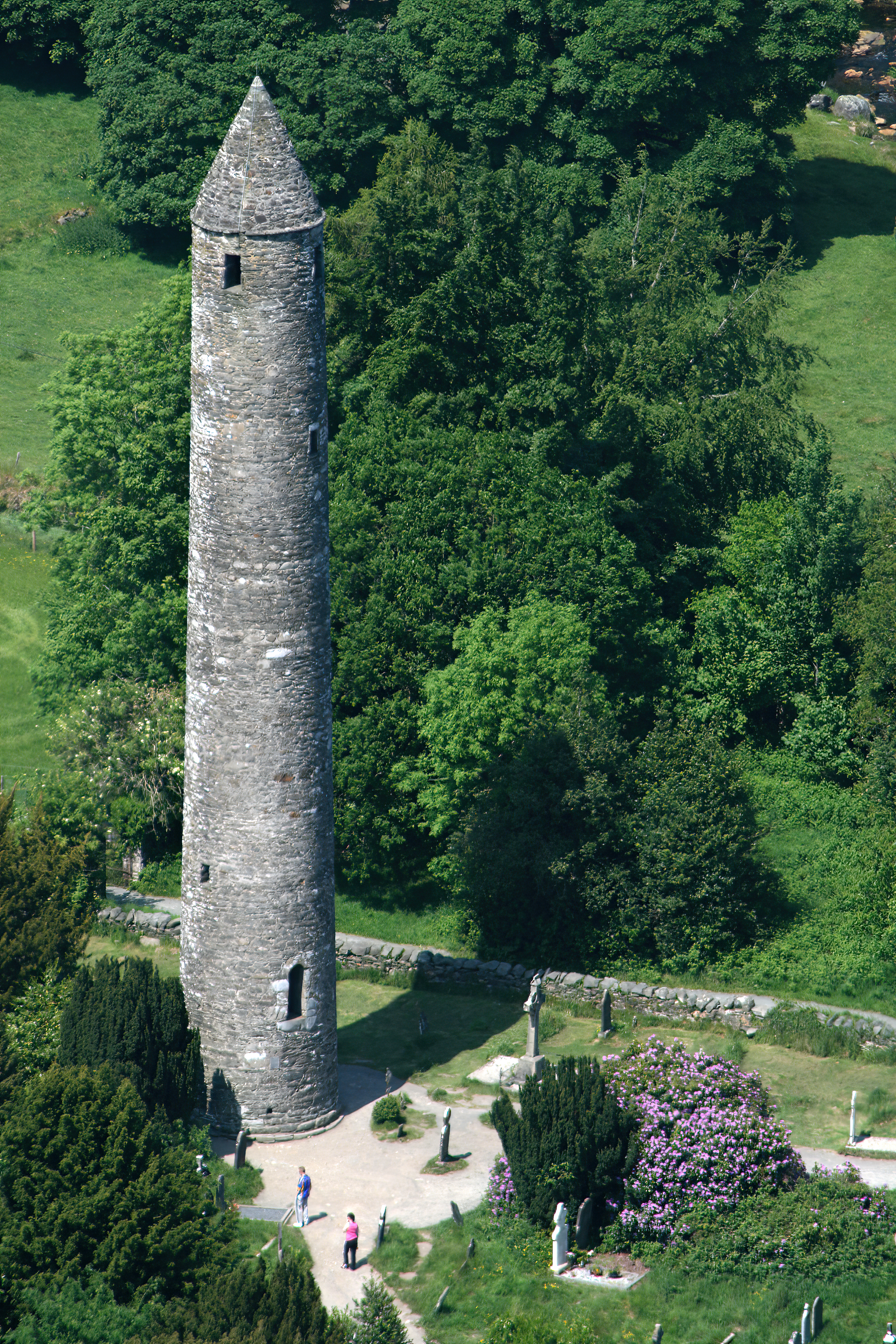
Glendalough Round Tower
Glendalough represents iconic Irish countryside.  Nestled in a glaciated valley in the heart of County Wicklow, this serene valley boasts two lakes, monastic remains with a superb round tower, stone churches, and decorated crosses in an historical graveyard. Literally the name, Gleann Dá Loch, means “Valley of the Two Lakes.”

History
The early Christian ecclesiastical settlement was founded in the 6th century by St. Kevin, a hermit monk who died about 618 A.D.  A descendant of one of the ruling families of Leinster, he came to live at Glendalough (pronounced ‘glenda-lock’) as a young man.  According to legend, he lived a life of sleeping on stones, wearing animal skins, barely eating, and making friends with birds and animals.

By the 9th century, Glendalough rivaled only Clonmacnoise as one of the leading monastic cities in Ireland.  In its heyday, the settlement not only featured a monastery and monk cells, but also an infirmary, workshops, areas for manuscript writing and copying, guesthouses, farm buildings and houses.  Most of what survives today is from the 10th-12th centuries.

In 1214, the dioceses of Glendalough and Dublin were combined and the settlement fell into ruin destroyed by English forces in 1398.  The Feast of St. Kevin is celebrated on June 3.

Glendalough is currently a titular see in the Catholic Church.  It is used for bishops who hold no ordinary power of their own and thus are titular bishops.

Visiting Glendalough
Upper Lake at Glendalough
The two lakes at Glendalough are known as Upper Lake and Lower Lake, where the main entrance from the parking area, a visitor centre, the main monastic dwellings, and a hotel are located.  Walking trails connect the two lakes and other monastic sites.

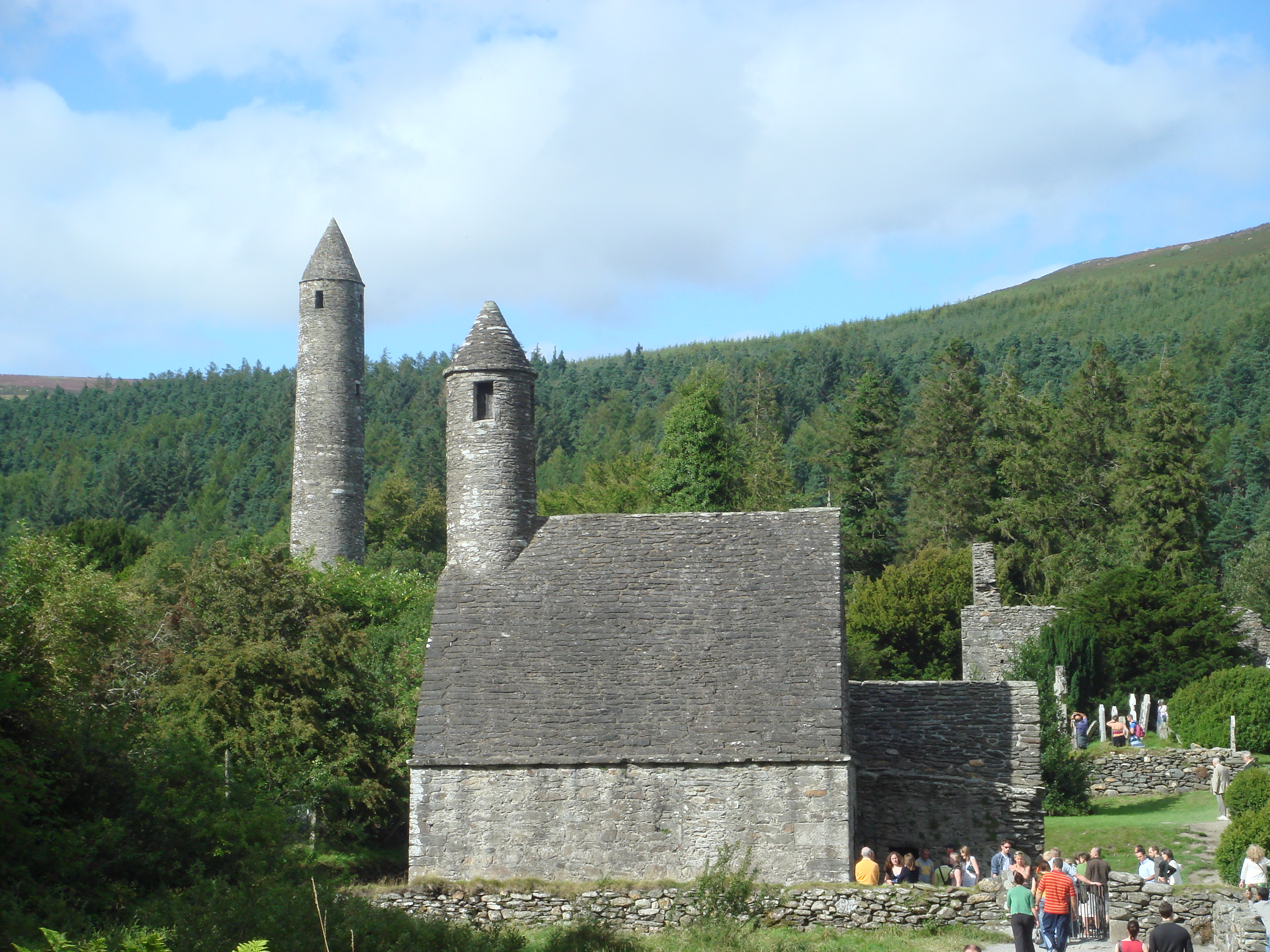
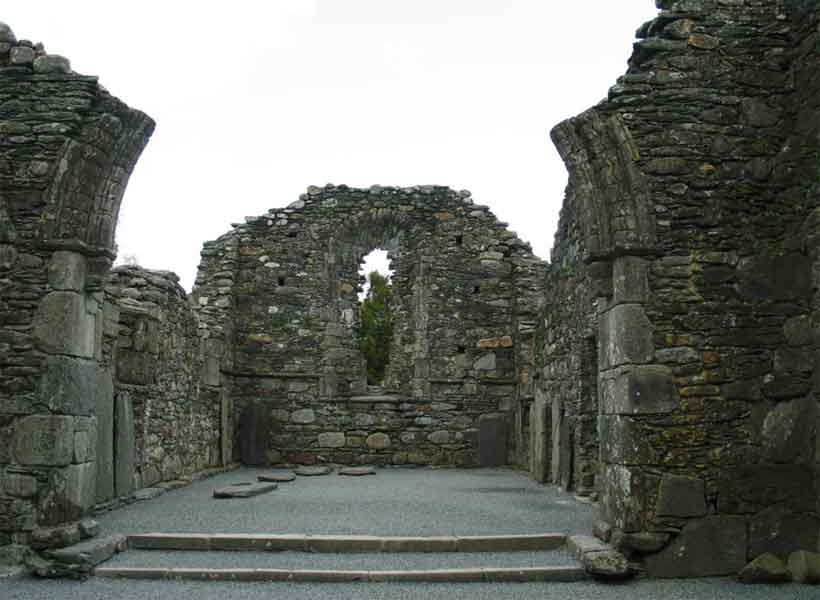
Visible at Lower Lake are the double-arched medieval gateway; the Cathedral, the largest building; St. Kevin’s Cross with an unpierced ring; the reconstructed priests’ house; St. Kevin’s Church (or Kitchen) with its distinctive round belfry; foundations of St. Kieran’s Church; and the iconic round tower.

The round tower possibly served as a belltower, a place of refuge when under attack, and/or a storage facility.  It originally had six timber-floored stories with the doorway to the tower 3-1/2 meters above ground to protect those inside from intruders.

Small windows at the top face the four points of the compass, and stories were accessed by internal wooden ladders.  The conical roof was replaced in 1876 from original stones.

Additional monastic structures – St. Mary’s Church, the CaherReefert Church, and St. Savior’s Church – can be visited on the hike to Upper Lake. Temple-na-Skellig and St. Kevin’s Bed, a cave, are only accessible via boat.

Crosses of Glendalough
There are nine marked walkingtrails in Wicklow Mountains National Park ranging from a short half hour walk to a four-hour hillwalk.  The park is host to a wide diversity of wildlife including red deer, sika deer, fallow deer, feral goat, red fox, mink, and over 100 species of birds.  The common lizard is the only reptile in the park, as there are no snakes in Ireland.

The visitor center located nearby hosts an interesting exhibit and a 17-minute film entitled “Ireland of the Monasteries.”


Join Rick Steves in this video: “Glendalough, Ireland: Exploring the Wicklow Mountains.”  (Watch only the first 1:55 minutes.)
For a unique birds eye view, enjoy this video: “Glendalough.” (3:40)