Showing posts with label museum. Show all posts

Friday, April 17, 2015

Irish National Stud and Gardens -- Ireland

Thoroughbreds at the Irish National Stud
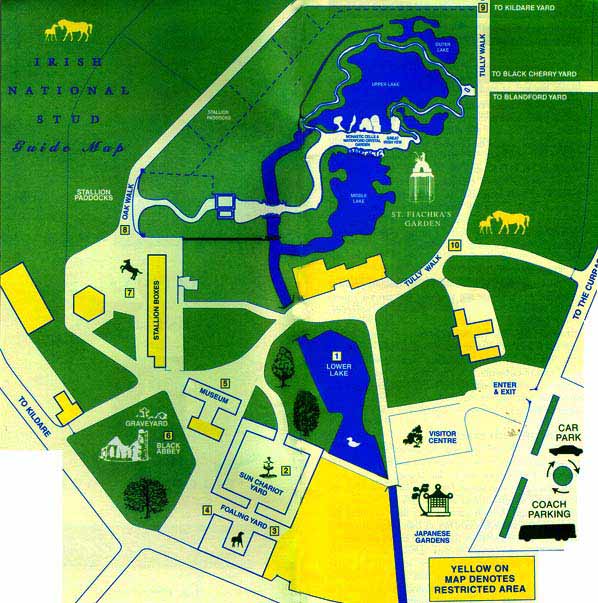
The Irish National Stud and Gardens located in County Kildare, Ireland, is where horse racing legends are born and the only one in Ireland open to the public.  Also located on the grounds are the world famous Japanese Gardens, the Horse Museum, and St. Fiachra's Garden, created to celebrate the Millennium.

The thoroughbred horse racing facility, which now belongs to the people of Ireland, is located on the 1,000-acre Tully Estate, home to some of the finest thoroughbreds in the world including these living legends who live(d) out their days in retirement at the stud:  “Beef or Salmon,” “Kicking King,” “Hardy Eustace,” “Rite of Passage,” “Moscow Flyer,” and “Vintage Crop.”

Tully’s famous stud farm where racehorses are conceived, born, and raised was bought from the Fay family by Colonel William Hall-Walker in 1900.  He became one of the most successful breeders of his time.  His finest hour came when King Edward VII led “Minoru,” born and raised at Tully, into the winner’s circle at the 1909 Derby.

The Horse Museum features a life size skeleton of “Arkle,” the famous steeplechaser who raced in the sixties.  He was a three-time winner of jumping’s ultimate prize, the Cheltenham Gold Cup.  Watch “Arkle” win the 1964 Gold Cup here (2:20).  “Sea the Stars” is the stud’s most modern champion and the museum houses much of his memorabilia.

Japanese Gardens
The Japanese Gardens were devised by Col. Hall-Walker (later Lord Wavertree), a wealthy Scotsman from a famous brewery family, and laid out between 1906 and1910 on four acres of woodland and lakeside walks by Japanese master horticulturist Tassa Eida and son Minoru (for whom the famous horse is named).

The natural habitat, carefully preserved as part of Ireland’s heritage, was planned to symbolize “The Life of Man,” tracing a soul from birth to death and beyond.  In addition to the flora, there are ponds, waterfalls, rock structures, bridges, and a tea house.  (For a complete description of the symbolism of the gardens, go here and scroll to read “The Japanese Gardens.”)

St Fiachra's Garden
In 1999, Saint Fiachra’s Garden was created to honor the patron saint of gardeners.  Designed by Professor Martin Hallinan, an award winning landscape architect, this natural environment was created to simulate the spirituality of the monastic movement in Ireland in the 6th and 7th centuries.  It features unique water spots and replicas of monastic ruins.

Consult this guide map to plan your visit and consider the following suggested time schedule for touring:
National Stud: 1 hour
Japanese Gardens: 20 minutes
St. Fiachra’s Garden: 45 minutes
Horse Museum: 20 minutes

Enjoy these related videos.
For a mini tour of the horse pastures: Irish National Stud (2:55)
For a peaceful tour of the Japanese Gardens: Japanese Gardens County Kildare (8:41)


Monday, September 29, 2014

Titanic Belfast - Northern Ireland

Titanic Belfast
It’s not an accident that Titanic Belfast looks like passing ships or that from above it resembles a star or that it opened in 2012… one hundred years after the ship’s tragic maiden voyage

The iconic six-floor building located on the site of the former Harland & Wolff shipyard in the city’s Titanic Quarter in the heart of Belfast sits just 100 yards from slipway number 2 where the historic ship was constructed.  To the right is the drawing office where she was designed and to the left is the River Lagan where she first set sail.

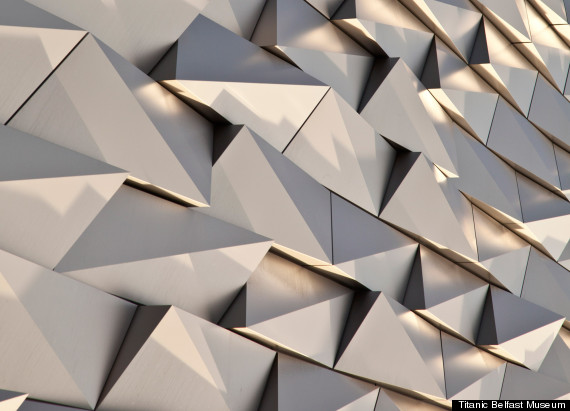
Actually the outside resembles the hulls of four ships covered with bright metal shards that resemble ocean waves from reflected light.  Some even say it resembles an iceberg.  The aerial star shape of the building is symbolic of the ship’s owner, the White Star Line.

Once inside, the giant atrium greets visitors as they embark on a self-guided tour through nine galleries that tell the story of the Titanic from its construction on Queen’s Island through its tragic sinking to its underwater discovery and her place in modern culture today.

The Titanic experience is told through state-of-the-art exhibits, interactive displays, audio, film, CGI, full-size replicas, and artifacts.  The highlight of the tour will be a dark ride through the Titanic under construction.

The Galleries

Gallery 1: Boomtown Belfast—Learn about booming Belfast in the early 1900s and walk through the Harland and Wolff shipyards where the Titanic was built.

Gallery 2: The Shipyard Ride—Experience the thrilling dark ride through the shipyard and encounter the sights, sounds, and smells of the Titanic’s construction.

Gallery 3: The Launch of Titanic—Experience the excitement of the ship’s launching as you look out to Titanic sitting on her slipway, made possible by innovative glazing that incorporates original imagery from the time.

Interior of Titanic exhibit
Gallery 4: Fitting-Out—Watch as the Titanic’s interior craftsmanship comes to life and view the luxury built into the epic ship.

Gallery 5: Maiden Voyage—Learn the stories of the passengers, crew, and heroes who embarked on the Titanic’s maiden voyage.

Gallery 6: The Sinking—Relive the drama as the Titanic sinks after hitting an iceberg.

Gallery 7: The Aftermath—Learn of the world’s reaction to the tragedy through news reports and recordings enhanced by live performances and exhibits.  Visitors can use interactive screens to search the passenger and crew lists to find out if one of their relatives was aboard the ship. 

Gallery 8: Myths and Reality—Separate fact from fiction through the many films, stories, and fantasies that have been inspired by the Titanic legend through interactive touch screens.  Celine Dion’s song My Heart Will Go On plays in the background.

Gallery 9: Visit and Explore the Wreck—Follow Dr. Robert Ballard, the discoverer of the Titanic’s resting place on the bottom of the Atlantic Ocean in 1985, as he works with Titanic Belfast.  Visitors will be able to visit the wreck with live links to the contemporary undersea exploration, however actual artifacts retrieved from the Titanic Wreck Site and Debris Field will not be on display for ethical reasons.

This video, National Geographic Live! – Robert Ballard: Restore the Titanic (20:29), tells the background leading up to Dr. Ballard's Titanic discovery in his own words just before the Titanic Belfast opened in 2012.  

The Ocean Exploration Centre is located just beneath Gallery 9 and promotes the exploration of the Titanic site as well as other areas of the ocean surrounding Northern Ireland.  Discover ocean secrets in real time with live video feeds.

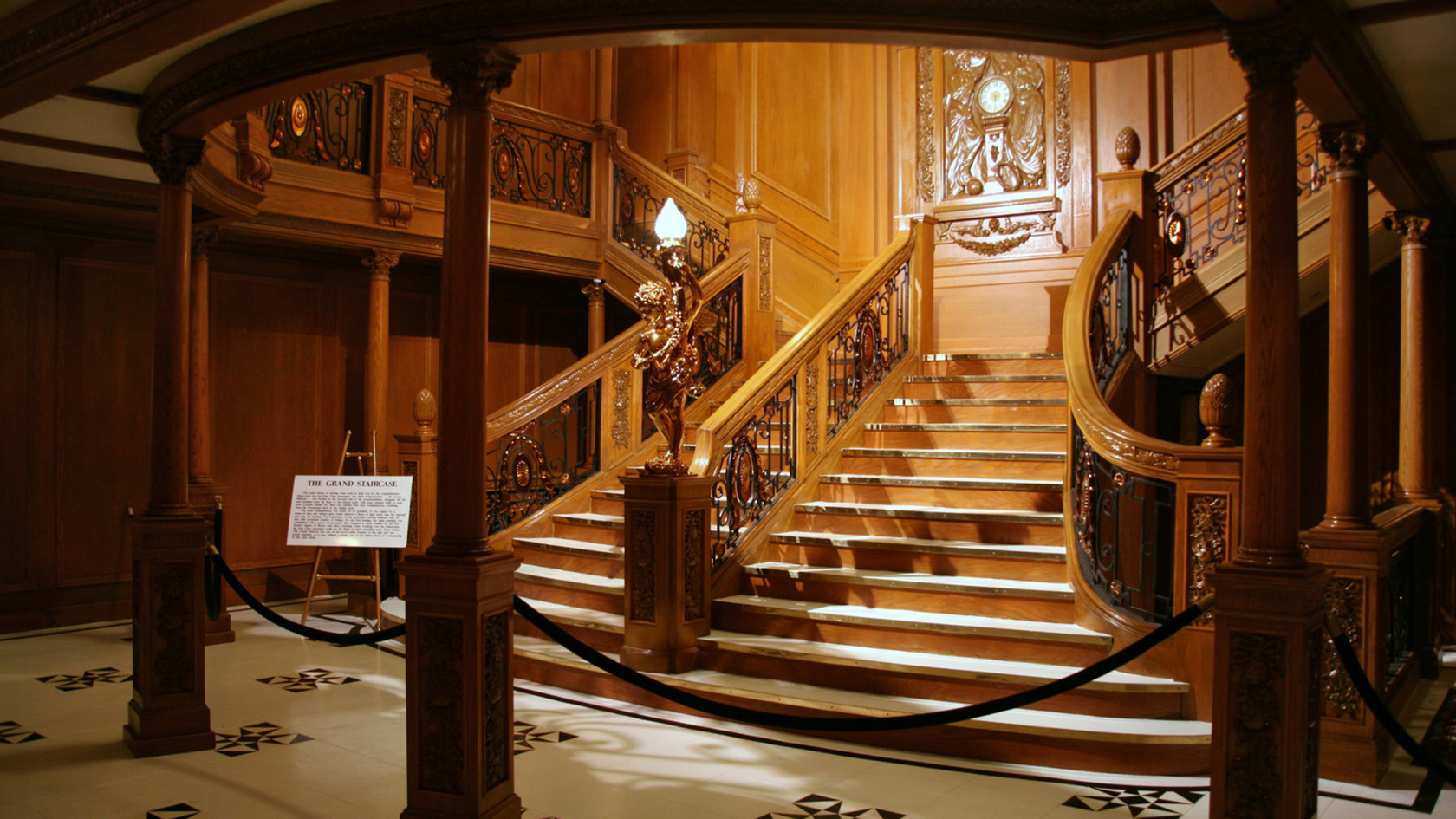
A replica of the Grand Staircase is located on the fifth and sixth floors in the Titanic Suite.  Unfortunately, this suite is reserved exclusively for banquets and conferences.  The only way visitors may view the staircase is to have afternoon tea on Sunday afternoons!

In front of the building stands, Titanica, a bronze female figure sculpture by Rowan Gillespie, which resembles a figurehead on a ship's prow.  Representing hope and positivity, it was dedicated by representatives of the Anglican, Catholic, Methodist, and Presbyterian churches.

It takes about 2-3 hours to tour the entire exhibit.  Take time also to visit each section of the Titanic Belfast official web site and learn many Titanic stories and ship facts.  Make your time at the world’s largest Titanic exhibition count.
RMS Titanic on maiden voyage, 1912

Tuesday, October 23, 2012

Berlin - Checkpoint Charlie Museum

Checkpoint Charlie Museum
Founded by human rights activist Dr. Rainer Hildebrandt, Museum Haus am Checkpoint Charlie explores the history of the Berlin Wall and the stories of the people whose lives were affected by it.  It depicts objects used to get over, under, and through the Berlin Wall in their efforts to escape the so-called “best border security system in the world.”

Celebrating its 50th birthday, the museum also hosts a new exhibition tracing movements which have promoted human rights from 1800 onwards and how the struggle continues today.

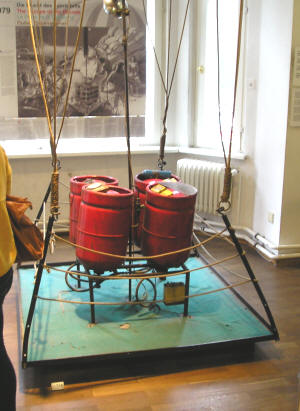
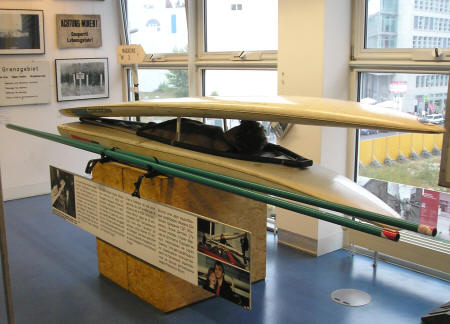
The permanent exhibit traces the history of the Berlin Wall.  On exhibit are some of the various deceptive means of escape including hot air balloons, escape cars, suitcases, homemade mini-subs, and even a cleverly hollowed out surfboard.

The human rights exhibit entitled From Gandhi to Walesa: Non-Violent Struggle for Human Rights Worldwide, features a diary and wooden sandals of Mahatma Gandhi as well as other artifacts. They also have the typewriter used to draft Charta 77, the hectograph from the illegal periodical Umweltblatter, and Elena Bonner's ‘death mask’ of partner Andrei Sacharov.

2012 also marks the opening of the new permanent NATO exhibit which charts the creation of NATO in 1949.

Originally opened in 1962 by Dr. Hildebrandt in two-and-a-half rooms to protest the newly erected Berlin Wall in 1961, its popularity outgrew its original location and it was moved to its present location at the Checkpoint Charlie border crossing in 1963.  Because of its location, the museum cafĂ© became a popular meeting point to plan escapes.

Today the museum is run by Dr. Hildebrandt’s widow Alexandra following his death in 2004.  Although the Berlin Wall may have come down, many people in the world still face discrimination, persecution, and unlawful imprisonment, and the attention the museum draws to their cause is immeasurable.

Here are some excellent videos.  The first is narrated by Alexandra Hildebrandt called Checkpoint Charlie (2:08).  This one is a segment from travel guru Rick Steve's travel show on Berlin called Berlin, Germany: Checkpoint Charlie (1:21).  The third, Checkpoint Charlie Berlin (3:25), is also quite informative.

Wednesday, March 9, 2011

The Island of Crete

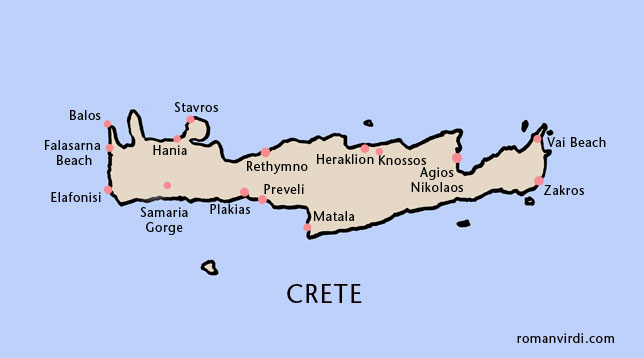
One of our island stops is on the island of Crete at the port of Heraklion from 7 a.m. til 11:30 a.m. – a 4½ hour stop. You will be free to roam around the city of Heraklion on your own or opt to take one of two excursions provided through the cruise line. One is to the Palace of Knossos and the other is the Panoramic Heraklion and Wine Tasting tour.

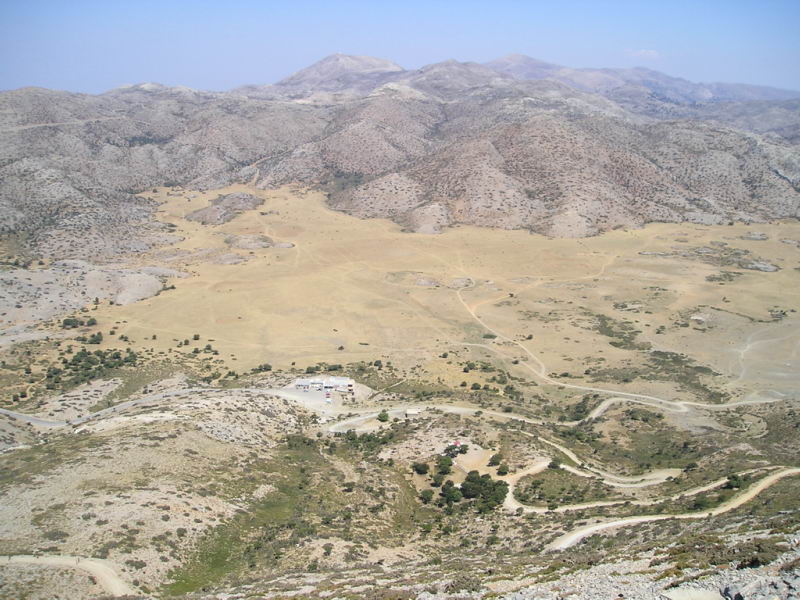
Crete is one of the largest islands in the Aegean Sea…and one of the most rugged. It is also home to the Minoan civilization which lay buried for nearly 3,000 years until Sir Arthur Evans discovered this archaeological wonder. Magnificent palaces at Knossos, Phaestos, Malia, and Zakros show just how sophisticated the Minoans were.

Over the centuries, the island fell under the rule of the Romans, Byzantines, Venetians, Ottoman Turks, and finally Greece. The most southerly of the Greek islands, four great mountain ranges traverse the island which stretches from east to west.

Crete’s capital of Heraklion (or Irakleio) lies on the northern coast and is famous for its Archaeological Museum which houses the world’s greatest collection of Minoan art including the famous frescoes from Knossos and the Phaestos Disc, which has yet to be deciphered.

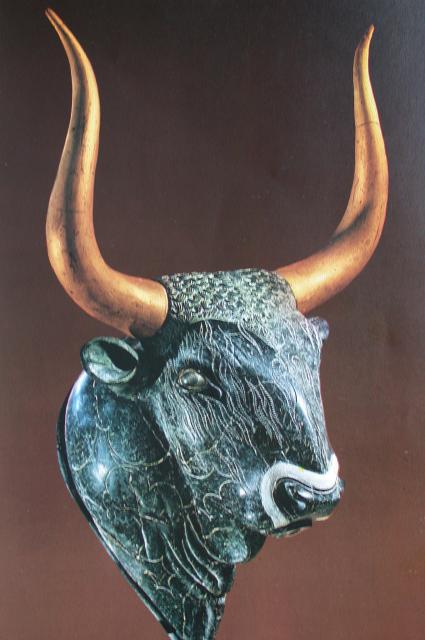
The museum, which began in 1883, also houses such great works as the Snake Goddess, Bull’s Head Rhyton, the Minoan Double Axe, the golden bee pendant, and the Bull Leaper.

The museum has been closed for renovation since 2006 and is scheduled to reopen in 2012, however a temporary exhibit of its most famous artifacts is in a building nearby. We will visit on Thursday and the museum is open from 8 a.m. – 7 p.m.

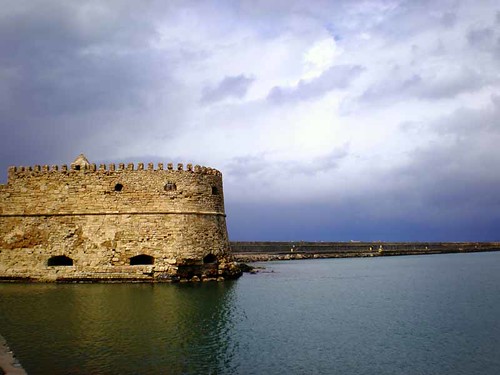
Heraklion’s harbor is dominated by a vast Venetian fortress of Rocca al Mare and Crete’s Historical Museum is on the waterfront. Housed here is El Greco’s View Mt. Sinai and the Monastery of St. Catherine, his only painting in Crete. El Greco, whose real name is Dominikos Theotokopoulous, was born in Crete in 1545.

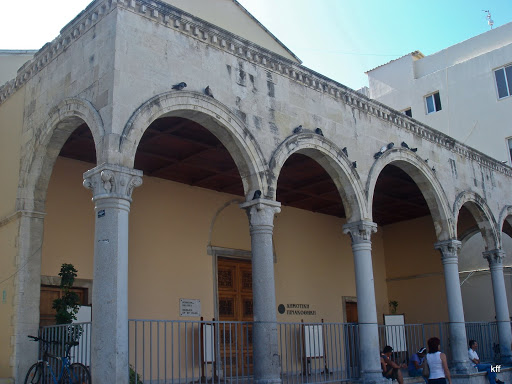
Also in Heraklion is the Plateia Eleftheriou Venizelou, a pedestrian zone with cafes and shops around the Morosini fountain. Facing the square is the restored Venetian church Agios Markos built in 1239 and now used for concerts. Also of note is the headless Roman statue that graces the 16th century Bembo Fountain. A place to stop for coffee!

Here's a 360 view of the port of Heraklion. This video is in Greek (I think!) but the pictures give you a good overview.

Wednesday, September 22, 2010

Delphi Archaeological Museum

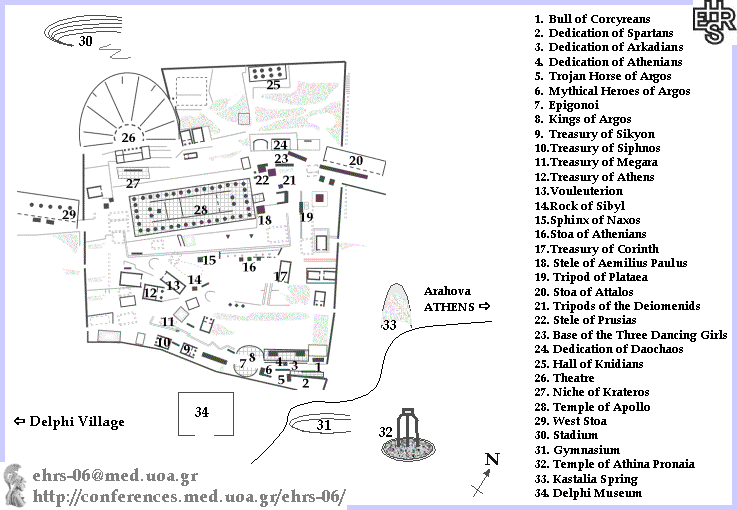
Located at the base of the ruins is the Delphi Archaeological Museum which houses artifacts that were found at Delphi. The exhibit primarily consists of offerings to the Oracle of Delphi discovered at the site and architectural parts of various buildings.

The museum’s 14 rooms are generally arranged chronologically. Collections include the Treasury of Sifnos, the Treasury of Athens, Hellenistic art sculptures, and Pediments of the Temple of Apollo.

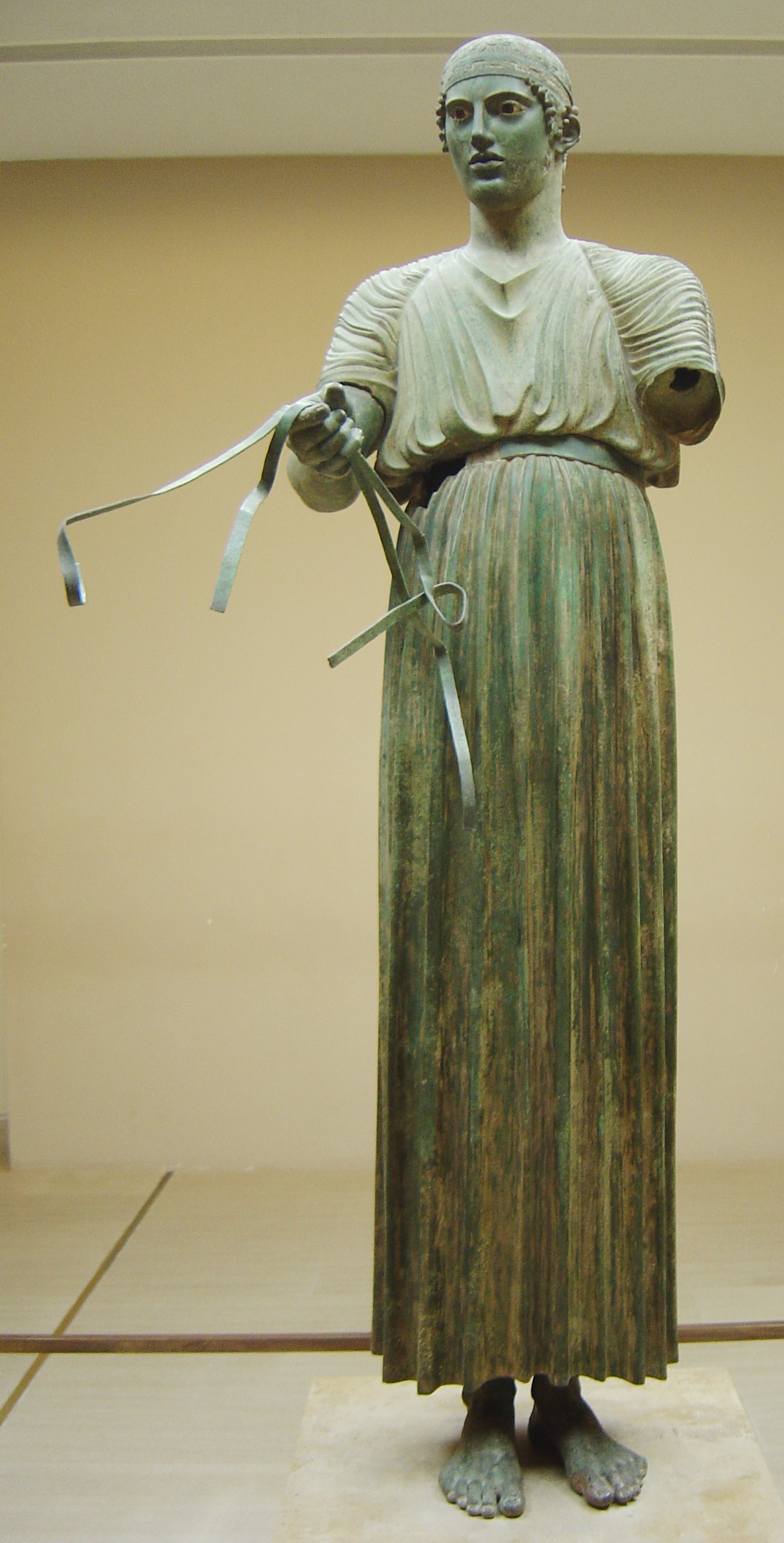
Highlights to see include the Charioteer, one the most famous statues in the exhibit. Also known as the "rein-holder," it was part of a larger exhibit, including horses and chariot, to commemorate a chariot race win in 474 BC. Portions of the horses were found with the charioteer.

The Omphalos is an ancient religious stone representing the navel of the world...where the two eagles collided in myth at the center of the world.

Kleobis and Biton are the statues of two human brothers from Greek mythology.

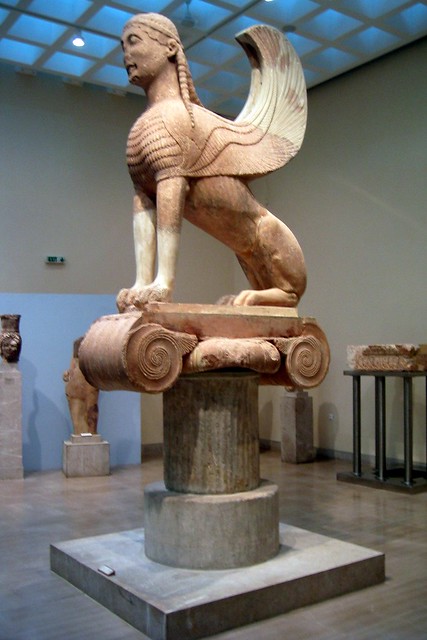
The Sphinx of Naxos sitting on an ionic column was a gift from the people of the Aegean island of Naxos to the oracle of Delphi in the sixth century BC.

The acanthus column with dancer, carved from Pentelic marble, features statues of three young women forming the upper part of a column encircled with acanthus leaves.

The cult statue of Antinous sculpted in Parian marble during the reign of Hadrian (117-138 CE), was found in the Temple of Apollo in 1893.

Wednesday, August 25, 2010

New (and Better) Itinerary!

Great News! Our itinerary now includes three additional items at NO additional charge to us! The optional Delphi excursion on Day 4 is now included as is a visit to the Delphi Museum. Also on Day 3 is included a visit to the new Acropolis Museum. When I wrote the blog last week I did not know!!

This week we all got an email from EF about optionals, and when I went online to check on it, I discovered the itinerary had changed…for the better! The only optional now offered by EF for our trip is the Greek evening. A friend I met at the EF teacher convention in China had just returned from this trip and does not recommend paying extra for the Greek evening as we will have one on the cruise.

The optional excursions on the Greek Islands are not booked through EF, but with the cruise line while onboard. He has also made some recommendations for them that I will share later when I blog about each island. You can then make your own decision as to which, if any, optional excursions to pay extra for while on the cruise.

Wednesday, August 18, 2010

New Acropolis Museum in Athens

The new Acropolis Museum might be your choice for your free time in Athens. Located at the base of the Acropolis the new archeological museum opened 21 June 2009 to replace a smaller version.

Over 4,000 artifacts discovered in and around the Acropolis are housed in the museum, except for the Elgin Marbles from the Parthenon which are still contained in the British Museum… and a source of contention as Greece has repeatedly requested their return and designed this larger museum to house them.

The museum is located on the southeastern slope of the Acropolis in the historical area of Makriyianni on the road that originally led up to the sacred site. Excavations during construction revealed earlier Byzantine ruins that now lie beneath the museum which can be seen in many places through transparent floors.

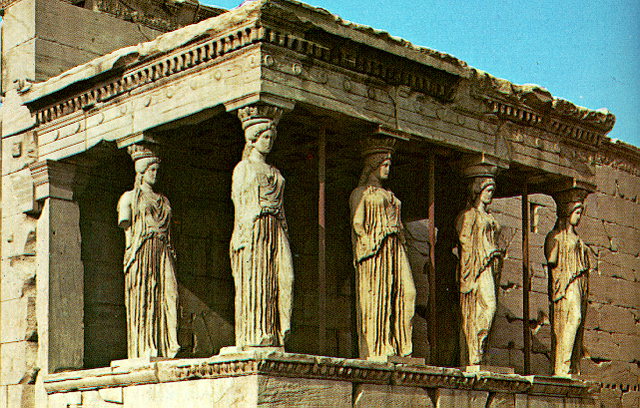
Exhibits are on three levels while a fourth middle level houses shops, cafes, and offices. On the first level of the museum there are the findings of the slopes of the Acropolis. The long and rectangular hall whose floor is sloping, resembles the ascension to the rock. Then, the visitor is found at the large trapezoidal hall which accommodates the archaic findings. The original Caryatids from the Erechthion are housed here also.

Be sure to click on the Photos link at the bottom of the web site Organization for the Construction of the New Acropolis Museum and look at each set of photos by clicking “Start Slideshow” at the bottom of each page. In particular, you will want to watch the videos from the link at the bottom of the site. The one on the virtual tour is not high quality, but the others on the construction, moving the exhibits, and the archeological findings beneath the museum are interesting.

Now take a look at the official Acropolis Museum web site and be sure to open each of the galleries to see what the exhibitions look like with the museum now open to the public.

Tuesday, July 13, 2010

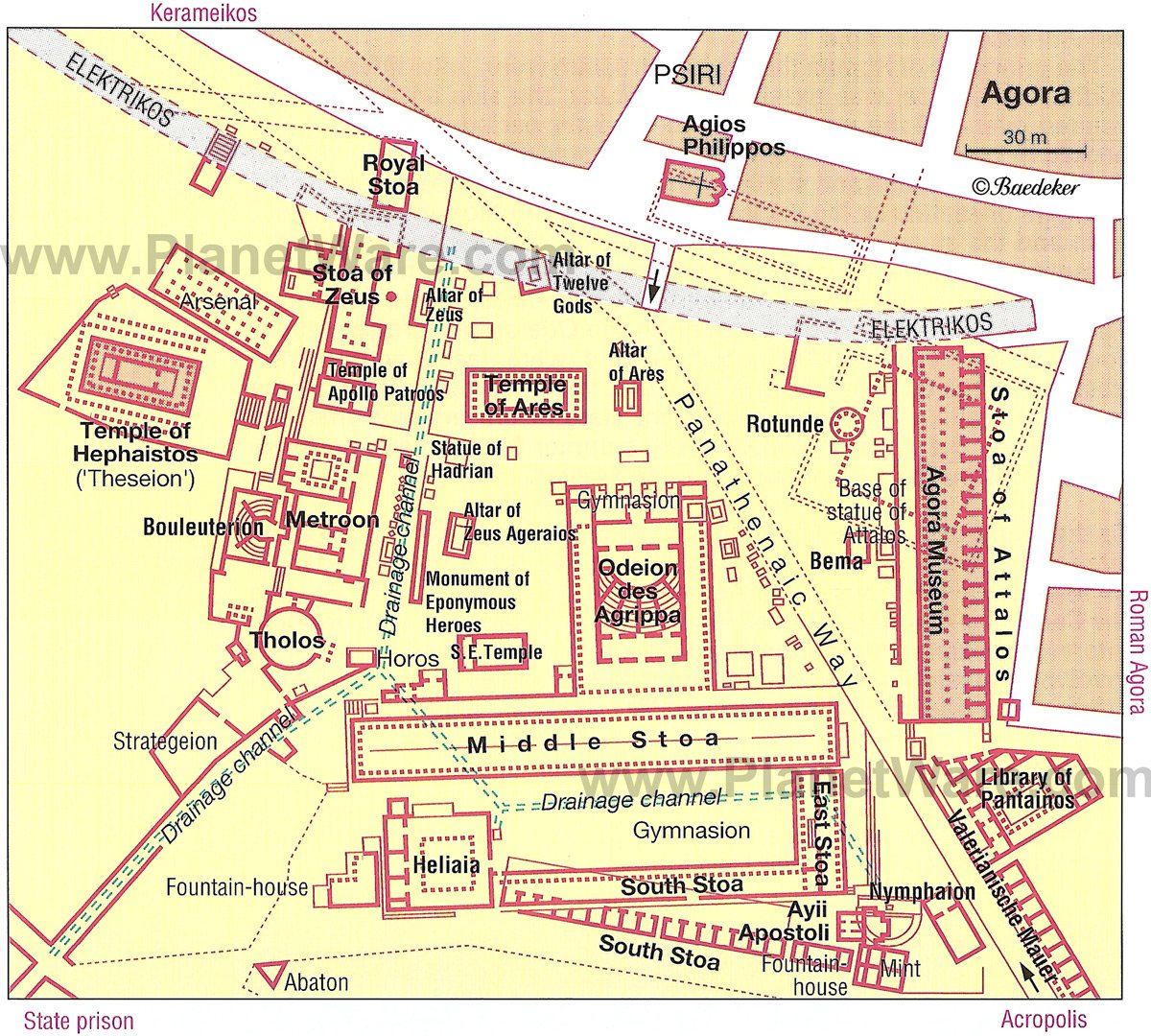
Ancient Agora of Athens

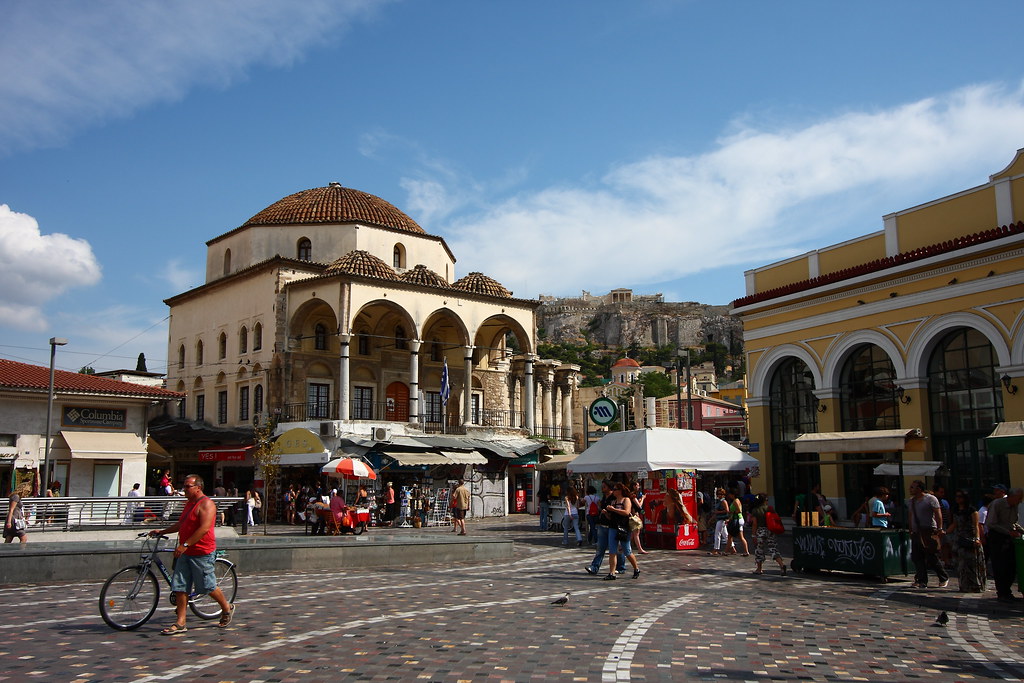
As mentioned previously the Tower of the Winds is actually located just between the Plaka District and the Ancient Agora of Athens (a site similar to the Roman Forum in Rome). The Agora is located just north of the Acropolis.

The democratically governed Agora was the political and religious heart of Athens as far back as the 6th century BC. It was also the center of daily and commercial life…similar to what town squares used to be in the United States.

It was here that law courts were located and anyone who happened to be in the Agora during a trial could witness these proceedings. It was however only adult male citizens appointed by lot who could serve as jurors.

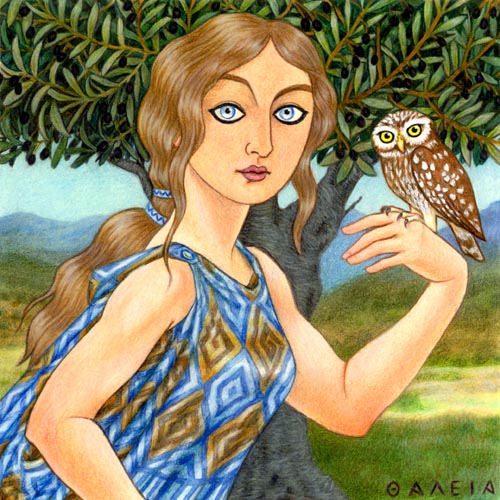
The state prison was located here as well as the mint which produced the city’s coins inscribed with an owl, the symbol of Athena, goddess of wisdom and the patron goddess of Athens.

The American School of Archeology has been excavating the Agora since 1930 and the finds are exhibited in the two-story stoa of Attalos which now serves as a museum. This main building in the Agora was built by King Attalos of Pergamon (ruled 159-138 BC) but was destroyed in 267 AD.

It was rebuilt between 1953-56 on the original foundations using ancient building materials. A unique exhibit in the museum is a klepsydra, a water clock that was used for timing plaintiff’s speeches. Other items include bronze ballots and everyday items such as terracotta toys and leather sandals.

Also located in the Agora (and its best preserved ruins) are the Odeion of Agrippa, once a covered theatre, and the Hephaisteion, a temple to Hephaistos also known as the Theseion.

This 51-page full-color guide to the Agora prepared by excavator John McK. Camp II presents information about each building in the Agora complete with color photographs, maps, diagrams, and drawings. If you are planning to spend your free time exploring Athens (we have a day and a half!), then you might want to print this guide to use in your visit to the site.

You will enjoy this short YouTube video, Teacher Travels: Ancient Agora, which shows many of the fascinating relics discovered by the archealogists.

Wednesday, June 16, 2010

The Acropolis in Athens

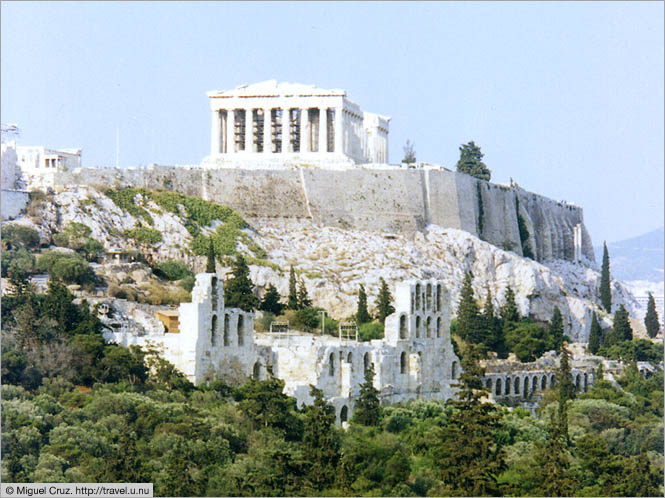
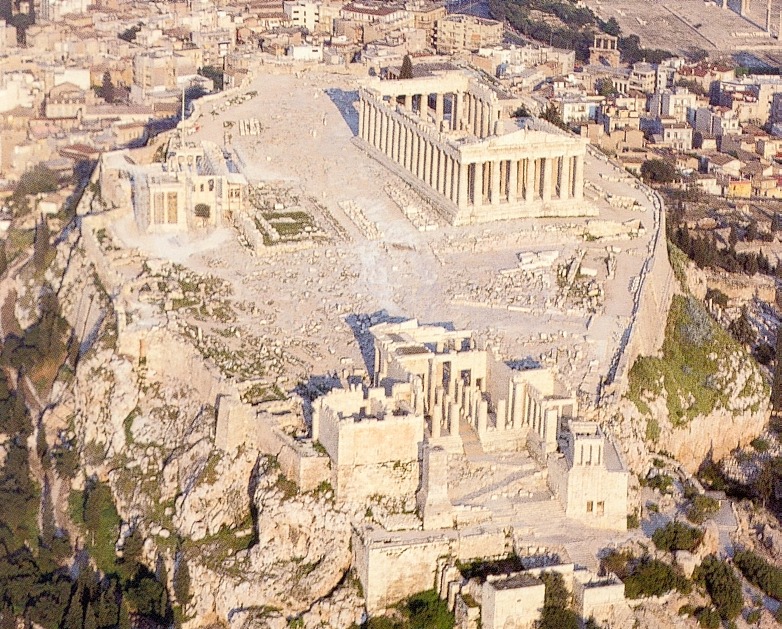
The Acropolis is literally a giant rock upon which is built one of the most famous buildings of all time...the Parthenon. But it is not the only building atop the outcrop which sits at the southernmost part of Athens, Greece. All that remains are three contrasting temples and a unique gateway that leads to the Acropolis.

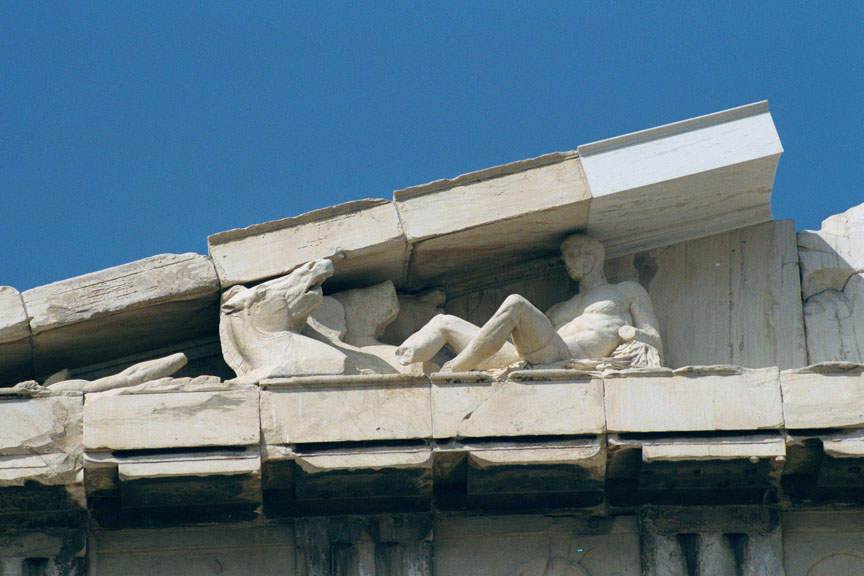
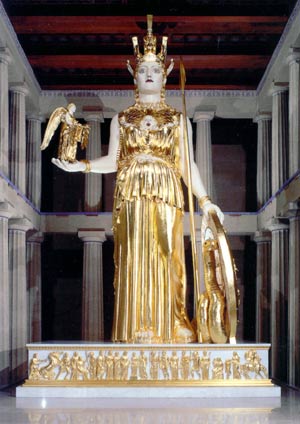
In the center is the Parthenon, although few sculptures remain on this temple to Athena, the patron goddess of Athens. Only the outside columns remain. The new Acropolis Museum located to the southeast of the Parthenon near the Theatre of Dionysius contains many of the original sculptures from the buildings on the Acropolis.

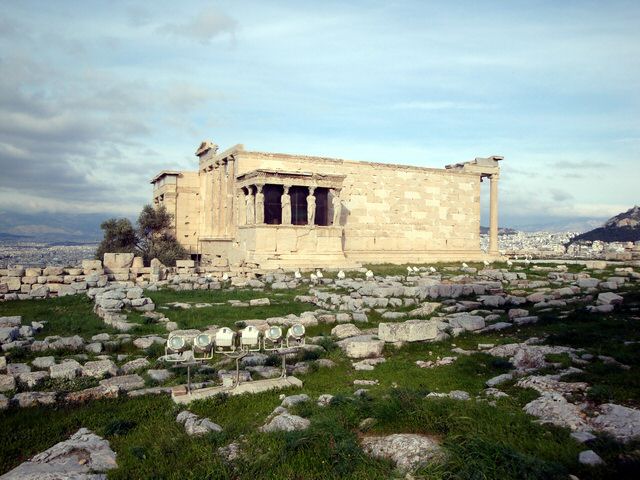
Also atop the Acropolis is the Erechtheion famous for its Caryatids, or the statues of women used as columns on the south porch. The original statues are now in the Acropolis Museum while casts are now on the Erechtheion. An olive tree now grows beside the Porch of Caryatids where Athena first planted her tree in a competition against Poseidon.

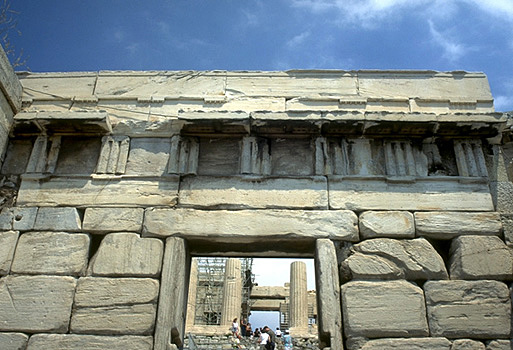
The massive Propylaia gateway was built in 437-432 B.C. as a "new" entrance to the Acropolis and beside it is the tiny Temple of Athena Nike, built to honor Athena of Victory. At the base of the Propylaia is the Beule Gate, the original gateway to the Acropolis.

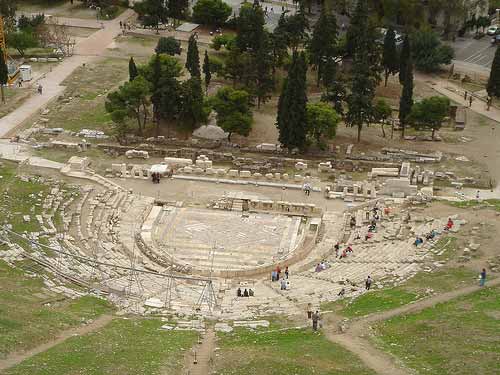
Two theatres lie at the base of the Acropolis. The larger of the two, the Theatre of Herodes Atticus, also known as the Odeion of Herodes Atticus, was built in A.D. 161 and lies near the Propylaia. It is still used today for outdoor concerts.

The smaller theatre is also the older . The Theatre of Dionysos was built in 333-330 B.C.
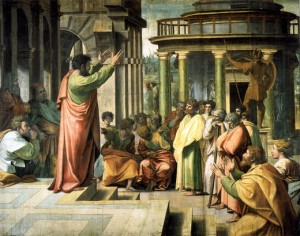
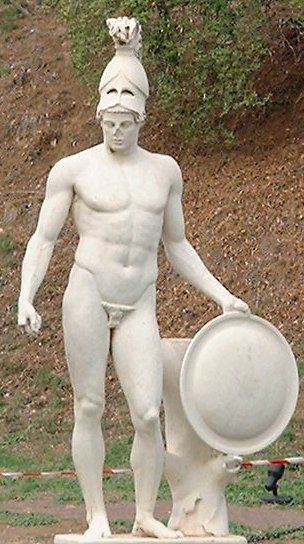
Located just west of the Acropolis is Areopagos Hill, or Mars Hill, where St. Paul delivered his sermon in A.D. 51. Greeks called their god of war "Ares," while he was called "Mars" by the Romans. While on the Areopagus, in the shadow of the Acropolis, Paul preached one of the most memorable sermons recorded in the Bible (Acts 17:22-31).