Showing posts with label Acropolis. Show all posts

Tuesday, March 19, 2013

Painted Churches of Texas - Ammannsville

St. John the Baptist Church

One of the beautiful country churches on the Painted Churches of Texas tour is in Ammannsville, settled by both German and Czech immigrants in the 1870s.  St. John the Baptist Catholic Church is called the “pink church” because the entire interior is painted a soft pastel pink.

Front Altar
The first church, built in 1890, was destroyed by an inland hurricane in 1909.  The second church built in 1910 was destroyed by fire in 1917, but six statues and a crucifix were saved from the fire.  This second church was very ornate inside and out, built in a highly Victorian style.

The present church, built in 1919, is the third in this location and was built in a much simpler design on the outside.  However when you enter, your eyes feast on a richly decorated white altar set against a rose colored background. 

The "Pink Church" at Ammannsville 
Stained Glass Window
The ceilings are a relatively simple stencil pattern with more ornate decoration on the walls. Legend says that an unknown itinerant artist painted the walls of the church, however research has shown that decorative painter Fred Donnecker is responsible for the artistry back in 1919.

It also features stained glass windows and faux marble columns painted to resemble the real thing. 

Wednesday, August 25, 2010

New (and Better) Itinerary!

Great News! Our itinerary now includes three additional items at NO additional charge to us! The optional Delphi excursion on Day 4 is now included as is a visit to the Delphi Museum. Also on Day 3 is included a visit to the new Acropolis Museum. When I wrote the blog last week I did not know!!

This week we all got an email from EF about optionals, and when I went online to check on it, I discovered the itinerary had changed…for the better! The only optional now offered by EF for our trip is the Greek evening. A friend I met at the EF teacher convention in China had just returned from this trip and does not recommend paying extra for the Greek evening as we will have one on the cruise.

The optional excursions on the Greek Islands are not booked through EF, but with the cruise line while onboard. He has also made some recommendations for them that I will share later when I blog about each island. You can then make your own decision as to which, if any, optional excursions to pay extra for while on the cruise.

Wednesday, August 18, 2010

New Acropolis Museum in Athens

The new Acropolis Museum might be your choice for your free time in Athens. Located at the base of the Acropolis the new archeological museum opened 21 June 2009 to replace a smaller version.

Over 4,000 artifacts discovered in and around the Acropolis are housed in the museum, except for the Elgin Marbles from the Parthenon which are still contained in the British Museum… and a source of contention as Greece has repeatedly requested their return and designed this larger museum to house them.

The museum is located on the southeastern slope of the Acropolis in the historical area of Makriyianni on the road that originally led up to the sacred site. Excavations during construction revealed earlier Byzantine ruins that now lie beneath the museum which can be seen in many places through transparent floors.

Exhibits are on three levels while a fourth middle level houses shops, cafes, and offices. On the first level of the museum there are the findings of the slopes of the Acropolis. The long and rectangular hall whose floor is sloping, resembles the ascension to the rock. Then, the visitor is found at the large trapezoidal hall which accommodates the archaic findings. The original Caryatids from the Erechthion are housed here also.

Be sure to click on the Photos link at the bottom of the web site Organization for the Construction of the New Acropolis Museum and look at each set of photos by clicking “Start Slideshow” at the bottom of each page. In particular, you will want to watch the videos from the link at the bottom of the site. The one on the virtual tour is not high quality, but the others on the construction, moving the exhibits, and the archeological findings beneath the museum are interesting.

Now take a look at the official Acropolis Museum web site and be sure to open each of the galleries to see what the exhibitions look like with the museum now open to the public.

Thursday, June 24, 2010

The Parthenon

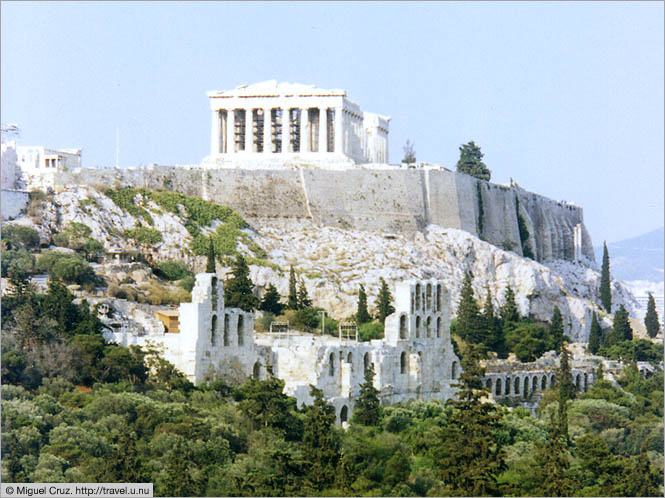
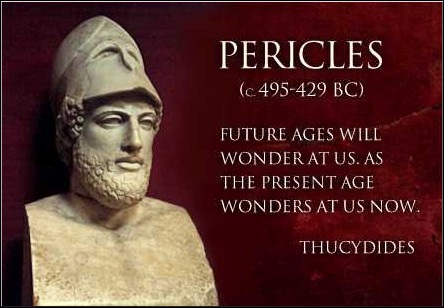
One of the most famous buildings in the world is the Parthenon, the crown jewel that tops the Acropolis in Athens, Greece. Pericles commissioned its construction as a grand rebuilding project in 447 BC.

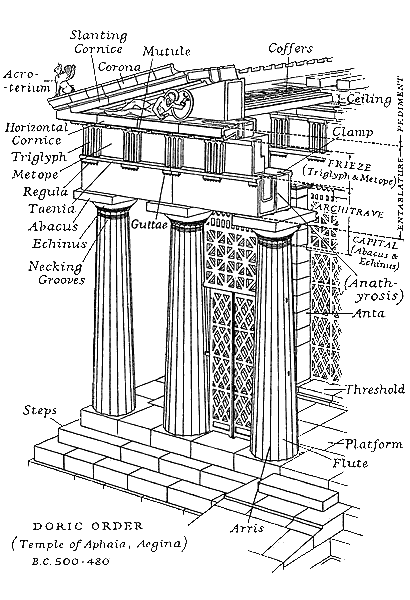
The sculptor Pheidias was entrusted to supervise the construction of a magnificent new Doric temple to the goddess Athena, the patron goddess of the city. Built on the site of earlier Archaic temples, it was built primarily to house the Parthenos, Pheidias’s impressive 39-foot high cult statue of Athena covered in ivory and gold.

Taking nine years to complete, the temple was dedicated to the goddess during the Great Panathenaia festival of 438 BC. Constructed of Pentelic marble by the artchitects Kallikrates and Iktinos, the complex architecture of the Parthenon replaces straight lines with slight curves. All the columns swell in the middle, similar to a cigar shape, and all lean slightly inwards.

The reason for this is not quite clear. Some suggest it was done to prevent visual distortion, while others argue it was simply for aesthetic reasons. I have also heard that its design withstands earthquakes better, of which the surrounding area is susceptible.

The building remained a temple to Athena for over a thousand years until the Roman Empire came into power. It was then the statue was looted and destroyed. The Parthenon has also served as a Christian church, a mosque, and even a Turkish arsenal. Its present state of ruin owes to an ammunition explosion during a Venetian invasion in 1687.

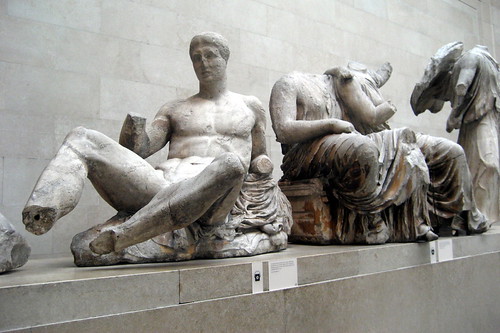
The pediments, metopes, and friezes which run around the temple depict the people and horses in the Panathenaic procession, while other sculptures represent Greek mythology and Athenian historical events. During the explosion, many of the sculptures were blown off the building and scattered.

In 1806, Thomas Bruce, 7th earl of Elgin, removed many of the sculptures with the Turks permission and the "Elgin Marbles" are currently on display in the British Museum in London. At present, the Greeks are trying to get the sculptures returned to Athens, but with little luck. But there are two sides to every story...the British and the Greeks.

The Parthenon is currently in a state of restoration, but officials do not plan to return it to its pre-1687 state. An exact to scale replica of the Parthenon stands in Nashville, Tennessee. It was built in 1897 as part of the Tennessee Centennial.

Enjoy a 360-degree panorama view of multiple locations atop the Acropolis. Just click on any location and number at this site and move your cursor around. You're almost there!