|
| The Berlin Wall |
After World War
II, Germany, and the city of Berlin, were divided into American,
British, French, and Soviet zones with border crossings such as Checkpoint
Charlie. Relationships quickly disintegrated,
and in 1949 the American, British, and French sectors became West
Germany, while the Soviet sector became East
Germany.
Since the city of Berlin was situated entirely in the
Soviet zone, West
Berlin became an island of democracy within Communist East Germany.
Between 1949 and 1960, 2.5 million refugees, half under
the age of 25, fled East Germany.
Roughly half a million people crossed the borders between East and West
Berlin daily allowing an opportunity for citizens to compare living conditions
on both sides. East Germany was on the
brink of social and economic collapse.
So on the night of 13 August 1961, while most Berliners
slept, the Communist party of the German Democratic Republic (GDR, or East
Germany) stretched a barbed
wire and concrete barricade between East and West Berlin. Officially, the wall was meant to keep
Western “fascists” out of East Germany.
Primarily, though, it served to stem mass defections from East to
West.
Between 1961 and 1988, over 100,000 people tried to escape
across the wall which stretched almost 100 miles with an average height of
11.8 feet and wrapped entirely around West Berlin.
As a deterrent
to escape attempts, there was also a 300-foot-No-Man’s-Land,
an additional inner wall, soldiers patrolling with dogs, a raked ground that
showed footprints, anti-vehicle trenches, electric fences, massive light
systems, watchtowers, bunkers, and minefields.
Indeed, these measures were major deterrents for
escaping, but it is estimated that at least 5,000 managed to make it safely
across the border.
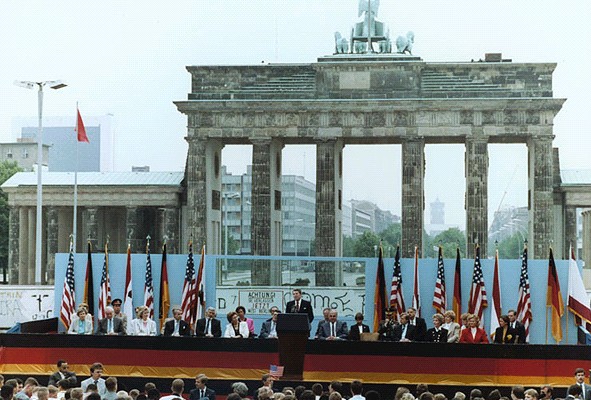
In a
speech at the Brandenburg Gate celebrating the 750th
anniversary of Berlin on 12 June 1987, US
President Ronald Reagan challenged Soviet Communist leader Mikhail
Gorbachev to “tear down this
wall” in support of increasing freedom in the Eastern Bloc.
The Berlin Wall
stood until 9
November 1989 when the head of the East German Communist party announced
that citizens of the GDR could
cross the border any time they wanted. Many celebrated by crossing the wall and
bringing hammers and picks to chip
away the iconic barrier.
After the wall fell, East and West Germany once again
unified and Germany became a single state once again on 3 October 1990.
On 13 August 1998, a memorial was erected
along Bernauer Strasse where traces of the former strip have been preserved.
But don’t expect to see much of the 100-mile long
wall as most of it has been chiseled away and carted off. Not much remains of the once infamous wall.
Both sides of the wall were featured in the John le
Carre book (1963) and movie (1965) The
Spy Who Came in from the Cold.
You’ll find the full
movie here (107:24) and here
(112:00), but it requires a lot of buffer time to load.