Showing posts with label Berlin. Show all posts

Friday, June 7, 2013

What to Do on Our Free Afternoons

Szechenyi Thermal Pools
Our itinerary calls for free afternoons in all four major cities – Berlin, Prague, Krakow, and Budapest.  That means we need to do a little research prior to our tour to plan where we would like to go.  In case the full group optionals planned by our tour director do not make, I recommend small groups as you can cover more territory and save time – especially if you have a plan before we arrive.

We will not be doing the Potsdam optional excursion on the itinerary, so we do have a free afternoon in Berlin.  We have already paid for an afternoon excursion to the Wieliczka Salt Mine near Krakow, so that afternoon is not free.  So you will need to make some decisions for Berlin, Prague, and Budapest.  We do have a Danube River cruise in Budapest included in our tour (and not on the detailed itinerary), but I do not know if it is in the afternoon or evening.

One site to revisit for ideas is the original slide show I created when we first learned about our tour.  Also revisit the series of 37 Rick Steves videos on Central and Eastern Europe.

The following links might also give you some ideas:

BERLIN
Interactive Berlin Map (Hover over an attraction and it is located on the map.  Click on an attraction and go to more information.)

PRAGUE
Interactive Prague Map

BUDAPEST
Interactive Budapest Map

KRAKOW
Interactive Krakow Map

DRESDEN
Interactive Dresden Map

Tuesday, November 20, 2012

The Berlin Wall

The Berlin Wall
One of the most iconic symbols of the Cold War was the infamous Berlin Wall which separated East and West Berlin from 1961 to 1989.

After World War II, Germany, and the city of Berlin, were divided into American, British, French, and Soviet zones with border crossings such as Checkpoint Charlie.  Relationships quickly disintegrated, and in 1949 the American, British, and French sectors became West Germany, while the Soviet sector became East Germany.

Since the city of Berlin was situated entirely in the Soviet zone, West Berlin became an island of democracy within Communist East Germany.

Between 1949 and 1960, 2.5 million refugees, half under the age of 25, fled East Germany.  Roughly half a million people crossed the borders between East and West Berlin daily allowing an opportunity for citizens to compare living conditions on both sides.  East Germany was on the brink of social and economic collapse.

So on the night of 13 August 1961, while most Berliners slept, the Communist party of the German Democratic Republic (GDR, or East Germany) stretched a barbed wire and concrete barricade between East and West Berlin.  Officially, the wall was meant to keep Western “fascists” out of East Germany.  Primarily, though, it served to stem mass defections from East to West. 

Between 1961 and 1988, over 100,000 people tried to escape across the wall which stretched almost 100 miles with an average height of 11.8 feet and wrapped entirely around West Berlin.


Indeed, these measures were major deterrents for escaping, but it is estimated that at least 5,000 managed to make it safely across the border.

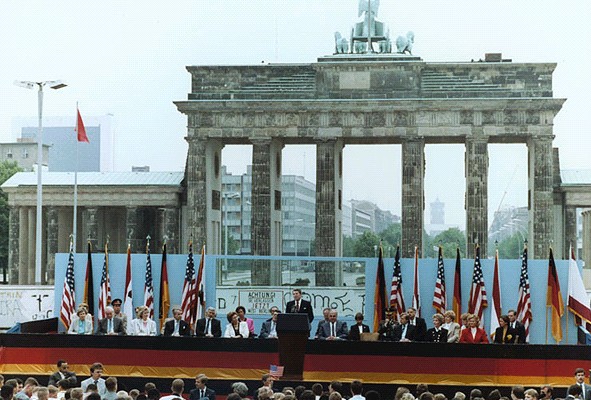
In a speech at the Brandenburg Gate celebrating the 750th anniversary of Berlin on 12 June 1987, US President Ronald Reagan challenged Soviet Communist leader Mikhail Gorbachev to “tear down this wall” in support of increasing freedom in the Eastern Bloc.

The Berlin Wall stood until 9 November 1989 when the head of the East German Communist party announced that citizens of the GDR could cross the border any time they wanted.  Many celebrated by crossing the wall and bringing hammers and picks to chip away the iconic barrier.

After the wall fell, East and West Germany once again unified and Germany became a single state once again on 3 October 1990.

On 13 August 1998, a memorial was erected along Bernauer Strasse where traces of the former strip have been preserved.

But don’t expect to see much of the 100-mile long wall as most of it has been chiseled away and carted off.  Not much remains of the once infamous wall.

Both sides of the wall were featured in the John le Carre book (1963) and movie (1965) The Spy Who Came in from the Cold.  You’ll find the full movie here (107:24) and here (112:00), but it requires a lot of buffer time to load.

Tuesday, October 23, 2012

Berlin - Checkpoint Charlie Museum

Checkpoint Charlie Museum
Founded by human rights activist Dr. Rainer Hildebrandt, Museum Haus am Checkpoint Charlie explores the history of the Berlin Wall and the stories of the people whose lives were affected by it.  It depicts objects used to get over, under, and through the Berlin Wall in their efforts to escape the so-called “best border security system in the world.”

Celebrating its 50th birthday, the museum also hosts a new exhibition tracing movements which have promoted human rights from 1800 onwards and how the struggle continues today.

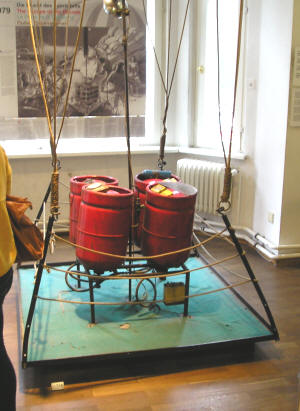
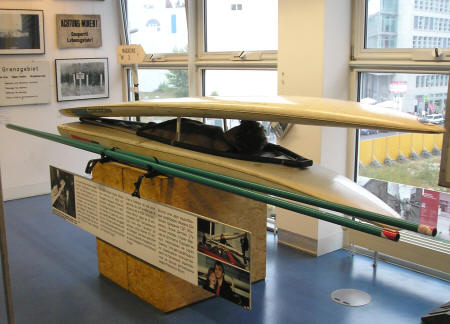
The permanent exhibit traces the history of the Berlin Wall.  On exhibit are some of the various deceptive means of escape including hot air balloons, escape cars, suitcases, homemade mini-subs, and even a cleverly hollowed out surfboard.

The human rights exhibit entitled From Gandhi to Walesa: Non-Violent Struggle for Human Rights Worldwide, features a diary and wooden sandals of Mahatma Gandhi as well as other artifacts. They also have the typewriter used to draft Charta 77, the hectograph from the illegal periodical Umweltblatter, and Elena Bonner's ‘death mask’ of partner Andrei Sacharov.

2012 also marks the opening of the new permanent NATO exhibit which charts the creation of NATO in 1949.

Originally opened in 1962 by Dr. Hildebrandt in two-and-a-half rooms to protest the newly erected Berlin Wall in 1961, its popularity outgrew its original location and it was moved to its present location at the Checkpoint Charlie border crossing in 1963.  Because of its location, the museum café became a popular meeting point to plan escapes.

Today the museum is run by Dr. Hildebrandt’s widow Alexandra following his death in 2004.  Although the Berlin Wall may have come down, many people in the world still face discrimination, persecution, and unlawful imprisonment, and the attention the museum draws to their cause is immeasurable.

Here are some excellent videos.  The first is narrated by Alexandra Hildebrandt called Checkpoint Charlie (2:08).  This one is a segment from travel guru Rick Steve's travel show on Berlin called Berlin, Germany: Checkpoint Charlie (1:21).  The third, Checkpoint Charlie Berlin (3:25), is also quite informative.

Thursday, August 30, 2012

Berlin – 775th Birthday!


Nikolai Church
Berlin, the capital city of Germany, is hosting its 775th birthday celebration this August 25-October 28, 2012 commemorating the finding of the first documentation dated 28 October 1237 which reveals the existence of Berlin’s sister city Cölln.  The anniversary culminates with the jubilee festival October 28.

Berlin and Cölln were originally two tiny villages on either side of the Spree River which later grew into trading centers.  They were destroyed during the Thirty Years’ War, but celebrated a cultural re-emergence under Prussian rulers Friedrich Wilhelm I and his successor, Frederick the Great.

A unique addition to the city for the celebration includes a large (VERY large) scale 1:775 outdoor ground map of 18th century Berlin recently installed on Museum Island, a UNESCO World Heritage site located on the Spree River. 

There are five museums on Museum Island, some recently restored, which cover more than 6,000 years of culture and art.

The city will set up a system of temporary guided paths to lead visitors through an historical walk through medieval Berlin and her sister city Cölln.  Recent excavations and preserved documents will help paint a picture of the double city in the Middle Ages.

The exhibits on display include findings made in January 2010 during excavations for the U-Bahn in front of the Red Town Hall, two churches, and sites along the city walls.  Excavations have recently discovered a 13th century drinking well, a 16th century belt clasp, a 17th century key, and the remains of a medieval Latin school.

A highlight of the celebration will be to feature the 800 years of immigration and cultural diversity in a variety of exhibits.

The Berlin Nikolai Church will also be celebrating its 800th anniversary this year as the oldest parish church in Berlin.  It was recently completely renovated and will be the site of the finale of the October 28 jubilee.

Thursday, August 2, 2012

Berlin - Brandenburg Gate


The most recognizable site in Berlin has to be the famous Brandenburg Gate (Brandenburger Tor) located on Pariser Platz (Paris Plaza).  As the national symbol of Germany, during the Cold War, it stood between East and West Germany as part of the impassable Berlin Wall. It is the only remaining gate of a series through which Berlin was once entered. 

The Gate closed when the Berlin Wall was built in 1961, but reopened in 1989 when the Berlin Wall fell following a peaceful revolution that ended the Cold War and again united the country.  It now stands as a symbol of a reunified Germany.

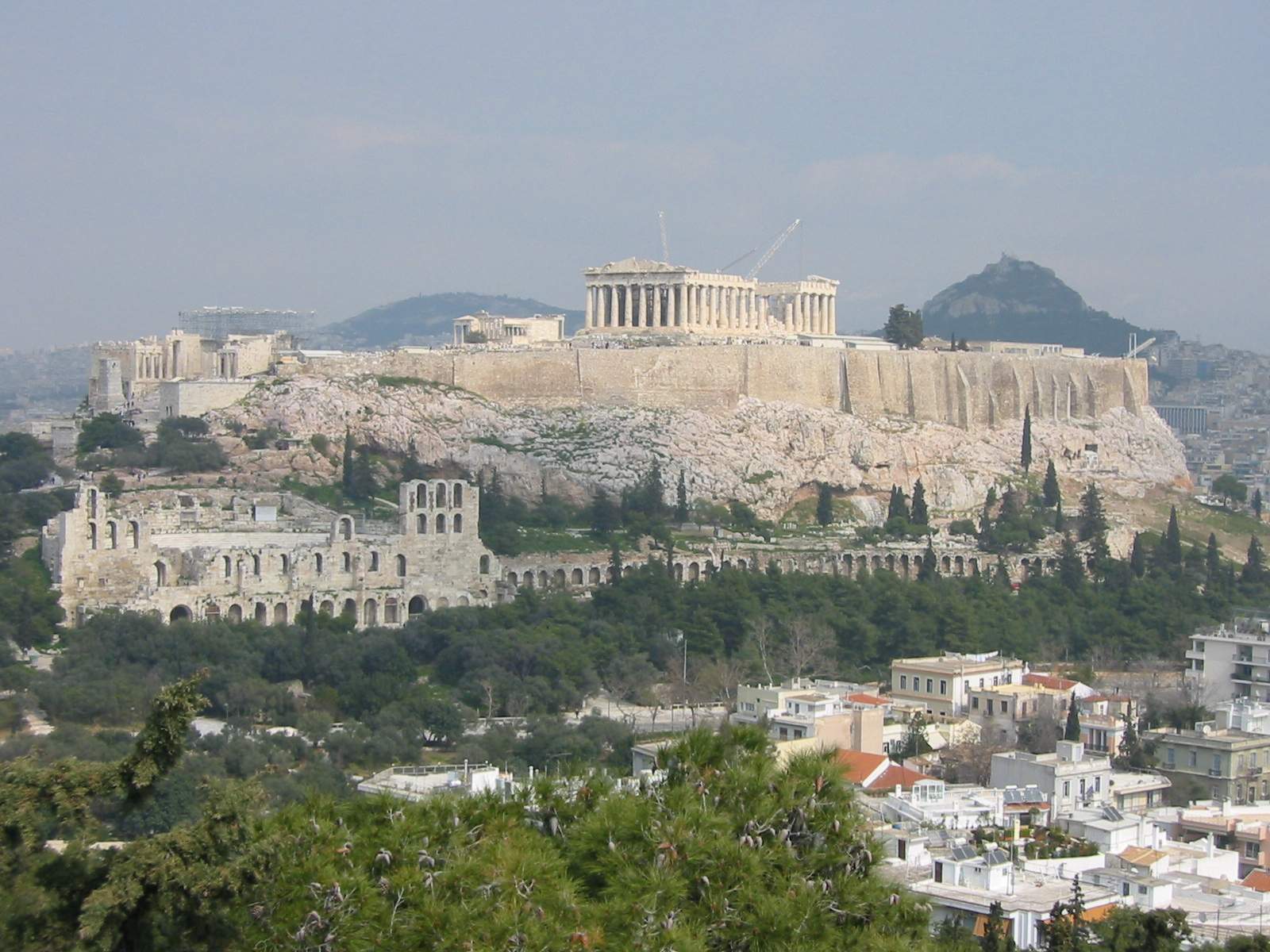
Commissioned by Friedrich Wilhelm II to represent peace, the Gate was designed by Karl Gotthard Langhans.  Built in 1791 in a design based on the Propylaea, the gateway to the Acropolis in Athens, it served as the grand entrance to the boulevard “Unter den Linden” leading to the palace of the Prussian monarchs before the destruction of the city castle.  The bas-reliefs of scenes from Greek mythology took another four years to complete. 

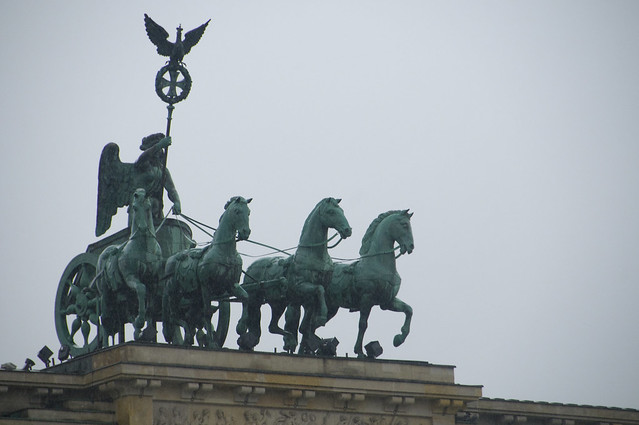
The Gate has twelve columns, six on the entrance side and six on the exit.  The columns form roadways, and citizens originally were allowed to use only the outer two.  Only the royal family was allowed to pass through the central archway.  The Gate was topped in 1793 by the bronze Quadriga, a four-horsed chariot driven by Victoria, the winged goddess of victory, which faces east.

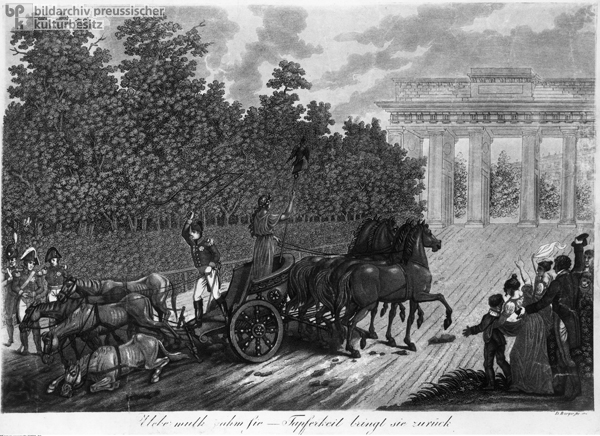
The Brandenburg Gate has witnessed much in history.  During the Napoleonic Wars in 1806, Napoleon took the Quadriga sculpture back to Paris as a war trophy.  After the Battle of Waterloo, it was returned to Berlin as a symbol of victory.

And it was through the Brandenburg Gate in 1933 that Nazismarched to celebrate Hitler’s rise to power.  Heavilydamaged during World War II, the Brandenburg Gate was refurbished in 2000 and reopened to the public in December 2002.  In June 1987, President Ronald Reagan made his famousspeech at the Gate and urged, “Mr. Gorbachev, tear down this wall!”

Some of the Gate’s most beautiful photographs are ones shot at night as it is lighted against the evening sky. This 360degree panorama of Pariser Plaza and the Brandenburg Gate is gorgeous.  It does need Java to run, but my computer had a popup to click “Run this time” and it worked.  The widescreen view is the best.

This BBC documentary about bringing down the Berlin Wall, “BBC Brandenburg Gate,” (2:14) is quite informative.  This video is an interesting modern and historical perspective of the gate and shows it from various views, “Carl Gotthard Langhans: Brandenburg Gate, Berlin” (4:00).