Showing posts with label Prague. Show all posts

Friday, June 7, 2013

What to Do on Our Free Afternoons

Szechenyi Thermal Pools
Our itinerary calls for free afternoons in all four major cities – Berlin, Prague, Krakow, and Budapest.  That means we need to do a little research prior to our tour to plan where we would like to go.  In case the full group optionals planned by our tour director do not make, I recommend small groups as you can cover more territory and save time – especially if you have a plan before we arrive.

We will not be doing the Potsdam optional excursion on the itinerary, so we do have a free afternoon in Berlin.  We have already paid for an afternoon excursion to the Wieliczka Salt Mine near Krakow, so that afternoon is not free.  So you will need to make some decisions for Berlin, Prague, and Budapest.  We do have a Danube River cruise in Budapest included in our tour (and not on the detailed itinerary), but I do not know if it is in the afternoon or evening.

One site to revisit for ideas is the original slide show I created when we first learned about our tour.  Also revisit the series of 37 Rick Steves videos on Central and Eastern Europe.

The following links might also give you some ideas:

BERLIN
Interactive Berlin Map (Hover over an attraction and it is located on the map.  Click on an attraction and go to more information.)

PRAGUE
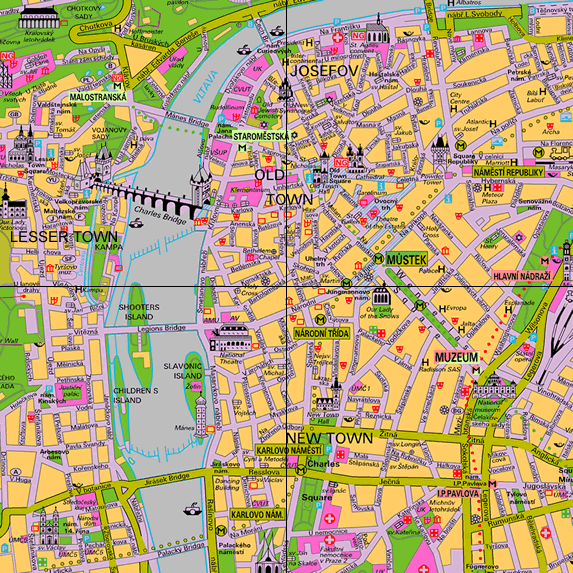
Interactive Prague Map

BUDAPEST
Interactive Budapest Map

KRAKOW
Interactive Krakow Map

DRESDEN
Interactive Dresden Map

Thursday, September 20, 2012

Prague – St. Vitus Cathedral

St. Vitus Cathedral
Of the many buildings that compose the Prague Castle complex, St. Vitus Cathedral is the most prominent.  It is the spiritual symbol of the Czech Republic and a gothic masterpiece that has been the site of the coronation of many Czech kings and queens.

This is the third church built on this site.  The first was a pagan temple.  Then in 929, a domed rotunda was commissioned by Duke Wenceslas I and consecrated to St. Vitus, because the duke had acquired a holy relic (the arm of St. Vitus) from Emperor Henry I. 

When the Roman Catholic bishopric at Prague was founded in 1060, the rotunda was converted to a basilica with two steeples.  The present-day cathedral was commissioned by Charles IV in 1344 and took nearly six centuries to complete. 

The first builders, Matthias of Arras and later Peter Parler, built the chancel with a ring of chapels, St. Wenceslas Chapel, the Golden Portal, and the lower part of the main steeple.

Although Parler began construction of the large southern steeple, he did not complete it. It achieved its originally planned height after being crowned with the Renaissance helmet at its summit in the 16th century.

Work was intermittent, and for many centuries the church sat uncompleted.  The final phase of construction took place between 1873-1929. 

The western side of the cathedral is marked by two tall towers and the Rose Window, inspired by cathedral windows in Paris.  It dates from the 1920s and depicts scenes from the Creation.  The visitor entrance is on the western side.

The Golden Portal is the former main entrance to the cathedral.  Above it is a 14th century Venetian art mosaic polished with gold of the Last Judgment, with Jesus surrounded by angels and kneeling Czech patrons.

The royal mausoleum, where kings, queens, and patron saints are interred, is located under in the chancel of the cathedral in front of the high altar. 

Perhaps the most outstanding room in the cathedral, the St. Wenceslas Chapel, where lies the tomb of the patron saint and site of the original rotunda, is decorated with beautiful original 14th century frescoes of the Passion Cycle and over 1,300 semi-precious stones. 

Another band of decorations commemorates the life of St. Wenceslas and the magnificent chandelier lights the interior.  Every coronation began here when the kings went here to pray.  Understandably, the chapel is not open to visitors, but it can be seen through the entrance.  (Note: September 28 is St. Wenceslas Day.)

A door in the southwest corner of the chapel leads to the Crown Chamber in which the priceless Bohemian Crown Jewels are stored.  The St. Wenceslas Crown dates from 1347 when Charles IV had it made for his coronation.

But don’t count on seeing them…they were displayed only nine times in the 20th century!  And don’t even try to get near them...they are in an iron safe behind that locked door with seven locks and seven individual key holders who guard the keys! 

Here is a collection of 14 videos of St. Vitus Cathedral all in one place. The second one, “St. Vitus Cathedral, Prague” (1:43) is a good brief overview. 

Tuesday, June 26, 2012

Prague - Charles Bridge


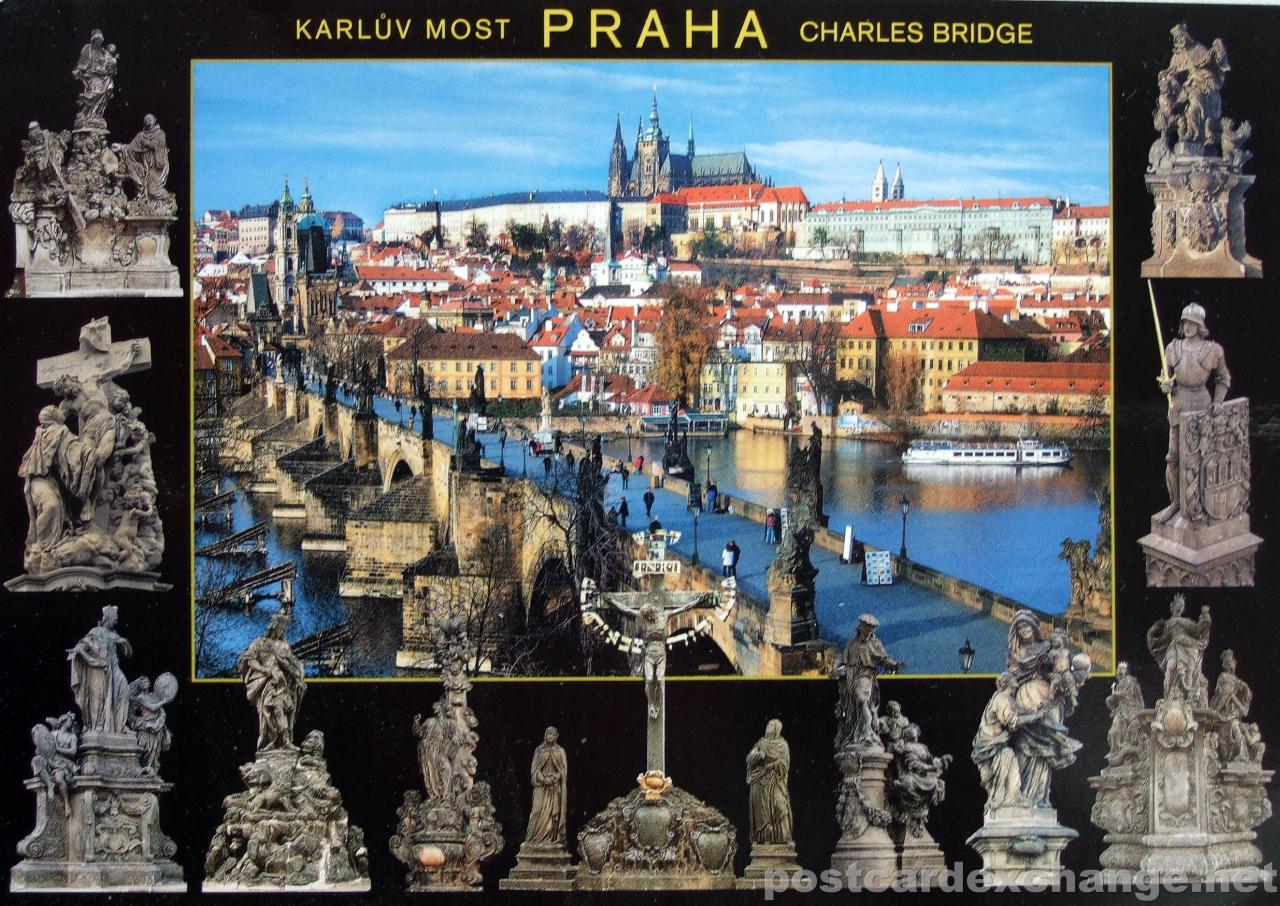
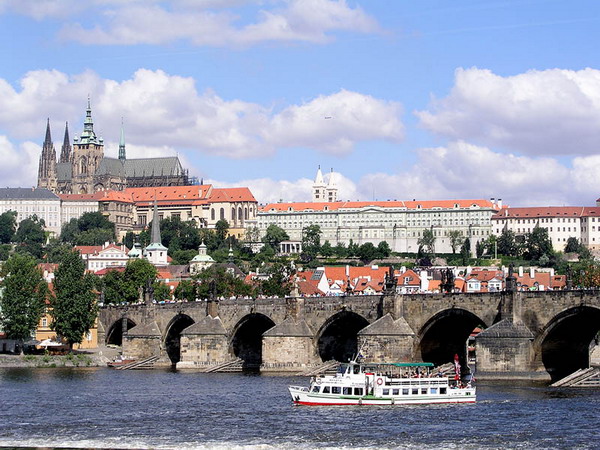
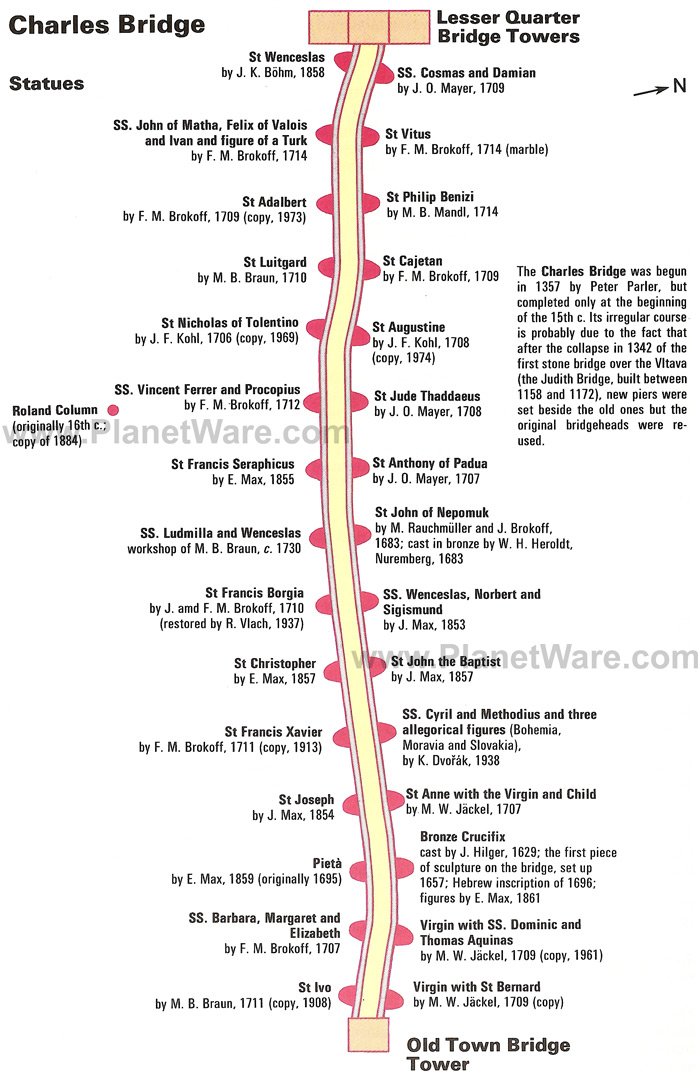
The famous Charles Bridge, which connects Old Town with Lesser Quarter (or Mala Strana) and Prague Castle, is the oldest bridge in Prague, Czech Republic.  Built between the 14 th and 15 th century, it crosses the Vltava River and is lined on both sides with a total of 30 baroque statues, mostly from the 18th century, standing on parapets.

Originally known as the Prague Bridge, it was renamed after Holy Roman Emperor Charles IV, who laid the foundation stone at a very unique, and calculated, time – 135797531 (in 1357 on the 9th day of the 7th month at 5:31 a.m.). It is 520 m long and 10 m wide and boasts 16 arches. The bridge is fortified at both ends by three towers, two of them on the Lesser Quarter side and the third one on the Old Town side. 

 In charge of the construction was architect Petr Parléř whose other works include the St. Vitus Cathedral at the Prague Castle. It is said that egg yolks were mixed into the mortar to strengthen the construction of the bridge, although this has not been proven.

The original wooden bridge was destroyed by floods in the 11th century and in 1172, Wenceslas I built the stone Judith Bridge named for his wife, but it was destroyed in the 1342 flood. The bridge was damaged by several other floods over the centuries, including ones in 1784, 1890, and 2002.

Most of the statues were damaged by floods over the centuries and replaced by replicas. The originals can be seen in the Lapidary of the National Museum.

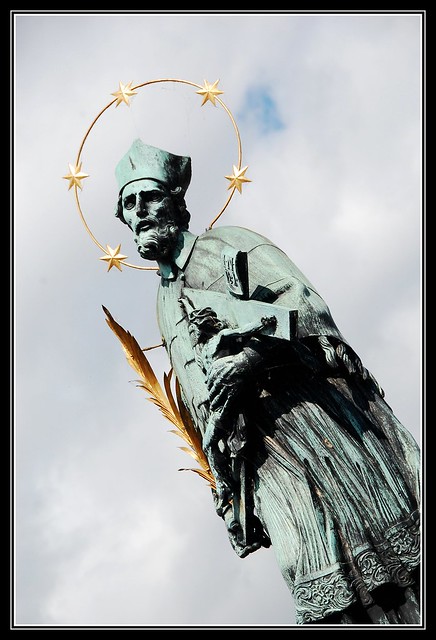
One of the most famous statues is of St. John Nepomuk whose tomb is in St. Vitus Cathedral.  It is the oldest statue on the bridge dating from 1683.  The shiny gold part you see in the photo link is where people rub it thinking it will bring good luck.

St. John of Nepomuk was a parson, who refused to betray a secret, confided to him by Queen Sophia, to the king Wenceslas IV. He was tortured on the king´s demand and then thrown to the river Vltava from the Charles Bridge in 1393. 

The five stars allegedly appeared above the river after the martyr was thrown there. They are supposed to symbolize the five letters of the Latin word “tacet”, which means “silent”. There is a brass cross with five stars at the place on the parapet where he was thrown into the river.
Statues on the left hand of the bridge from the Old Town bridge tower:
  1. St. Ivo
  2. St. Barbara, St. Margaret and St. Elizabeth
  3. Pieta
  4. St. Joseph
  5. St. Francis Xaverius
  6. St. Christopher
  7. St. Francis Borgias
  8. St. Ludmila
  9. St. Francis Seraphic
  10. St. Vincent of Ferrara and St. Procope
  11. St. Nicolas of Tolentino
  12. St. Luitgarda
  13. St. Adalbert
  14. Statuary of St. John of Matha, St. Felix of Valois and St. Ivan
  15. St. Wenceslas
Statues on the right hand of the bridge from the Old Town bridge tower:
  1. St. Bernard
  2. St. Thomas Aquinas and St. Dominique
  3. Statuary of St. Cross - Calvary
  4. St. Anna
  5. St. Cyril and St. Method
  6. St. John the Baptist
  7. Sts. Norbert, Wenceslas and Sigismond
  8. St. John of Nepomuk
  9. St. Anthony of Padua
  10. St. Judas Thaddeus
  11. St. Augustine
  12. St. Cajetan
  13. St. Philip Benicius
  14. St. Vitus
  15. St. Kosma and St. Damian
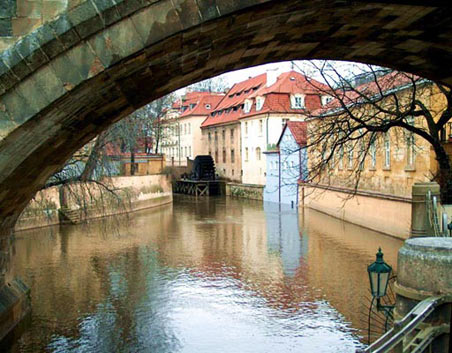
Kampa Island is located under the Charles Bridge and was at one time a renowned potters' market.  The staircase leading to Kampa Island underneath the bridge is from 1844.

During the day, the pedestrian only bridge is occupied by many artists and musicians.  Charles Bridge Museum, opened in June 2007 to celebrate 650th anniversary of the bridge's construction, is located next to the foot of the bridge from the Old Town side.

A great time of day to come to the bridge is at sunset when you can enjoy a breathtaking view of the fully lit Prague Castle against the evening sky.

The bridge made a Hollywood appearance in the movie Mission: Impossible.

This short documentary video (3:29) sums it up pretty well.  And take a walking tour with Karl in this video (6:12) on the Charles Bridge.

Tuesday, June 5, 2012

Prague - Astronomical Clock


In case you’ve been wondering about the tiny picture in the left bar…well that is the Orloj, reputed to be the third oldest clock in the world and the oldest one still working located in Prague.  The mystery about the astronomical clock is that no one knows exactly how old it really is.

Located on the southern wall of the Old Town City Hall in Old Town Square in Prague, the capital city of the Czech Republic, it is truly a wonder to behold.  Not only does it tell time, but symbols of the zodiac tell the course of the heavens.  When the bell tolls, windows fly open andmechanical apostles, skeletons, and "sinners" begin their hourly show (although it can only be seen from 9 a.m. until 9 p.m.).  Watch this video to see the whole performance.

History of the Prague Clock

It is believed the original clock tower in Prague was built about 1410 by Mikulas of Kadan in collaboration with Jan Ondrejuv called Sindel, professor of mathematics and astronomy of Prague Charles University.  At that time the clock showed only astronomical data.

Later, in 1490, the tower facade was decorated with flamboyant Gothic sculptures and a golden calendar dial.  1865-66 brought still more additions such as the wooden carvings of the twelve apostles and a calendar disk with astrological signs.

The clock and the entire City Hall suffered much damage during WorldWar II in May 1945. On the last day of the war, the centre of old Prague was the aim of Nazi artillery.  Fortunately, everything could be reconstructed and the figures of the apostles replaced by the creations of the woodcarver Vojtech Sucharda following the war.


Before it was known who actually built the original clock, natives claimed that Hanus the clockmaker was the originator, and town officials had him blinded so that he would never duplicate his masterpiece.

In revenge, the blind man climbed the tower and stopped his creation. The clock remained silent for more than fifty years. Centuries later, during dreary decades of communist domination, the legend of the blinded clockmaker became a metaphor for thwarted creativity.   A children’s fiction book called The Cabinet of Wonders (2008) by MarieRutkoski is a fantasy with roots to this legend.

The Figures on the Clock

In addition to the figures of the 12 apostles there are also eight figures on the left and right side of the clock dial and the calendar.

The four figures at the clock dial are symbols of Prague medieval society. On the left are Vanity admiring himself in a mirror and the Miser/Jewholding his bag of gold. On the right are represented Death ringing his belland a Turk (or The Piper) shaking his head.

Under the clock dial you will see the Calendar painted by Josef Manes in 1805.  Well, the one you will see is actually a replica, the original is kept on the sides of the stairway of the Prague Museum of History.  On the calendar you will see a chronicler, an angel, an astronomer and a philosopher (from left to right).

The Clock Tower is also decorated with exquisite coats of arms and different royal symbols. There is also a rooster that crows after the Apostles have finished their blessing.


The Astronomical Dial shows the medieval perception of the Universe: the Earth is the center. The blue part of the dial represents the sky above the horizon, the brown part the sky below it. There are Latin words ORTVS (east) and OCCASVS (west) written above the horizon, and AVRORA (dawn) and CPEPVSCVLVM (twilight) below. There is a Zodiac ring, which represents the stars in the sky and it moves according to it. The two clock hands bear the signs of the Sun and the Moon. 

There are three circles on the dial, showing different time: the outer circle with Schwabacher numerals shows the Old Czech Time (“Italian Time”), the circle with Roman numerals shows the Central European Time, and the inner circle with Arabic numerals shows the “Babylonian Time”: the length of an hour differs there according to the season – it is longer in the summer, shorter in the winter. The Prague Astronomical Clock is the only one in the world able to measure it. Furthermore, the little star by the zodiac ring shows the sidereal time.

Calendar Dial

The newest part of the clock is the Calendar Dial. The Prague Old Town symbol graces the centre. The rotary outer circle describes every single day of the year, and the current date is indicated at the top. There are also medallions with zodiac signs and with pictures depicting every month.

600th Anniversary

On October 9, 2010, the Clock's 600th anniversary was celebrated with a light show on the face of the clock tower. Two HD projectors were used to project several animated videos on the clock.  This video is absolutely amazing and you must watch it!

The videos showed it being built, torn down, rebuilt, and peeled away to show its internal mechanisms and the famous animated figures, as well as various events in the clock's history.

As much as I tried to “understand” the clock as I read several resources, it still defied my imagination.  I guess we’ll just have to print this (or any other explanation you find) and stand in wonder while we try to piece together the intricacies and beauty of this fabulous feat of engineering.