Showing posts with label bridge. Show all posts

Wednesday, October 29, 2014

Carrick-a-Rede Rope Bridge, Northern Ireland

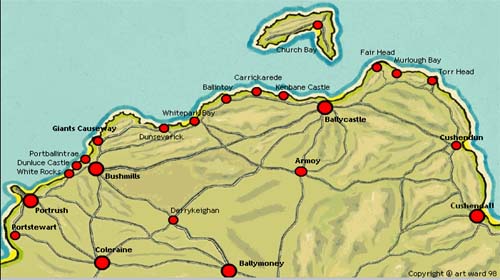
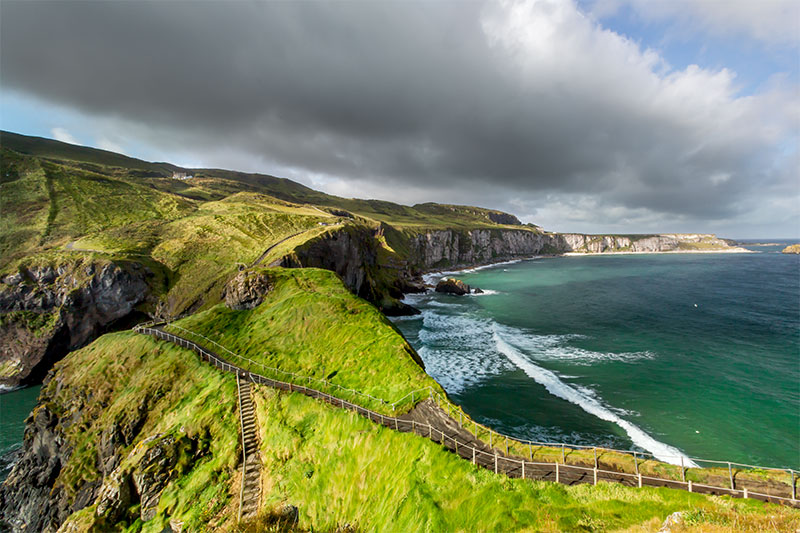
Located in the northernmost corner of Northern Ireland near Ballintoy in County Antrim is the unique Carrick-a-Rede Rope Bridge that spans a narrow 98-foot deep chasm allowing access to a beautiful island. The 65-foot long bridge connects the mainland to tiny Carrick-a-Rede Island and, although it has been rebuilt several times over the years, a bridge has spanned this rocky area for almost four centuries.

Carrick-a-Rede Rope Bridge
From here you can actually see Rathlin Island and the Scottish isles!  The Mull of Kintyre is the most visible part of Scotland just beyond Rathlin.

An earlier bridge was just a single rope handrail and widely spaced slats used by fishermen to check their nets on the island, which provided great salmon fishing grounds until 2002.  In fact, the name is Irish for “rock of the casting.” The current two-handrailed bridge was erected in 2008 by the National Trust for an easier and safer crossing.

The views from the bridge and the island are spectacular, but warning signs also urge visitors to be careful.  There are few guards and railings on the island cliffs, so be sure to watch your step while exploring on marked paths.  Click here for a 360-degree view of the area.

There’s a 30- to 45-minute coastal walk up to Carrick-a-Rede, and there are some steep steps and stairs.  No one has been injured falling from the bridge, but some have feared the crossing back to the mainland.  What happens to them?  Click here to find out.

Afraid of heights? Not to worry.  The views from the mainland are just as beautiful as from the island.  Taking the rope bridge challenge just provides an adrenaline rush and another notch on your “I did it” belt!

As a reward for crossing the bridge, enjoy tea and cake and the lovely view at the WeighbridgeTearoom located on Carrick-a-Rede Island.

Rope Bridge to Carrick-a-Rede Island
The area around the bridge is also rich in geology, flora, and fauna diversity and is designated an Area of Specific Scientific Interest.  The island is one of the best examples of a volcanic plug in Northern Ireland.  Marine erosion has exposed an area of this geological wonder.

Noisy seabird colonies of fulmars, kittywakes, guillemots, and razorbills breed on the islands close to the rope bridge.  Sheep and cattle also graze in nearby meadows. Porpoises, dolphins, and sea lions have been spotted in the waters below, as well as a basking shark! 

Wild thyme can carpet the area in pink and at least three different types of orchids can be found around the sites as well as other wildflowers.  Even the Facebook page of the National Trust shows that the Northern Lights were visible from the nearby town of Ballintoy!

Other sites in the area include Larry Bane,once a chalk quarry in the mid-1970’s, but now an access point for a walk to the rope bridge and a 400-year-old restored fisherman’s cottage to show the connection between the bridge and a once thriving industry.

Locations around Larry Bane and Ballintoy have been used as sets for episodes of the highly popular HBO series Game ofThrones, such as Renly’s Warcamp.

Click here for a handy pdf map of the Carrick-a-Rede walking trail and bridge.  You’ll see that the walking path to the bridge is much longer than the walk over the bridge.

Join this visitor in his walk across Carrick-a-Rede Rope Bridge video to get a feel for life on the edge!

Tuesday, June 26, 2012

Prague - Charles Bridge


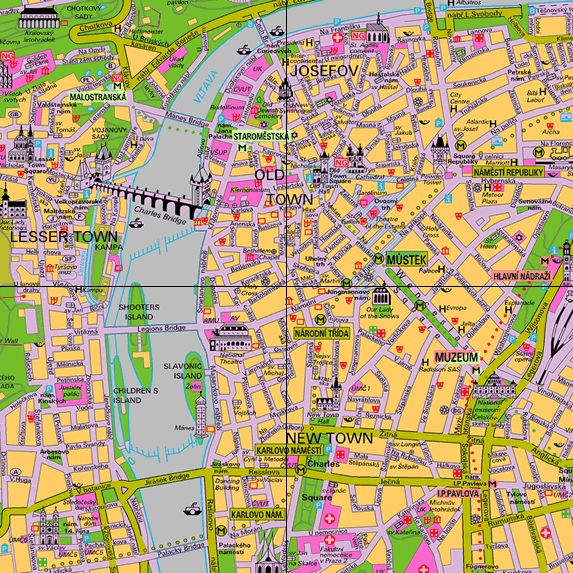
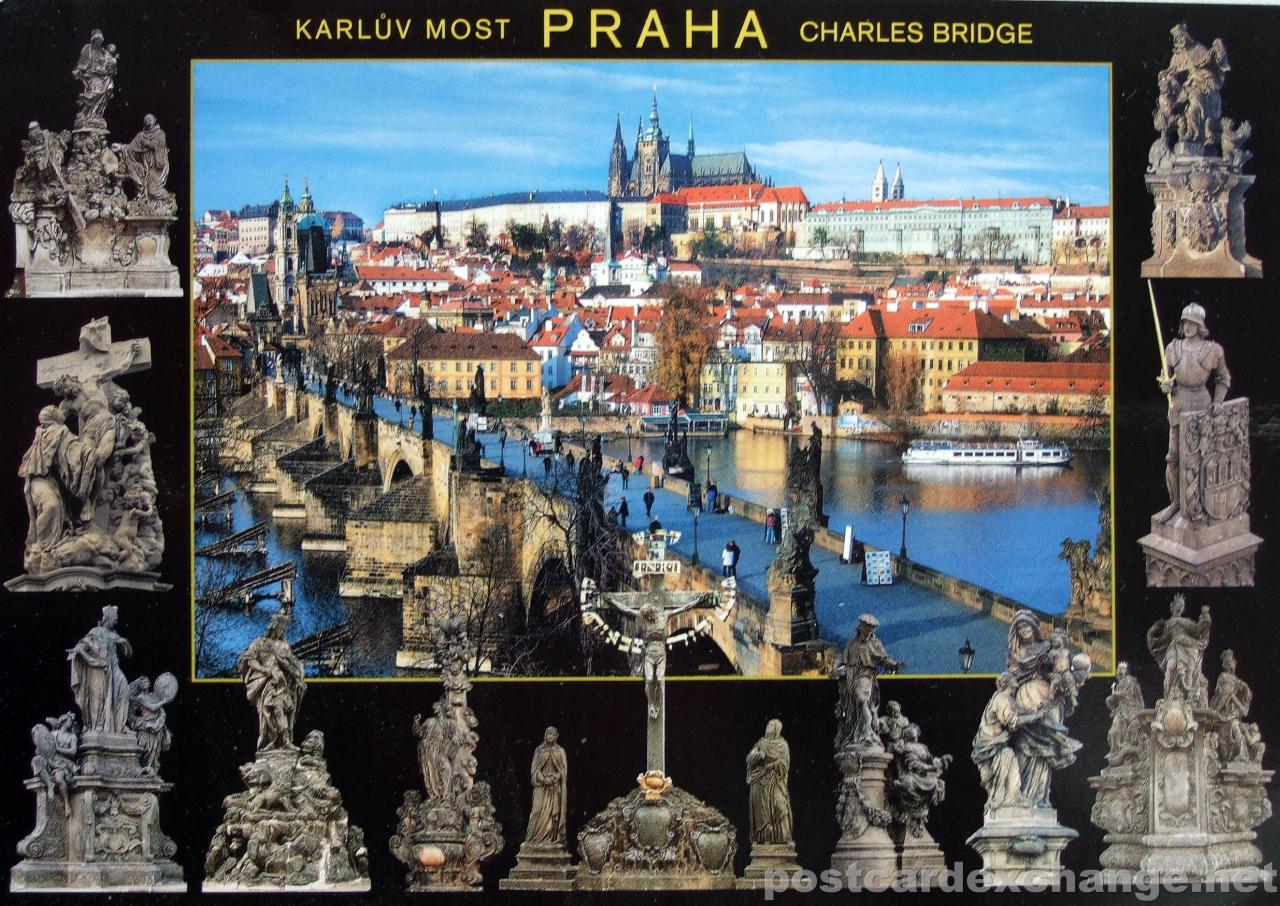
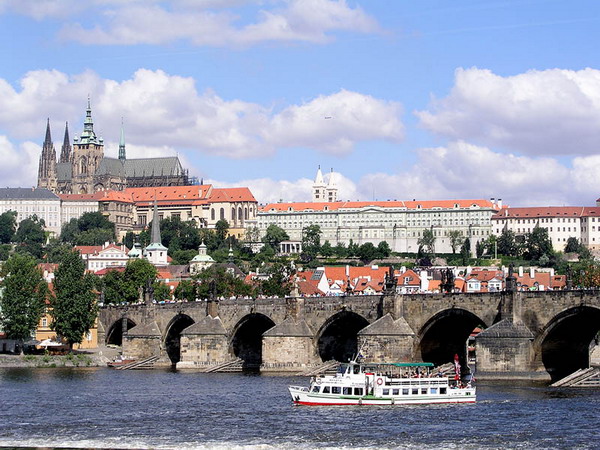
The famous Charles Bridge, which connects Old Town with Lesser Quarter (or Mala Strana) and Prague Castle, is the oldest bridge in Prague, Czech Republic.  Built between the 14 th and 15 th century, it crosses the Vltava River and is lined on both sides with a total of 30 baroque statues, mostly from the 18th century, standing on parapets.

Originally known as the Prague Bridge, it was renamed after Holy Roman Emperor Charles IV, who laid the foundation stone at a very unique, and calculated, time – 135797531 (in 1357 on the 9th day of the 7th month at 5:31 a.m.). It is 520 m long and 10 m wide and boasts 16 arches. The bridge is fortified at both ends by three towers, two of them on the Lesser Quarter side and the third one on the Old Town side. 

 In charge of the construction was architect Petr Parléř whose other works include the St. Vitus Cathedral at the Prague Castle. It is said that egg yolks were mixed into the mortar to strengthen the construction of the bridge, although this has not been proven.

The original wooden bridge was destroyed by floods in the 11th century and in 1172, Wenceslas I built the stone Judith Bridge named for his wife, but it was destroyed in the 1342 flood. The bridge was damaged by several other floods over the centuries, including ones in 1784, 1890, and 2002.

Most of the statues were damaged by floods over the centuries and replaced by replicas. The originals can be seen in the Lapidary of the National Museum.

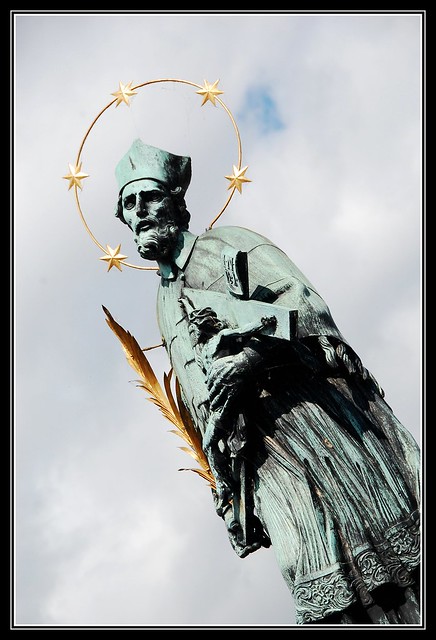
One of the most famous statues is of St. John Nepomuk whose tomb is in St. Vitus Cathedral.  It is the oldest statue on the bridge dating from 1683.  The shiny gold part you see in the photo link is where people rub it thinking it will bring good luck.

St. John of Nepomuk was a parson, who refused to betray a secret, confided to him by Queen Sophia, to the king Wenceslas IV. He was tortured on the king´s demand and then thrown to the river Vltava from the Charles Bridge in 1393. 

The five stars allegedly appeared above the river after the martyr was thrown there. They are supposed to symbolize the five letters of the Latin word “tacet”, which means “silent”. There is a brass cross with five stars at the place on the parapet where he was thrown into the river.
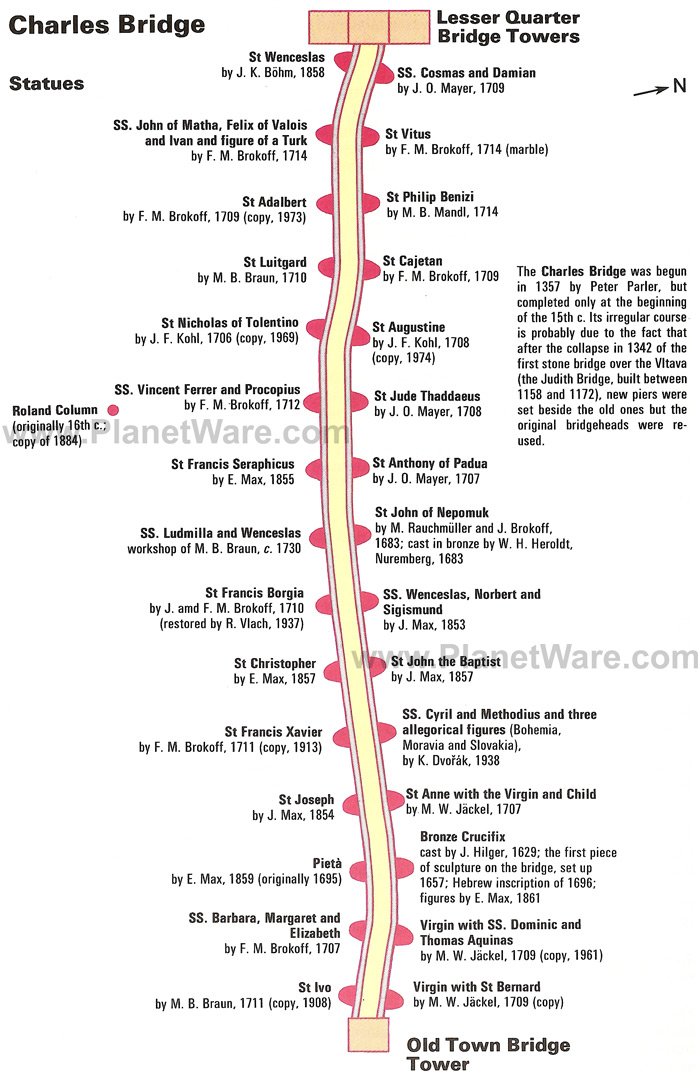
Statues on the left hand of the bridge from the Old Town bridge tower:
  1. St. Ivo
  2. St. Barbara, St. Margaret and St. Elizabeth
  3. Pieta
  4. St. Joseph
  5. St. Francis Xaverius
  6. St. Christopher
  7. St. Francis Borgias
  8. St. Ludmila
  9. St. Francis Seraphic
  10. St. Vincent of Ferrara and St. Procope
  11. St. Nicolas of Tolentino
  12. St. Luitgarda
  13. St. Adalbert
  14. Statuary of St. John of Matha, St. Felix of Valois and St. Ivan
  15. St. Wenceslas
Statues on the right hand of the bridge from the Old Town bridge tower:
  1. St. Bernard
  2. St. Thomas Aquinas and St. Dominique
  3. Statuary of St. Cross - Calvary
  4. St. Anna
  5. St. Cyril and St. Method
  6. St. John the Baptist
  7. Sts. Norbert, Wenceslas and Sigismond
  8. St. John of Nepomuk
  9. St. Anthony of Padua
  10. St. Judas Thaddeus
  11. St. Augustine
  12. St. Cajetan
  13. St. Philip Benicius
  14. St. Vitus
  15. St. Kosma and St. Damian
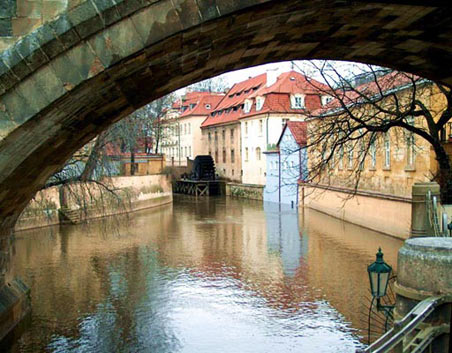
Kampa Island is located under the Charles Bridge and was at one time a renowned potters' market.  The staircase leading to Kampa Island underneath the bridge is from 1844.

During the day, the pedestrian only bridge is occupied by many artists and musicians.  Charles Bridge Museum, opened in June 2007 to celebrate 650th anniversary of the bridge's construction, is located next to the foot of the bridge from the Old Town side.

A great time of day to come to the bridge is at sunset when you can enjoy a breathtaking view of the fully lit Prague Castle against the evening sky.

The bridge made a Hollywood appearance in the movie Mission: Impossible.

This short documentary video (3:29) sums it up pretty well.  And take a walking tour with Karl in this video (6:12) on the Charles Bridge.