Thursday, August 30, 2012

Berlin – 775th Birthday!


Nikolai Church
Berlin, the capital city of Germany, is hosting its 775th birthday celebration this August 25-October 28, 2012 commemorating the finding of the first documentation dated 28 October 1237 which reveals the existence of Berlin’s sister city Cölln.  The anniversary culminates with the jubilee festival October 28.

Berlin and Cölln were originally two tiny villages on either side of the Spree River which later grew into trading centers.  They were destroyed during the Thirty Years’ War, but celebrated a cultural re-emergence under Prussian rulers Friedrich Wilhelm I and his successor, Frederick the Great.

A unique addition to the city for the celebration includes a large (VERY large) scale 1:775 outdoor ground map of 18th century Berlin recently installed on Museum Island, a UNESCO World Heritage site located on the Spree River. 

There are five museums on Museum Island, some recently restored, which cover more than 6,000 years of culture and art.

The city will set up a system of temporary guided paths to lead visitors through an historical walk through medieval Berlin and her sister city Cölln.  Recent excavations and preserved documents will help paint a picture of the double city in the Middle Ages.

The exhibits on display include findings made in January 2010 during excavations for the U-Bahn in front of the Red Town Hall, two churches, and sites along the city walls.  Excavations have recently discovered a 13th century drinking well, a 16th century belt clasp, a 17th century key, and the remains of a medieval Latin school.

A highlight of the celebration will be to feature the 800 years of immigration and cultural diversity in a variety of exhibits.

The Berlin Nikolai Church will also be celebrating its 800th anniversary this year as the oldest parish church in Berlin.  It was recently completely renovated and will be the site of the finale of the October 28 jubilee.

Tuesday, August 14, 2012

Tip - Collapsible Water Bottles


Two of our travelers gave me this tip about an inexpensive collapsible water bottle that will be great for travel.  The cost – only $1 at Dollar Tree!  Can’t get any better than that! 

According to the Dollar Tree web site: “It is the ideal water bottle for people on the go!  When empty, the plastic water bottle completely collapses and folds for easy travel and packing.  Fill it up and it stands on its own, plus it has a metal carabiner for easy attaching to bikes, bags, and more.  Plus, it’s top-rack dishwasher safe and reusable, made of FDA-approved BPA-free plastic.”

The bottles hold over 16 ounces (I measured! and that’s 17.5 ounces according to the package).  It has a sip-top lid and cap, and comes in assorted colors according to what is available at the Dollar Tree you visit: pink, orange, red, yellow, green, blue, yellow designed, and black designed.  You can also order cases of 36 from their web site for the same price at $36 for the case plus shipping.

I decided to test them out this week and bought several in a variety of colors.  I’ve carried one to work and so far it has worked exactly as advertised.  I’ve seen other collapsible water bottles advertised, but the prices are $5 - $10 each and over.  You can’t go wrong with a dollar. 

As a traveler, you can fold and put into your carry on, backpack, purse, or pocket or hook it to a handle.  Once through security at the airport, fill it at the water fountain.  Its shape is also conducive to fitting in the seat back pockets of cars and planes.  Also you could fill with about a cup of water and put in the freezer (remember it will expand) and pull out whenever you’re ready to go somewhere and have cold water as it melts.

Great for travel, stocking stuffers, summertime gifts for friends or your child’s soccer or football team, outdoor jobs and gardening, school or work, on your kid’s belt loop at an amusement park, and on bike rides. Would love to hear your comments if you have other ideas.

To be fair, there are some drawbacks.  They do not fit in round cup holders, it usually takes two hands to tip and drink (it’s flexible, remember), it perspires if cold (and so does my regular water bottle and tea glass!), and I doubt it has a lifetime guarantee!

But again, for a dollar you can buy several, pack several, and have a spare if something goes wrong.  For traveling when you need to conserve space in your luggage and weight of the baggage, these look to be a good idea.

Thursday, August 2, 2012

Berlin - Brandenburg Gate


The most recognizable site in Berlin has to be the famous Brandenburg Gate (Brandenburger Tor) located on Pariser Platz (Paris Plaza).  As the national symbol of Germany, during the Cold War, it stood between East and West Germany as part of the impassable Berlin Wall. It is the only remaining gate of a series through which Berlin was once entered. 

The Gate closed when the Berlin Wall was built in 1961, but reopened in 1989 when the Berlin Wall fell following a peaceful revolution that ended the Cold War and again united the country.  It now stands as a symbol of a reunified Germany.

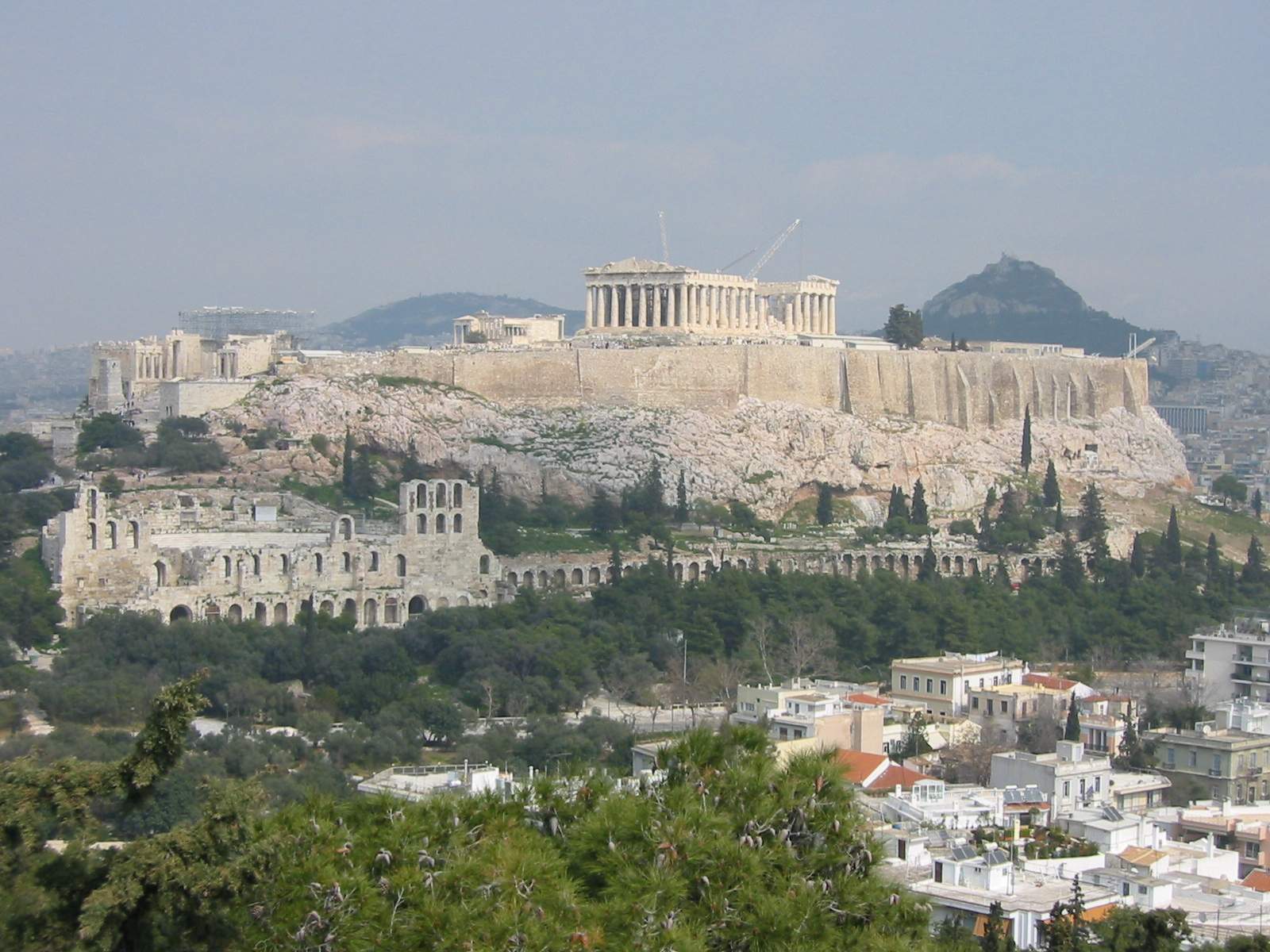
Commissioned by Friedrich Wilhelm II to represent peace, the Gate was designed by Karl Gotthard Langhans.  Built in 1791 in a design based on the Propylaea, the gateway to the Acropolis in Athens, it served as the grand entrance to the boulevard “Unter den Linden” leading to the palace of the Prussian monarchs before the destruction of the city castle.  The bas-reliefs of scenes from Greek mythology took another four years to complete. 

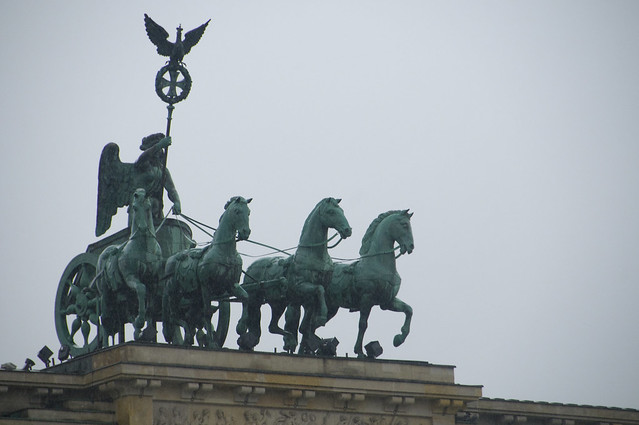
The Gate has twelve columns, six on the entrance side and six on the exit.  The columns form roadways, and citizens originally were allowed to use only the outer two.  Only the royal family was allowed to pass through the central archway.  The Gate was topped in 1793 by the bronze Quadriga, a four-horsed chariot driven by Victoria, the winged goddess of victory, which faces east.

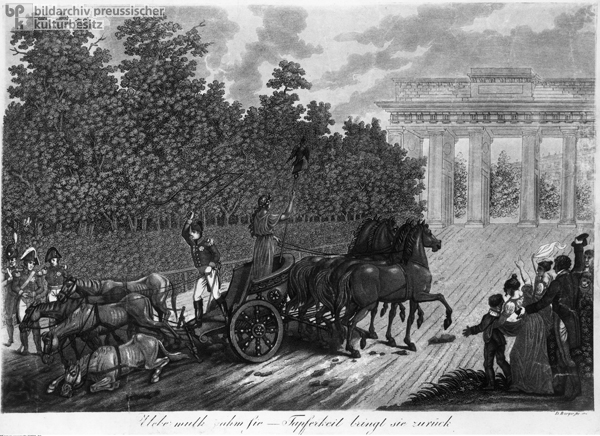
The Brandenburg Gate has witnessed much in history.  During the Napoleonic Wars in 1806, Napoleon took the Quadriga sculpture back to Paris as a war trophy.  After the Battle of Waterloo, it was returned to Berlin as a symbol of victory.

And it was through the Brandenburg Gate in 1933 that Nazismarched to celebrate Hitler’s rise to power.  Heavilydamaged during World War II, the Brandenburg Gate was refurbished in 2000 and reopened to the public in December 2002.  In June 1987, President Ronald Reagan made his famousspeech at the Gate and urged, “Mr. Gorbachev, tear down this wall!”

Some of the Gate’s most beautiful photographs are ones shot at night as it is lighted against the evening sky. This 360degree panorama of Pariser Plaza and the Brandenburg Gate is gorgeous.  It does need Java to run, but my computer had a popup to click “Run this time” and it worked.  The widescreen view is the best.

This BBC documentary about bringing down the Berlin Wall, “BBC Brandenburg Gate,” (2:14) is quite informative.  This video is an interesting modern and historical perspective of the gate and shows it from various views, “Carl Gotthard Langhans: Brandenburg Gate, Berlin” (4:00).

Thursday, July 26, 2012

Krakow - Wawel Cathedral and Castle


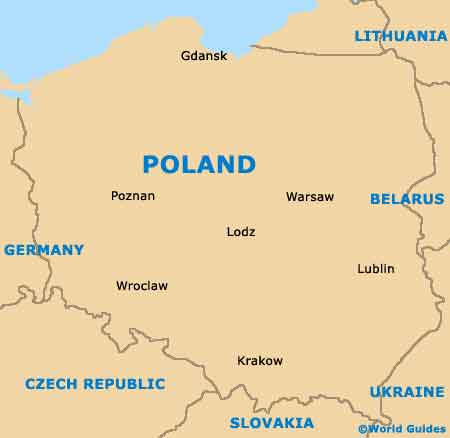
In the 16th century, Poland was one of the few countries to resist change from the Reformation to become one of the most prominent countries in Europe in the early 17th century.  But less than 200 years later, Poland had ceased to exist swallowed up by Prussia, Russia, and the Austro-Hungarian Empire.

While soldiers lived in the royal palaces, the crown jewels were melted down.  From 1797 until the Warsaw Pact was dissolved in 1991, Poland celebrated only two decades of independence from 1921-1939.

Throughout its tumultuous history, only two entities served to stabilize and unite Krakow – the second oldest university in central Europe and Wawel Cathedral and Castle atop Wawel Hill (pronounced Vavel).  Both serve as iconic symbols of all that is Poland. 

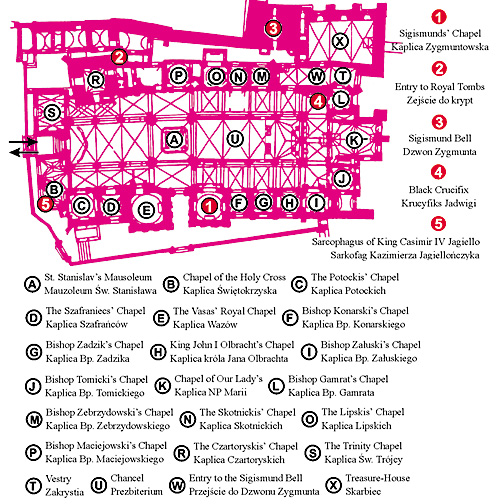
Wawel Cathedral overlooks the River Vistula and is the burial place of 41 of the 45 Polish monarchs, and the cathedral is a shrine to Stanislaw, an early bishop of Krakow who was executed in 1079 for his part in a rebellion against King Boleslaw.  His silver coffin held up by four silver angels lies beneath a black marble canopy at the main altar

Most of the buildings in the complex date from the 14th century, although the 18 elaborate side chapels were added later and it is there where the majority of the memorials to the monarchs are located including those of the two responsible for the cathedral’s creation: Wladyslaw the Short and Kazimierz the Great (made of red marble.)

One of the most interesting stories is of the most magnificent chapel – the Zygmunt, or Sigismund, chapelKing Sigismund, designed the chapel as a mausoleum for his Jagiellon dynasty, which ruled Poland for over 200 years.  However, his wife poisoned the first two wives of their only son before they could produce an heir.  Even though their son, Sigismund Augustus II, remarried, he was so distraught that he never consummated the marriage.  King Sigismund’s daughter, Anna, became the last of the Jagiellon dynasty.

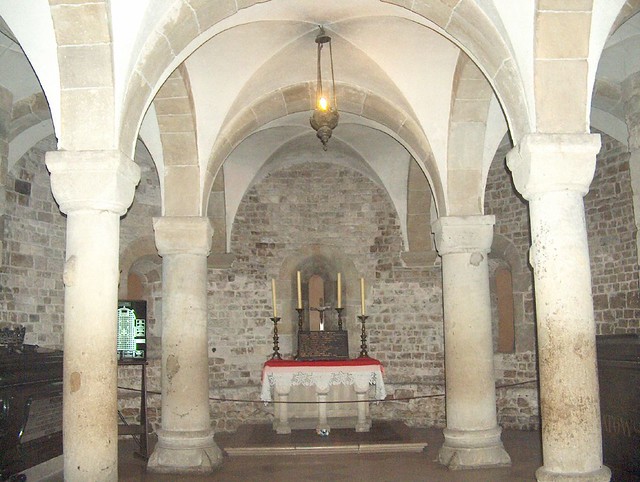
The underground Saint Leonard’s Crypt is a mausoleum for royals and national heroes.  This brief history of the Wavel Cathedral from the official web site is excellent and has great photos.

The cathedral roof boasts three towers, one containing the great Zygmunt Bell from 1520, still rung on special occasions.  This video “Krakow – Royal Sigismund Bell” (0:44) gives you a short tour in the bell tower.  For a wonderfully complete guide to print to use while touring Warwel Cathedral, go here as it describes each chapel in detail.

Father Karol Wojtyla, later to become Pope John Paul II, said his first Mass in the crypt of Wawel Cathedral on 3 November 1946.  Seventeen years later, he took over the cathedral as Archbishop of Krakow.  Fifteen years after that, he led the entire Roman Catholic world as Pope.

Also atop Wawel Hill is the gothic castle which is heavily influenced by Italian Renaissance style.  The three tiers of galleries enclose a courtyard where one can see the noted Hen’s Foot Tower and the Danish Tower.

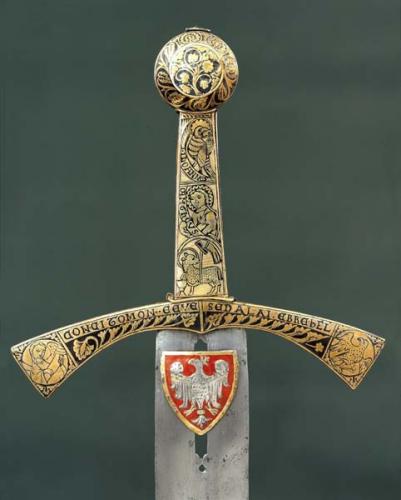
Very little is left of the crown jewels, but the most important is the sword of state, or Szczerbiec, used since the 13th century in coronation ceremonies in Wawel Cathedral.  This site will tell in detail the various rooms and exhibitions in the royal castle.  Click on each of the tabs for more information.  This might be a good guide to print to use on tour.   This site also has some very nice photos.

Legend says that a fierce dragon once lived in a lair at the foot of Wawel Hill and was slain by the hero Krak, the founder of Krakow

This video of “Wawel Castle in Krakow  - Crakow Life” (1:40) gives a brief overview of outside the castle and cathedral.

Wednesday, July 18, 2012

Krakow - Auschwitz and Birkenau


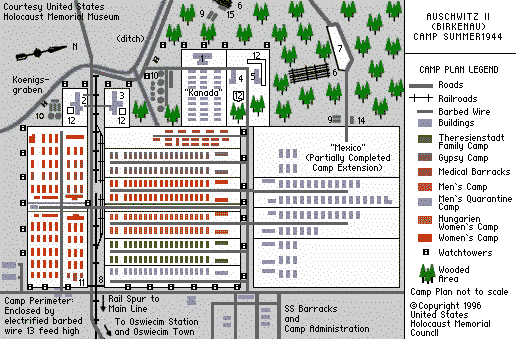
Located in Poland near the city of Krakow, these two Nazi concentration camps, also known as Auschwitz I and Auschwitz II, were the scene of one of Hitler’s worst crimes in World War II.  Here over one million men, women, and children lost their lives.

Auschwitz was actually a network of concentration camps consisting of Auschwitz I (the base camp), Auschwitz II or Birkenau (an extermination camp), Auschwitz III or Buna-Monowitz (a labor camp), and 45 satellite camps.

From early 1942 to late 1944, transport trains delivered Jews to Birkenau’s gas chambers from all over Nazi-occupied Europe.  Although Jews were not the only ones imprisoned here, around 90 percent of those who died were of Jewish descent.  On 27 January 1945, the Soviets liberated the Auschwitz camps.

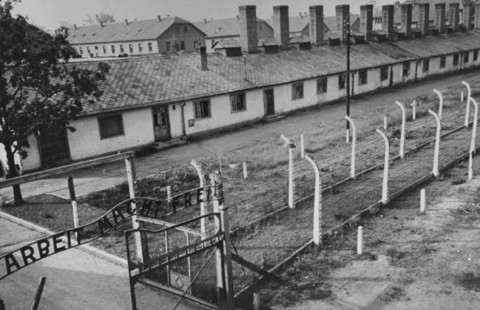
Prisoners entered the camp through iron gates topped with the infamous motto “Arbeit macht frei” (Work makes free) believing they were entering a labor camp.  But in addition to hard labor, prisoners were subjected to inhumane medical experiments and death.

This site from AwesomeStories.com, Auschwitz: Place of Horrors, tells the story using primary source photos and documents.

Today, the Auschwitz-Birkenau Memorial and Museum stands as a testament to those who lost their lives in one of history’s worst atrocities.  It consists of the extensive grounds and original camp blocks, barracks and guard towers, in addition to exhibits of personal possessions belonging to the millions who were brought here.

Also on exhibit are items depicting the life of prisoners while in the camp, as well as SS items belonging to the perpetrators left behind in the camp after liberation.

The museum’s collection of art associated with Auschwitz-Birkenau is the largest of its kind in the world.  These works made by the prisoners show the emotional stress endured by those prisoners every day and gives us an insight into what life must have been like for those who endured the hardships.

Some of the art was “commissioned” by camp officials, while much of the art was made secretly by the prisoners upon threat of harsh punishment if caught.  The Lagermuseum was a “special” museum that exhibited the plunder from the people deported to the camps.  In addition, there are many postwar art pieces created by former prisoners.

To view some historical photos and documents housed in the museum’s archives, click here.  Each icon is a sub-category.  Click on each sub-category for a full viewing.

Romanian-born Jewish American Elie Wiesel, Nobel Peace Prize winner, wrote a book called Night about his experiences in Auschwitz.  I have read it and it is truly thought provoking.  It will give depth and meaning to your visit if read before our departure.

This special documentary, “Oprah and Elie Wiesel at Auschwitz Part 1,” (9:59) gives you an idea of the camp from the perspective of a man who truly lived the experience.  This “Video Tour of Auschwitz-Birkenau” (14:49) will show you the camps. (Word of warning: some graphic images at the beginning.)

The 1993 movie Schindler’s List starring Liam Neeson depicts a Nazi German businessman who helped save thousands of Polish-Jews near Krakow by employing them in his factory.

A visit to the Auschwitz site is a very sobering experience meant to remind us that we must learn from history.  As philosopher George Santayana said, “Those who cannot remember the past are condemned to repeat it.”

Friday, July 13, 2012

Really Cool Travel Photos


Sometimes it is just plain fun to look at exceptional travel photos.  This first site is a slide show from Budget Travel entitled “25 Most Photographed Places.” The really cool feature to this slide show is that after each photo of a cool place, there will be another photo of the same place but from a unique perspective, position, lighting, etc.

So go through the entire slide show, take note of the tips, practice up on your photographic techniques this coming year and be ready to take some awesome pictures! (Note: #23 is the Brandenburg Gate in Berlin and my favorite is #38—way cool!)

The next site is absolutely breathtaking photography!  It is 360 degree aerial 3D photography by AirPano of some of the most unique sites in the world.  You simply have to see them to appreciate the clarity.  They were taken with a miniature aerial helicopter equipped with a camera.

Unfortunately not one is of any of the sites on our upcoming tour, but if you’ve traveled with me before you will recognize several and perhaps others you have traveled to yourself.  Just click on the triangle inside the circle and move your mouse in all directions.  Click on iPhone or iPad if you are viewing in those formats. (Note: I found it worked easier on the iPad.)

Panoramas DK is unbelievable!  It has SO many wonderful places to visit.  Again not many from where we are touring except for Berlin Potsdamer Platz.  You really must look at Versailles Hall of Mirrors France.  It’s almost like walking the hall again!  And use your mouse to scroll up and view the fabulous ceilings! (Note: You will need QuickTime to view this site.)

This site, 360 cities, has a panorama view of Prague.  There’s also one of Auschwitz-Birkenau.  Scroll down on this site to see other panorama views at the concentration camp.

Interested in creating your own panorama?  Here are 8 tips on how to do just that.  Autostitch is a free panorama software download. With only 11 months left before we leave for Eastern Europe, you’ve got a little time to practice!

Tuesday, June 26, 2012

Prague - Charles Bridge


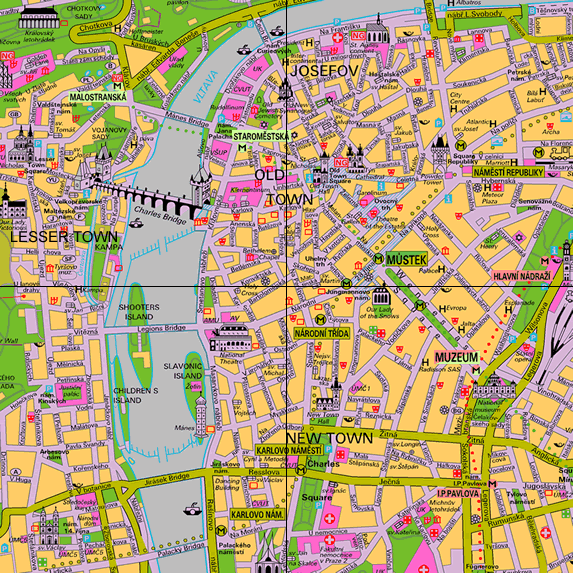
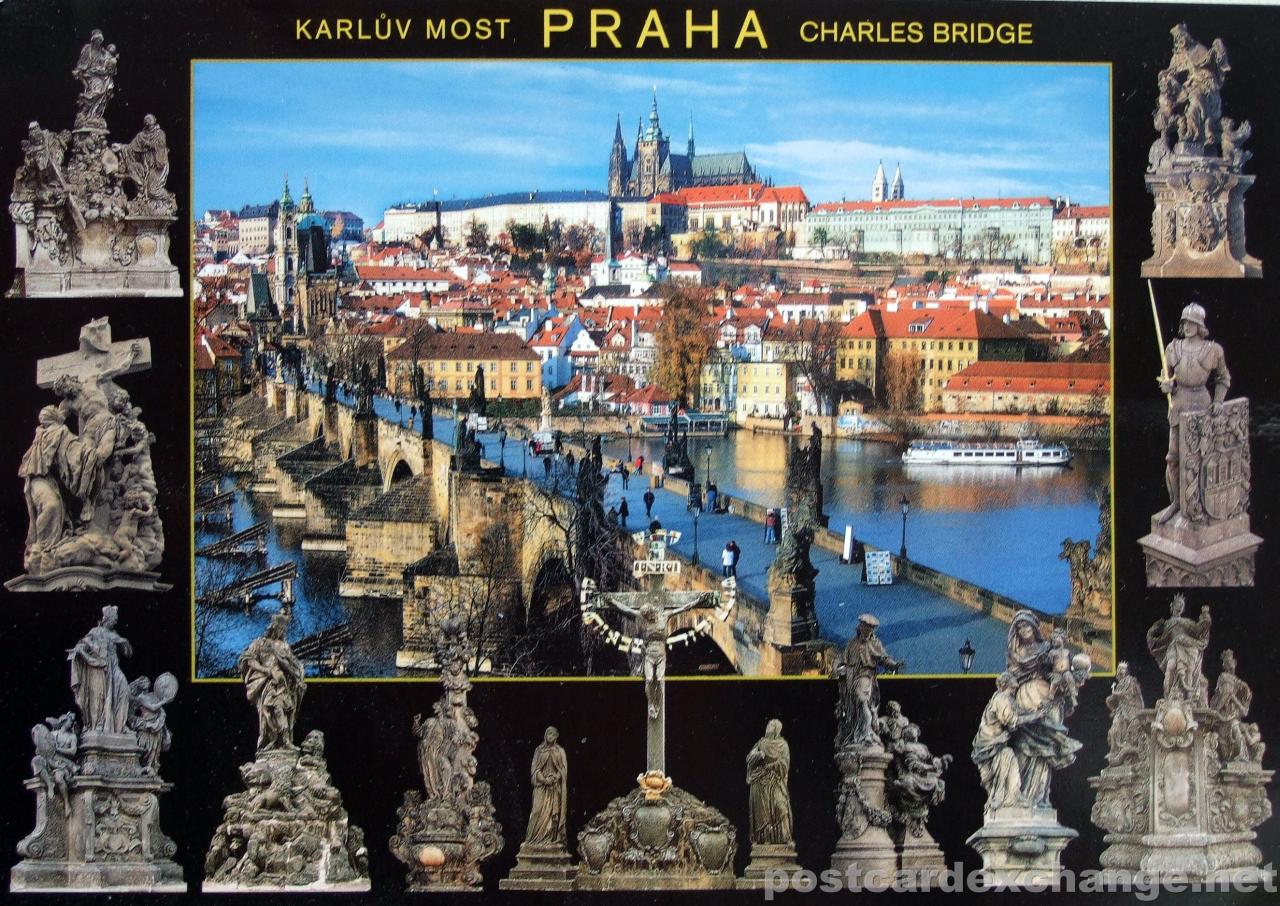
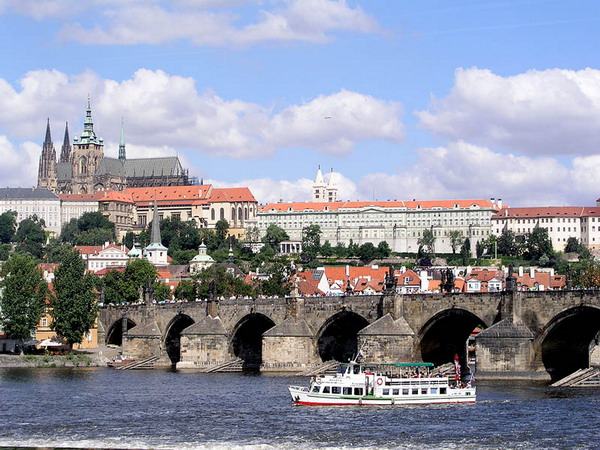
The famous Charles Bridge, which connects Old Town with Lesser Quarter (or Mala Strana) and Prague Castle, is the oldest bridge in Prague, Czech Republic.  Built between the 14 th and 15 th century, it crosses the Vltava River and is lined on both sides with a total of 30 baroque statues, mostly from the 18th century, standing on parapets.

Originally known as the Prague Bridge, it was renamed after Holy Roman Emperor Charles IV, who laid the foundation stone at a very unique, and calculated, time – 135797531 (in 1357 on the 9th day of the 7th month at 5:31 a.m.). It is 520 m long and 10 m wide and boasts 16 arches. The bridge is fortified at both ends by three towers, two of them on the Lesser Quarter side and the third one on the Old Town side

 In charge of the construction was architect Petr Parléř whose other works include the St. Vitus Cathedral at the Prague Castle. It is said that egg yolks were mixed into the mortar to strengthen the construction of the bridge, although this has not been proven.

The original wooden bridge was destroyed by floods in the 11th century and in 1172, Wenceslas I built the stone Judith Bridge named for his wife, but it was destroyed in the 1342 flood. The bridge was damaged by several other floods over the centuries, including ones in 1784, 1890, and 2002.

Most of the statues were damaged by floods over the centuries and replaced by replicas. The originals can be seen in the Lapidary of the National Museum.

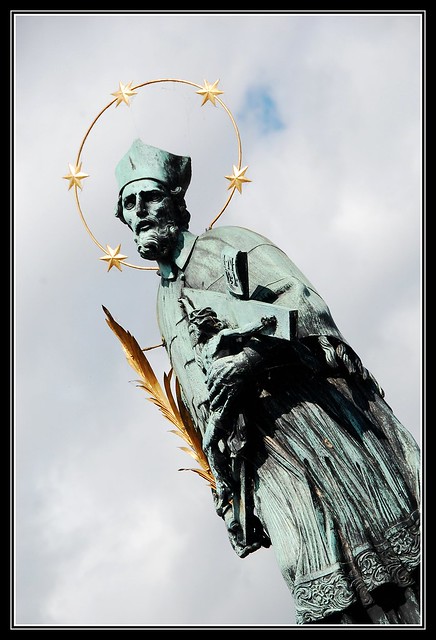
One of the most famous statues is of St. John Nepomuk whose tomb is in St. Vitus Cathedral.  It is the oldest statue on the bridge dating from 1683.  The shiny gold part you see in the photo link is where people rub it thinking it will bring good luck.

St. John of Nepomuk was a parson, who refused to betray a secret, confided to him by Queen Sophia, to the king Wenceslas IV. He was tortured on the king´s demand and then thrown to the river Vltava from the Charles Bridge in 1393. 

The five stars allegedly appeared above the river after the martyr was thrown there. They are supposed to symbolize the five letters of the Latin word “tacet”, which means “silent”. There is a brass cross with five stars at the place on the parapet where he was thrown into the river.
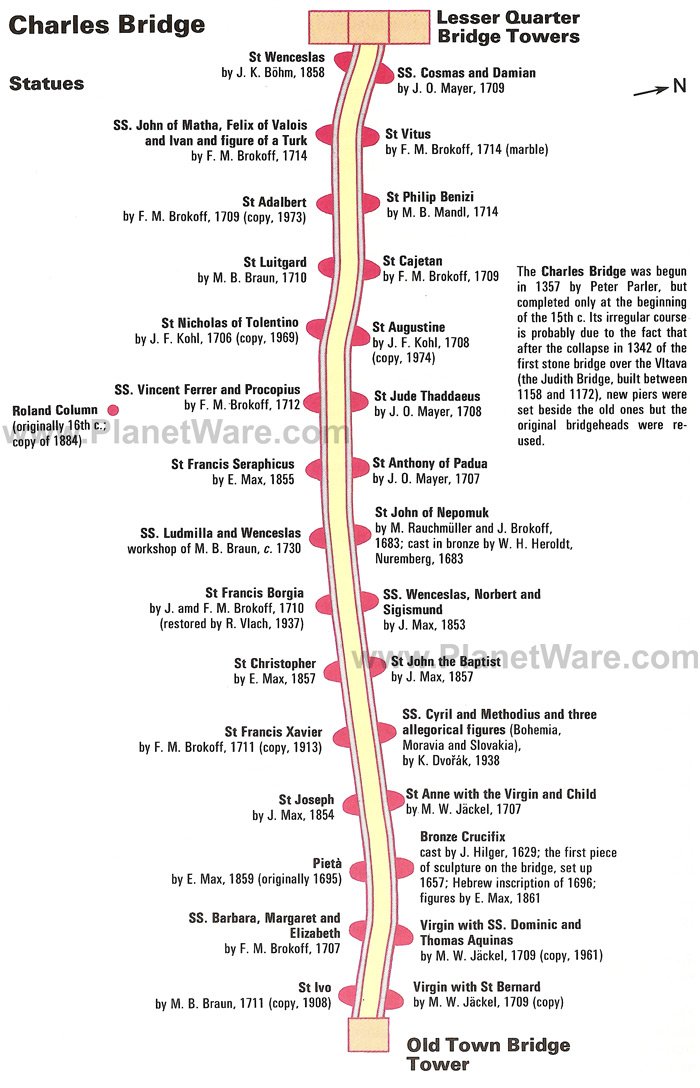
Statues on the left hand of the bridge from the Old Town bridge tower:
  1. St. Ivo
  2. St. Barbara, St. Margaret and St. Elizabeth
  3. Pieta
  4. St. Joseph
  5. St. Francis Xaverius
  6. St. Christopher
  7. St. Francis Borgias
  8. St. Ludmila
  9. St. Francis Seraphic
  10. St. Vincent of Ferrara and St. Procope
  11. St. Nicolas of Tolentino
  12. St. Luitgarda
  13. St. Adalbert
  14. Statuary of St. John of Matha, St. Felix of Valois and St. Ivan
  15. St. Wenceslas
Statues on the right hand of the bridge from the Old Town bridge tower:
  1. St. Bernard
  2. St. Thomas Aquinas and St. Dominique
  3. Statuary of St. Cross - Calvary
  4. St. Anna
  5. St. Cyril and St. Method
  6. St. John the Baptist
  7. Sts. Norbert, Wenceslas and Sigismond
  8. St. John of Nepomuk
  9. St. Anthony of Padua
  10. St. Judas Thaddeus
  11. St. Augustine
  12. St. Cajetan
  13. St. Philip Benicius
  14. St. Vitus
  15. St. Kosma and St. Damian
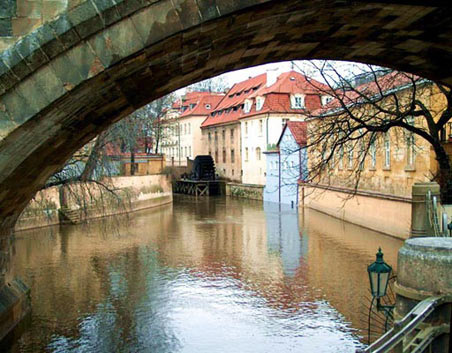
Kampa Island is located under the Charles Bridge and was at one time a renowned potters' market.  The staircase leading to Kampa Island underneath the bridge is from 1844.

During the day, the pedestrian only bridge is occupied by many artists and musicians.  Charles Bridge Museum, opened in June 2007 to celebrate 650th anniversary of the bridge's construction, is located next to the foot of the bridge from the Old Town side.

A great time of day to come to the bridge is at sunset when you can enjoy a breathtaking view of the fully lit Prague Castle against the evening sky.

The bridge made a Hollywood appearance in the movie Mission: Impossible.

This short documentary video (3:29) sums it up pretty well.  And take a walking tour with Karl in this video (6:12) on the Charles Bridge.