Saturday, February 28, 2015

The Burren in Western Ireland

Rolling hills of The Burren
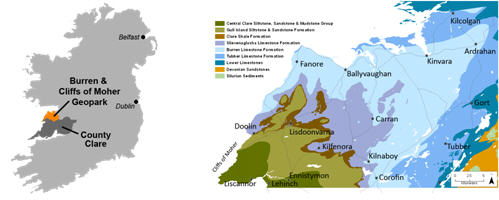
 Not far from the Cliffs of Moher in the west of Ireland lies The Burren, or "Boíreann" meaning a rocky place.  And it is that indeed...close to 125 square miles of limestone rock covering imposing majestic mountains and tranquil valleys with gently meandering streams.  Geologists marvel at underground rivers, caves, depressions, plateaus, and other fascinating geological formations.

Formed millions of years ago under a tropical sea and later carved by glaciers, the flowing ice rounded the hills and left deposits of huge boulders and criss-crossing cracks known as "grikes."  This erosion process left a barren landscape, however it has been referred to in the past as "fertile rock" due to the mixture of nutrient rich herb and floral species.   

In 1651, a Cromwellian Army Officer named Edmund Ludlow remarked, "of this barony it is said that it is a country where there is not water enough to drown a man, wood enough to hang one, nor earth enough to bury them. This last is so scarce that the inhabitants steal it from one another and yet their cattle are very fat. The grass grows in tufts of earth of two or three foot square which lies between the limestone rocks and is very sweet and nourishing."

The Burren region is internationally famous for its landscape and diverse flora.  Summer visits treat the visitor to a colorful array of plants and flowers.  Over 600 different flowering plants have been recorded in the Burren.  Arctic, alpine, and Mediterranean plants thrive side-by-side.

Megalithic tomb - Poulnabrone
The area is also known for more than 90 megalithic tombs, monuments, and ring forts, older than the Egyptian pyramids.  One of the more famous megalithic tombs, the portal dolmen at Poulnabrone, dates back to around 2,500 BC.  'Dolmen' is Breton for 'table', which is what a dolmen looks like - a large capstone on two or three standing stones.

The ring forts also testify to human presence on the Burren, among them the triple ring fort Cahercommaun on the edge of an inland cliff, and the exceptionally well-preserved Caherconnell Stone Fort.

A stop at the Burren Vistor Centre in the picturesque village of Kilfenora, Ireland’s first interpretive centre, presents a 12-minute film that introduces the visitor to this unique and fascinating region.  The exhibition area enables the visitor to experience the development of the Burren and its civilization from formation 320 million years ago to how the Burren is today.

The centre also hosts a celebration of traditional Irish music dedicated to the history and music of  The Kilfenora Céilí Band.

Enjoy this overview video of The Burren (6:39).


Friday, February 20, 2015

The Cliffs of Moher--Ireland

Cliffs of Moher and O'Brien's Tower
One of the most well-known natural wonders in Ireland are the amazing Cliffs of Moher on the island’s western coast which tower over 700 feet above the Atlantic and stretch for over five miles.  Situated in County Clare on the southwestern edge of the Burren region, the towering cliffs were carved by time, ocean, and weather…and the erosion process continues.

On a clear day, one can see from the Aran Islands and Galway in the north to the Dingle Peninsula and Blasket Islands in the south.  O’Brien’s Tower stands near the highest point of the cliffs and has served as a viewpoint for visitors for hundreds of years.  The round stone tower stands midpoint of the cliffs with trails along the edge.

The cliffs were formed millions of years ago when heavy rainfall on land created great floods that washed sand and mud into ancient rivers and then out to sea.  The cliffs are forever changing as the sea constantly erodes the cliffs from the bottom creating caves and sea stacks.

One of the most well-known sea stacks, Branaunmore at the foot of the Cliffs of Moher and below O’Brien’s Tower, stands 220 feet high.  Further west along the coast a number of sea caves have eroded.  One was featured in the 2009 movie Harry Potter and the Half Blood Prince.

Several other movies have been filmed in and around the Cliffs of Moher including The Princess Bride (1987), Ryan’s Daughter (1970), and The Guns of Navarone (1961).

Cliff's of Moher
Human presence on the cliffs dates back to the first century BC when a fort called Moher stood where the modern Moher Tower now stands at its southernmost point near Hag’s Head.  Steeped in legend two thousand years ago, the cliffs have served mankind as a place of lookout, fishing, quarrying, collecting eggs and feathers…and in the last few hundred years as a tourist destination.

Lucky visitors to the cliffs are occasionally treated to traditional Irish music when various individuals and groups perform…anything from the Celtic harp to lively Irish jigs and reels.

The Cliffs of Moher Visitor Experience built into a hillside provides an in-depth look at the area, and O’Brien’s Tower lies just to the south of this visitor centre.  The tower was built in 1835 by Cornelius O’Brien, a descendant of Brian Boru, the High King of Ireland.

O’Brien was a local landowner and a man ahead of his time.  He believed that the development of tourism could benefit the economy and bring the Irish people out of poverty.

Most likely our visit will not take us on a walking tour along the entire Cliffs of Moher (5:12) as seen in this video, but watching it shows some of the fantastic views along its stretch.  Planning Your Visit to the Cliffs of Moher (7:10) video is excellent to give you an overview of access to the visitor centre and the cliffs near it.


Thursday, February 5, 2015

Ulster-American Folk Park, Northern Ireland

Authentic food tasting at Ulster-American Folk Park
Whether your ancestors were Irish emigrants or not, Ulster-American Folk Park is a fascinating place to spend the day.  Located outside of Castletown in the western part of Northern Ireland, this open air museum allows visitors to be transported back in time and experience the life of 18th and 19th century Irish emigrants.

Characters in period costumes guide visitors from the thatched cottages of Ulster through a full-scale emigration ship to the log cabins of the American frontier.  This unique experience acquaints the visitor with native crafts, authentic food, and tales of the period.

The indoor exhibition explains the life of these emigrants, the reasons for leaving their native Ireland, and how they adapted to a new land.  The outdoor museum brings to life these people’s daily routines and activities in both the Old and New Worlds.

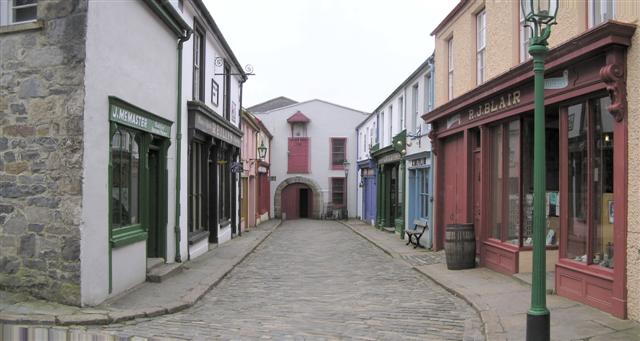
An Ulster street has been recreated with original shop fronts as well as an American street, all connected by a “walk-through” of a dockside full size galley and ship, the Brig Union.  Visitors are often offered a taste of some local foods, such as smoked salmon and bread cooked in the cottages that line the route.

Visitors also learn about crafts and trades of the era including blacksmithing, coopering, cobbler, clay pipes, wheelwright, and saddler.

The park contains about thirty buildings—some are re-creations while others are painstakingly restored originals, such as the Mellon Homestead, the birthplace of Irish-American banker and lawyer Thomas Mellon.  The home and outbuildings remain in their original location.

Centering around the Mellon home, the Old World section features whole streets of original houses, an original printing press, a bank, an old police barracks, the old Castletown National School, and two churches

The New World section features a tinsmith display and the original interior of a Virginia General Store.  Several original American buildings have been relocated to the park including the 1720s Fulton stone house from Lancaster County, Pennsylvania; the 1830 West Virginia home of Richard McCallister removed from Cabell County; and a brick plantation house built by Frances Rogan in the early 1800s in Nashville, Tennessee.

Together they give the visitor a glimpse into the struggles these early emigrants faced before, during, and after a strenuous Atlantic crossing.

Open year-round, the park celebrates various holidays with special events.  Even though, you might not get to visit around these holidays, see what’s happening daily by following them on Facebook!  They regularly post current pictures.

Enjoy this quick video tour of Ulster-American Folk Park (3:46).

This documentary, Out of Ireland: The Story of Irish Emigration to America (1:51:52), tells the story of the Ulster Irish journey to America.

The Ulster-American Folk Park is part of National Museums Northern Ireland, which also includes Ulster Museum, Ulster Folk and Transport Museum, the W5 Science Centre, and Armagh County Museum, all located in various parts of Northern Ireland.

If you would like to search for your Irish ancestors, try these genealogy sites:

Street view at Ulster-American Folk Park


Thursday, January 29, 2015

Time to Get Your Passport Ready!

You could travel to Europe without new clothes, guidebooks, or even a toothbrush, but there is no way you can even get on the plane without a passport! It is THE one essential that everyone must have.

If you already have a passport, then check the expiration date. It must be good for at least 6 months after our return. Some countries will not allow you to enter if you do not have six months left on your passport.

In other words, your expiration date must be AFTER December 2015.  If not you will need to renew before departure. Adult passports are good for 10 years.

If you do not have a passport at all, then you need to start the process now to obtain one. Whether you are getting a new one or renewing an old one…do not procrastinate, start now. Currently it takes at least 6 weeks to process a passport application.

NEW PASSPORT
Passports are obtained from the U.S. Department of State, but must be applied for locally in person at the district clerk’s office or post office. You will need a certified (stamped with a seal) copy of your birth certificate from the county where you were born. This can be obtained from the county clerk's office where you were born or the Vital Statistics Office in the state where you were born.

As of 1 April 2011, the U.S. Department of State requires the full names of the applicant’s parent(s)to be listed on all certified birth certificates to be considered as primary evidence of U.S. citizenship for all passport applicants, regardless of age. Certified birth certificates missing this information will not be acceptable as evidence of citizenship.

In addition to this requirement, certified copies of birth certificates must also include the following information to be considered acceptable primary evidence of U.S. citizenship:
·         Full name of the applicant
·         Date of birth
·         Place of birth
·         Raised, embossed, impressed or multicolored seal of issuing authority
·         Registrar’s signature
·         The date the certificate was filed with the registrar’s office (must be within one year)

If you cannot obtain a birth certificate that meets these requirements, please see Secondary Evidence of U.S. Citizenship.

You will need to do the following:

If you are a first time applicant then you must apply for your passport in person at the district clerk's office or post office. Go here to find the closest office. Check with your local offices for complete instructions. Here is a link to the district clerk’s office here in Ellis County, Texas to give you an idea.

Here we must provide a completed passport application which is available online, 2 passport quality photos (from CVS, Walgreens, etc.), certified copy of your birth certificate, your social security card or number, your driver's license or another state issued photo ID, and the fees ($110 cash or money order for the application and $25 cash for local processing fees). You can pay an extra fee to expedite the process, but save the money by starting early.

RENEW PASSPORT
If your passport is already out of date or if it will not be valid through December 2015 then you must renew your passport.  Passports may be renewed by mail by sending your old passport, application, and fees following the directions provided by the State Dept. 

You must complete Form DS-82: Application for a U.S. Passport by Mail.  Send the completed and signed form, your most recent passport, one passport photo stapled in the space provided on the application, and current fees ($110 for adult passport book).  You will also need to send a marriage certificate or court order if your current name does not match your passport name.

Again, don’t procrastinate!  Make getting your passport in proper order your trip priority now.

Saturday, January 17, 2015

The Exmouth Castle--The Wreck of an Irish Emigrant Ship

The Irish emigrant ship Exmouth Castle foundered off the Isle of Islay on the northwest coast of Scotland Wednesday 28 April 1847 enroute from Londonderry in Northern Ireland to Quebec killing 250 people on board, making it the worst peacetime tragedy of Islay area wrecks

She had sailed with a crew of 11, three middle class female cabin passengers, and 240 emigrant farmer and tradesmen families in steerage who were fleeing the Great Irish Potato Famine.  Many were women and children who were headed to Quebec to meet husbands who had already settled there.

The vessel was registered for 165 passengers, but as there were many under age, two children counted as one adult under regulations of the period, and there were only about 60 men aboard.

The ship set sail on Sunday 25 April when a terrible storm blew up on Monday afternoon after losing sight of land damaging the sails.  The damage became worse as the storm continued into Tuesday. 

In an effort to bring the ship into harbor for repairs, the captain mistook a flashing light for a stationary one late Tuesday night, and the ship was dashed upon the jagged rocks along the shores of Islay in the early hours of Wednesday morning, her passengers entombed below deck during the inclement weather.  It is little wonder these early emigrant ships were called “coffin ships.”

Only three members of the crew survived to tell the story.  One of them, William Roach, wrote a song about the tragedy called The Wreck of the Brig Exmouth.  Here also is a recording of Peggy Earl, whose great-grandmother saw some of the bodies washed ashore, including the children.  Only 108 bodies were recovered and buried on the island.

This first-hand account of the wreck, “Shipwreck on the Coast of Islay,” was printed in the Glasgow Herald on 5 May 1847.

A memorial at Sanaigmore Bay now stands on Islay as a remembrance of those who lost their lives in the tragedy.  On a clear day, one can look from the shores of Northern Ireland across the expanse of ocean toward the Isle of Islay where the terrible tragedy occurred.
Memorial on the Isle of Islay remembering those who died in the wreck of the Exmouth Castle

Friday, January 9, 2015

Ancient Church Ruins of St. Cuthbert, Northern Ireland

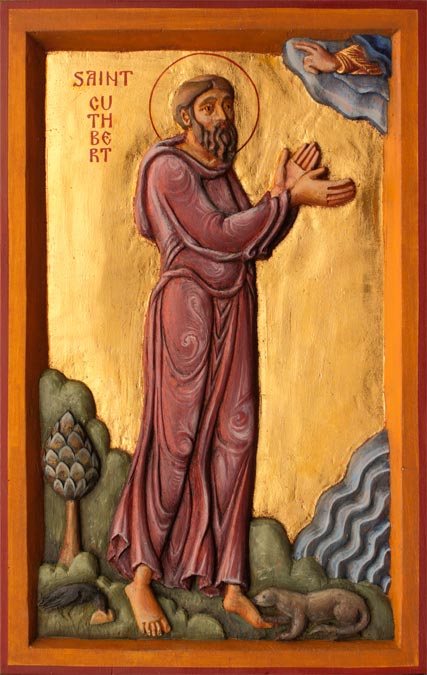
About a half mile from Dunluce Castle, on Ballytober Road, are the ancient church ruins of St. Cuthbert’s, named for the Northumbrian monk.  Built on the site of a much older medieval church, it was completed in the late 1630s. 

Lady Katherine Manners, wife of the first Earl of Antrim Randall McDonnell and widow of the late Marquess of Buckingham, is credited with building, or at least completely renovating, the church.  Although both the Earl and Countess were Catholic, they provided a place of worship for the Protestant settlers in the area—a rarity for church tolerance in the region.

The church was originally thatched and the white ceiling, according to memoirs of the time, was painted with signs of the zodiac.  It served the Parish of Dunluce from 1622-1821 when the new Church of St. John the Baptist was built in BushmillsSt. Cuthbert’s was then unroofed, as was the custom, and the contents sold at auction. 

The first known vicar of St. Cuthbert’s was a William Wallace from 1622-35, who served Dunluce, Portcaman, Ardclinis, and Derrykeighan, where he resided.  In 1634, it was recorded that he was contemplating moving to New England.

Using the headstones in the graveyard at St. Cuthbert’s, historians have pieced together some of the backgrounds of the inhabitants of the merchant village of Dunluce located near the castle, as well as the surrounding parish. 

The oldest readable stone is from 1630 and marks the burial site of two of the children of Walter Kidd, a merchant of Dunluce and Burgess of Irvine.  To read inscriptions on all the headstones, go here. (Scroll down to ‘Kid’ and read the actual inscription.)

It seems the Kidd family has kept records of their Irish ancestor and for a fascinating read on Walter and his family and profession, go to this genealogical document and scroll down to page 17.

The Ireland Genealogy Project Archives also has photos and texts of many of the stones in the cemetery.

La Girona banknote
Local folklore tells of sailors and noblemen buried in the open part of this cemetery to the south of the church in 1588.  They died when their ill-fated Spanish Armada Girona floundered off the coast near Dunluce at Port na Spaniagh (or the Bay of the Spanish).  Indeed, Earl Randall McDonnell mounted cannons taken from the wreckage on the Dunluce Castle parapets as well as possessed other artifacts from the ship.

Interestingly, the wreck of the Girona was simply a local tale told for 400 years until 1967 when Belgian diver and treasure hunter Robert Stenuit discovered the sunken warship off Lacada Point.

Another artifact at St. Cuthbert’s said to have come from the shipwreck was a muniment chest used for manuscripts and religious purposes, although it is not extant.

Note: The relics of the Northumberland monk St. Cuthbert (635-687 AD) now lie in Durham Cathedral where they were brought after the Viking raid in 793 on the monastery on Lindisfarne, or Holy Island, off the northern coast of England.

St. Cuthbert's Church near Dunluce Castle

Tuesday, January 6, 2015

2015 -- 15 Tips for International Travelers


Travel Guru Rick Steves recently posted an article on his web site about 15 Travel Skills for 2015.  Those of you who have travelled with me before will recognize a few of them, but it is in everyone's best interest to have "the best perspective-broadening experiences and life-long memories," Steves says.  And to do that, he recommends strongly that we "travel smart."

Be sure to go to Rick Steves' link above and review his top 15 practical trips for travel.  Feel free to comment below if you want to add to any his tips.