Showing posts with label shipwreck. Show all posts

Saturday, January 17, 2015

The Exmouth Castle--The Wreck of an Irish Emigrant Ship

The Irish emigrant ship Exmouth Castle foundered off the Isle of Islay on the northwest coast of Scotland Wednesday 28 April 1847 enroute from Londonderry in Northern Ireland to Quebec killing 250 people on board, making it the worst peacetime tragedy of Islay area wrecks

She had sailed with a crew of 11, three middle class female cabin passengers, and 240 emigrant farmer and tradesmen families in steerage who were fleeing the Great Irish Potato Famine.  Many were women and children who were headed to Quebec to meet husbands who had already settled there.

The vessel was registered for 165 passengers, but as there were many under age, two children counted as one adult under regulations of the period, and there were only about 60 men aboard.

The ship set sail on Sunday 25 April when a terrible storm blew up on Monday afternoon after losing sight of land damaging the sails.  The damage became worse as the storm continued into Tuesday. 

In an effort to bring the ship into harbor for repairs, the captain mistook a flashing light for a stationary one late Tuesday night, and the ship was dashed upon the jagged rocks along the shores of Islay in the early hours of Wednesday morning, her passengers entombed below deck during the inclement weather.  It is little wonder these early emigrant ships were called “coffin ships.”

Only three members of the crew survived to tell the story.  One of them, William Roach, wrote a song about the tragedy called The Wreck of the Brig Exmouth.  Here also is a recording of Peggy Earl, whose great-grandmother saw some of the bodies washed ashore, including the children.  Only 108 bodies were recovered and buried on the island.

This first-hand account of the wreck, “Shipwreck on the Coast of Islay,” was printed in the Glasgow Herald on 5 May 1847.

A memorial at Sanaigmore Bay now stands on Islay as a remembrance of those who lost their lives in the tragedy.  On a clear day, one can look from the shores of Northern Ireland across the expanse of ocean toward the Isle of Islay where the terrible tragedy occurred.
Memorial on the Isle of Islay remembering those who died in the wreck of the Exmouth Castle

Friday, January 9, 2015

Ancient Church Ruins of St. Cuthbert, Northern Ireland

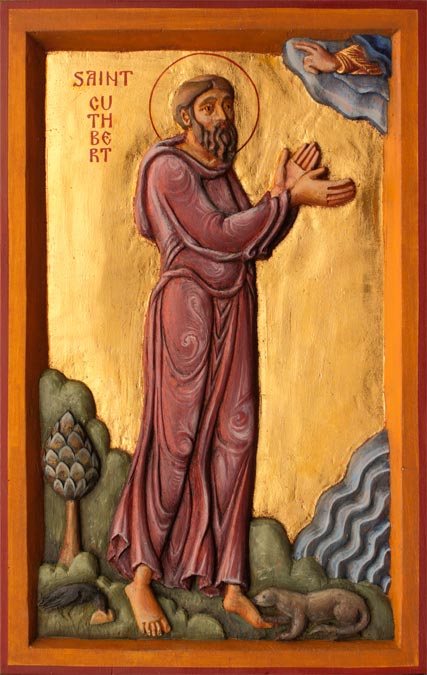
About a half mile from Dunluce Castle, on Ballytober Road, are the ancient church ruins of St. Cuthbert’s, named for the Northumbrian monk.  Built on the site of a much older medieval church, it was completed in the late 1630s. 

Lady Katherine Manners, wife of the first Earl of Antrim Randall McDonnell and widow of the late Marquess of Buckingham, is credited with building, or at least completely renovating, the church.  Although both the Earl and Countess were Catholic, they provided a place of worship for the Protestant settlers in the area—a rarity for church tolerance in the region.

The church was originally thatched and the white ceiling, according to memoirs of the time, was painted with signs of the zodiac.  It served the Parish of Dunluce from 1622-1821 when the new Church of St. John the Baptist was built in BushmillsSt. Cuthbert’s was then unroofed, as was the custom, and the contents sold at auction. 

The first known vicar of St. Cuthbert’s was a William Wallace from 1622-35, who served Dunluce, Portcaman, Ardclinis, and Derrykeighan, where he resided.  In 1634, it was recorded that he was contemplating moving to New England.

Using the headstones in the graveyard at St. Cuthbert’s, historians have pieced together some of the backgrounds of the inhabitants of the merchant village of Dunluce located near the castle, as well as the surrounding parish. 

The oldest readable stone is from 1630 and marks the burial site of two of the children of Walter Kidd, a merchant of Dunluce and Burgess of Irvine.  To read inscriptions on all the headstones, go here. (Scroll down to ‘Kid’ and read the actual inscription.)

It seems the Kidd family has kept records of their Irish ancestor and for a fascinating read on Walter and his family and profession, go to this genealogical document and scroll down to page 17.

The Ireland Genealogy Project Archives also has photos and texts of many of the stones in the cemetery.

La Girona banknote
Local folklore tells of sailors and noblemen buried in the open part of this cemetery to the south of the church in 1588.  They died when their ill-fated Spanish Armada Girona floundered off the coast near Dunluce at Port na Spaniagh (or the Bay of the Spanish).  Indeed, Earl Randall McDonnell mounted cannons taken from the wreckage on the Dunluce Castle parapets as well as possessed other artifacts from the ship.

Interestingly, the wreck of the Girona was simply a local tale told for 400 years until 1967 when Belgian diver and treasure hunter Robert Stenuit discovered the sunken warship off Lacada Point.

Another artifact at St. Cuthbert’s said to have come from the shipwreck was a muniment chest used for manuscripts and religious purposes, although it is not extant.

Note: The relics of the Northumberland monk St. Cuthbert (635-687 AD) now lie in Durham Cathedral where they were brought after the Viking raid in 793 on the monastery on Lindisfarne, or Holy Island, off the northern coast of England.

St. Cuthbert's Church near Dunluce Castle