Sunday, January 6, 2013

Getting Your Passport

Getting Your Passport
You could travel to Europe without new clothes, guidebooks, or even a toothbrush, but there is no way you can even get on the plane without a passport! It is THE one essential that everyone must have.

If you already have a passport, then check the expiration date. It must be good for at least 6 months after our return. Some countries will not allow you to enter if you do not have six months left on your passport.

In other words, your expiration date must be AFTER December 2013.  If not you will need to renew before departure. Adult passports are good for 10 years.

If you do not have a passport at all, then you need to start the process now to obtain one. Whether you are getting a new one or renewing an old one…do not procrastinate, start now. Currently it takes at least 6 weeks to process a passport application.

NEW PASSPORT
Passports are obtained from the U.S. Department of State, but must be applied for locally in person at the district clerk’s office or post office. You will need a certified (stamped with a seal) copy of your birth certificate from the county where you were born. This can be obtained from the county clerk's office where you were born or the Vital Statistics Office in the state where you were born.

As of 1 April 2011, the U.S. Department of State requires the full names of the applicant’s parent(s) to be listed on all certified birth certificates to be considered as primary evidence of U.S. citizenship for all passport applicants, regardless of age. Certified birth certificates missing this information will not be acceptable as evidence of citizenship.

In addition to this requirement, certified copies of birth certificates must also include the following information to be considered acceptable primary evidence of U.S. citizenship:
·         Full name of the applicant
·         Date of birth
·         Place of birth
·         Raised, embossed, impressed or multicolored seal of issuing authority
·         Registrar’s signature
·         The date the certificate was filed with the registrar’s office (must be within one year)

If you cannot obtain a birth certificate that meets these requirements, please see Secondary Evidence of U.S. Citizenship.

You will need to do the following:

If you are a first time applicant then you must apply for your passport in person at the district clerk's office or post office. Go here to find the closest office. Check with your local offices for complete instructions. Here is a link to the district clerk’s office here in Ellis County, Texas to give you an idea.

Here we must provide a completed passport application which is available online, 2 passport quality photos (from CVS, Walgreens, etc.), certified copy of your birth certificate, your social security card or number, your driver's license or another state issued photo ID, and the fees ($110 for the application and $25 for local processing fees). You can pay an extra fee to expedite the process, but save the money by starting early.

RENEW PASSPORT
If your passport is already out of date or if it will not be valid through December 2013 then you must renew your passport.  Passports may be renewed by mail by sending your old passport, application, and fees following the directions provided by the State Dept. 

You must complete Form DS-82: Application for a U.S. Passport by Mail.  Send the completed and signed form, your most recent passport, one passport photo stapled in the space provided on the application, and current fees ($110 for adult passport book).  You will also need to send a marriage certificate or court order if your current name does not match your passport name.

Again, don’t procrastinate!  Make getting your passport in proper order your trip priority now.

Tuesday, November 20, 2012

The Berlin Wall

The Berlin Wall
One of the most iconic symbols of the Cold War was the infamous Berlin Wall which separated East and West Berlin from 1961 to 1989.

After World War II, Germany, and the city of Berlin, were divided into American, British, French, and Soviet zones with border crossings such as Checkpoint Charlie.  Relationships quickly disintegrated, and in 1949 the American, British, and French sectors became West Germany, while the Soviet sector became East Germany.

Since the city of Berlin was situated entirely in the Soviet zone, West Berlin became an island of democracy within Communist East Germany.

Between 1949 and 1960, 2.5 million refugees, half under the age of 25, fled East Germany.  Roughly half a million people crossed the borders between East and West Berlin daily allowing an opportunity for citizens to compare living conditions on both sides.  East Germany was on the brink of social and economic collapse.

So on the night of 13 August 1961, while most Berliners slept, the Communist party of the German Democratic Republic (GDR, or East Germany) stretched a barbed wire and concrete barricade between East and West Berlin.  Officially, the wall was meant to keep Western “fascists” out of East Germany.  Primarily, though, it served to stem mass defections from East to West. 

Between 1961 and 1988, over 100,000 people tried to escape across the wall which stretched almost 100 miles with an average height of 11.8 feet and wrapped entirely around West Berlin.


Indeed, these measures were major deterrents for escaping, but it is estimated that at least 5,000 managed to make it safely across the border.

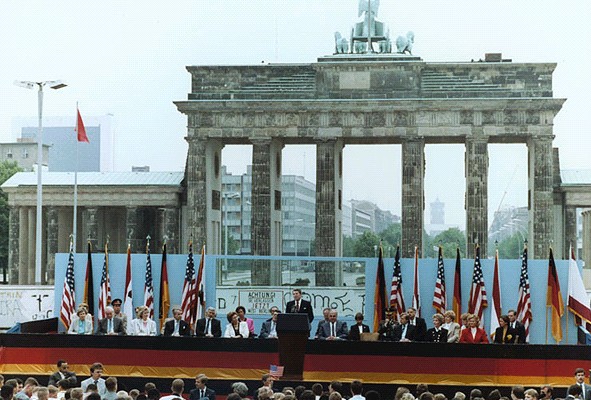
In a speech at the Brandenburg Gate celebrating the 750th anniversary of Berlin on 12 June 1987, US President Ronald Reagan challenged Soviet Communist leader Mikhail Gorbachev to “tear down this wall” in support of increasing freedom in the Eastern Bloc.

The Berlin Wall stood until 9 November 1989 when the head of the East German Communist party announced that citizens of the GDR could cross the border any time they wanted.  Many celebrated by crossing the wall and bringing hammers and picks to chip away the iconic barrier.

After the wall fell, East and West Germany once again unified and Germany became a single state once again on 3 October 1990.

On 13 August 1998, a memorial was erected along Bernauer Strasse where traces of the former strip have been preserved.

But don’t expect to see much of the 100-mile long wall as most of it has been chiseled away and carted off.  Not much remains of the once infamous wall.

Both sides of the wall were featured in the John le Carre book (1963) and movie (1965) The Spy Who Came in from the Cold.  You’ll find the full movie here (107:24) and here (112:00), but it requires a lot of buffer time to load.

Saturday, November 10, 2012

Dresden - Fine Porcelain

Dresden Lace

In 1708, Johann Friedrich Böttger discovered the secret of translucent white porcelain production.  He had been imprisoned by the Saxony ruler Augustus II the Strong because Böttger claimed he could make gold from raw materials. However, his discovery of how to produce “white gold” brought renown to the Saxony region.  The secret: baking the substance at high temperatures.

Dresden, Germany then became the hub of a prestigious porcelain decorating industry while the actual porcelain pieces were manufactured in nearby Meissen, Germany.  The first shop producing the luxurious porcelain started in Meissen in 1710 in a castle, as Augustus wanted a more secure location to protect this secret.

In 1872, the production of the fine china spread to Dresden with its first manufactory.  By the end of World War II, over 200 porcelain shops were located in Dresden.  Unfortunately, production came to a grinding halt with the Allied bombing of the city in 1945.

Dresden china can be recognized by markings on the bottom or back of the pieces.  Each piece is identified with the picture of a cobalt blue crown with a “D” or Dresden underneath.  Other markings denote which shop the piece was made in.

Meissen pieces are denoted with crossed blue swords.  The crossed swords represented Augustus II of Saxony who, as an admirer of fine porcelain made in China, encouraged the perfection of the making of German porcelain. 

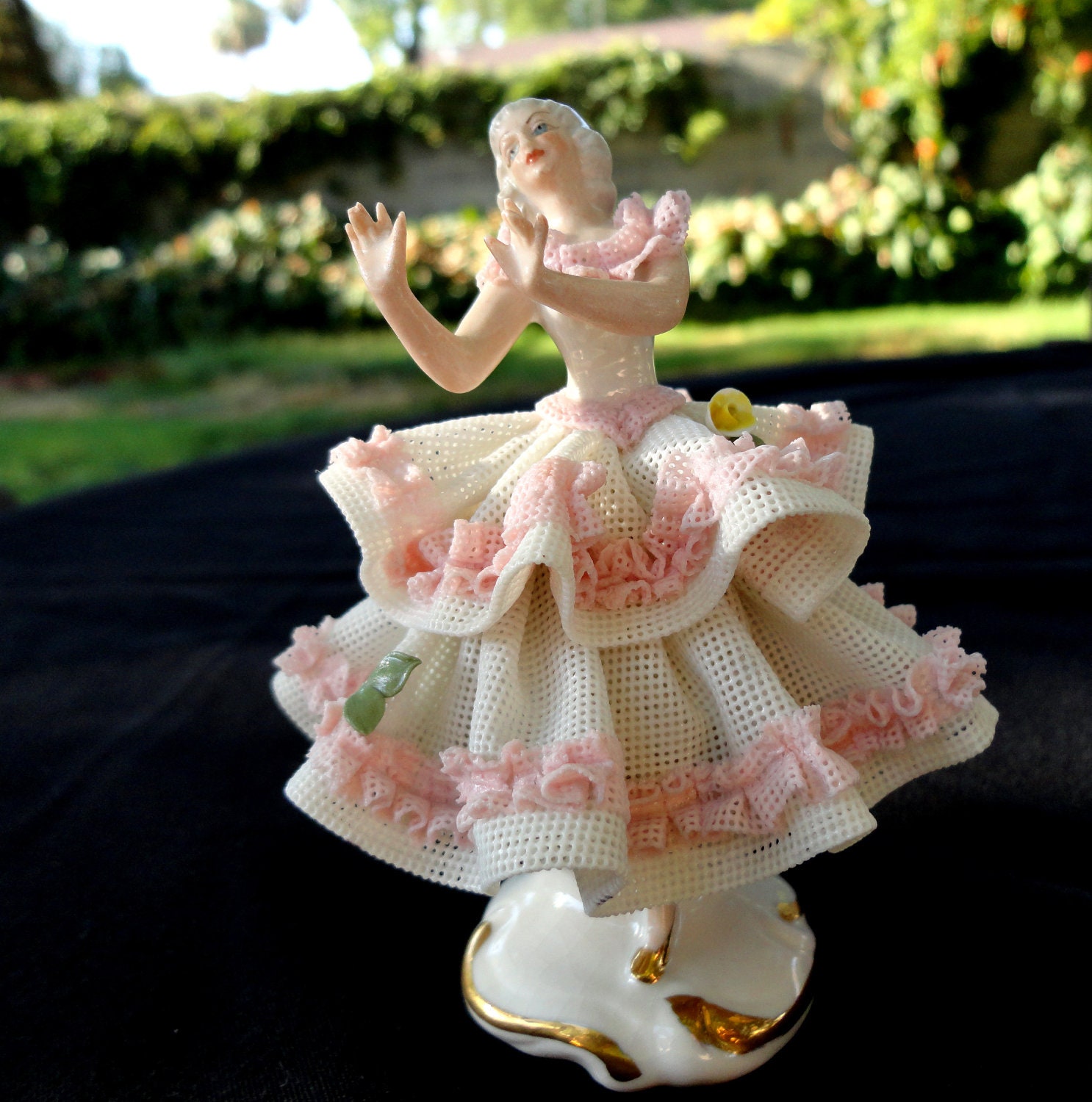
Dresden and Meissen porcelain factories were also famous for using “Dresden lace” on the figurines, a process in which real lace was dipped in liquid porcelain and then attached to porcelain ball gowns or ballerinas.  These figurines are extremely fragile and easily breakable.

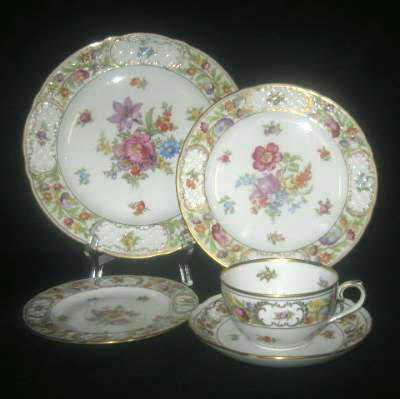
The Dresden design style features hand decorated plants, flowers, and fruits resembling the French Rococo style as well as gold gilding.  Designs were painted on place settings, serving pieces, and figurines.

The Dresden Porcelain Collection is part of the Staatliche Kunstsammlungen (State Art Collection) located in Zwinger Palace in Dresden.  The collection was founded by Augustus the Strong in 1715 and includes his collection of fine porcelain, some produced in China and some unique Dresden pieces. 

The collection largely survived the Allied bombings through evacuation procedures.  They have been on display at the Zwinger since 1962.

After Augustus’s death in 1733, Count von Bühl became Prime Minister and factory director and commissioned what has become known as the Swan Service, a unique place setting service of over 1,400 pieces.  The dinner plates are shaped like sea shells and adorned with swans.

One of Dresden’s most famous sites, the Procession of Princes, is an outdoor mural created entirely from porcelain.

Enjoy this video Meissen Porcelain Factory Dresden.  Watch as they make the porcelain and see the finished product.

Friday, November 2, 2012

Dresden, Germany

Dresden on the Elbe River

Prior to World War II, Dresden, Germany, the capital of Saxony, was known as the “Florence of the Elbe” because of the multitude of striking Baroque buildings along the beautiful Elbe River.

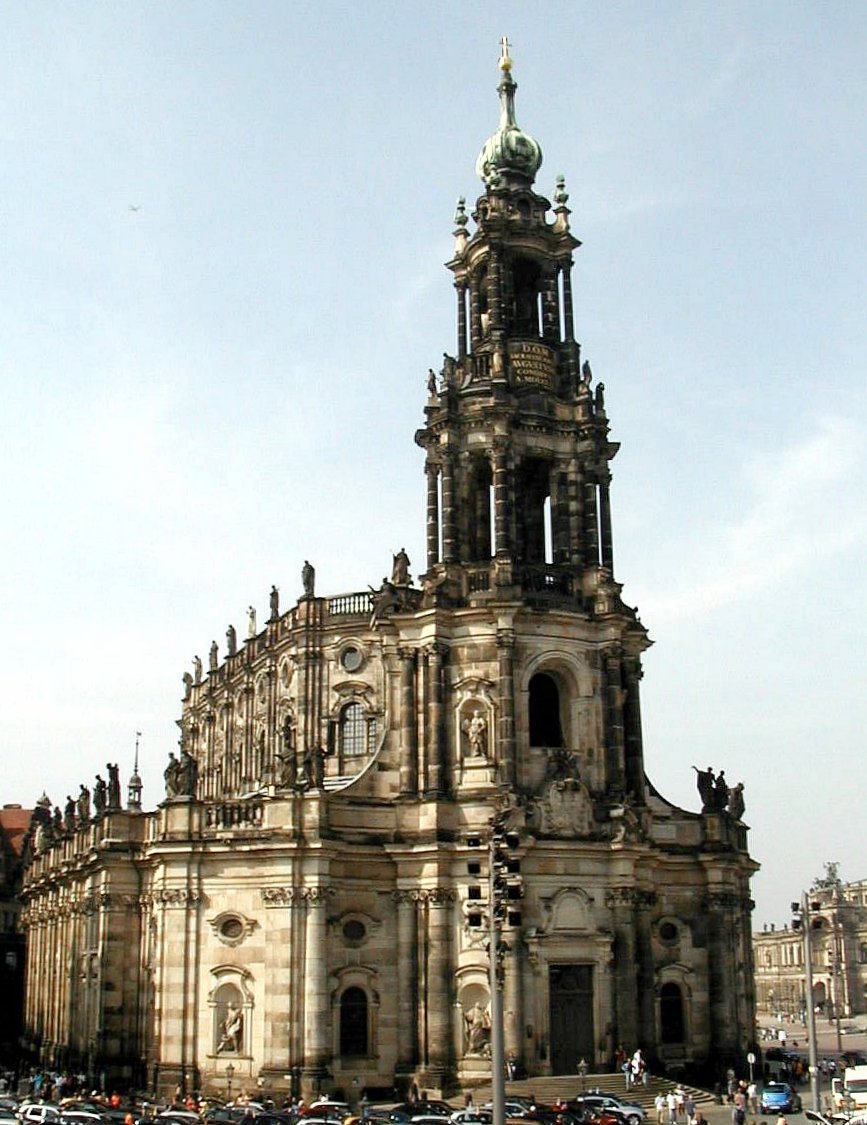
Dresden became a city in 1206 and celebrated its 800th birthday in 2006.  It gained this fame during the 18th century under Augustus the Strong and his son Augustus III.  Their vision produced many of Dresden’s iconic buildings including the Zwinger Palace, the Semper Oper (Opera House), the Lutheran Frauenkirche, and the Catholic Hofkirche.


Although Allied forces claimed the attack on the city was justified because of transportation and local factories serving German needs, the attack has drawn controversy over the years for destroying such a cultural center.

Today most of the city has been restored, although parts are still under reconstruction.  The most well-known of Dresden’s buildings, the Frauenkirche, which was completely destroyed, was restored in 2005 with its donated gold cross from the UK acting as a call to peace to all nations.

One Dresden icon, the 335-foot long outdoor mural entitled the Procession of Princes, depicts a parade of 35 rulers of the House of Wettin since 1127. Today the mural is made entirely of weatherproof ceramic tiles which replaced three earlier paintings which could not withstand the elements. Miraculously, the tiles survived the aerial bombing in 1945.

The Old Town area is one of the most popular tourist spots, but visitors will notice that many of the pre-war buildings still look black and burned—one of the few German cities, other than Berlin, that still shows evidence of WWII.

This site from the Library of Congress, shows numerous vintage photos of pre-war Dresden in all its glory, as well as photos of the devastated city. In particular, see Frauenkirche and New Market Square, 1930 and View of Dresden’s Newmarkt and the Frauenkirche, August 1949. And do look at the photo of the inside of the church. It is absolutely gorgeous!

This video, Beautiful Dresden – Bombed and Rebuilt, does an excellent job of telling Dresden’s story and providing a unique look at the city before and after restoration.

Literary note: Kurt Vonnegut, Jr. was in Dresden as a POW that fateful day in 1945. He later became a celebrated author writing his novel Slaughterhouse Five in 1969 about his experiences. It was made into a movie in 1972.

A TV movie entitled Dresden (2006) set against the historic bombing features a romance between a British pilot hiding in Germany and a German nurse.

Tuesday, October 23, 2012

Berlin - Checkpoint Charlie Museum

Checkpoint Charlie Museum
Founded by human rights activist Dr. Rainer Hildebrandt, Museum Haus am Checkpoint Charlie explores the history of the Berlin Wall and the stories of the people whose lives were affected by it.  It depicts objects used to get over, under, and through the Berlin Wall in their efforts to escape the so-called “best border security system in the world.”

Celebrating its 50th birthday, the museum also hosts a new exhibition tracing movements which have promoted human rights from 1800 onwards and how the struggle continues today.

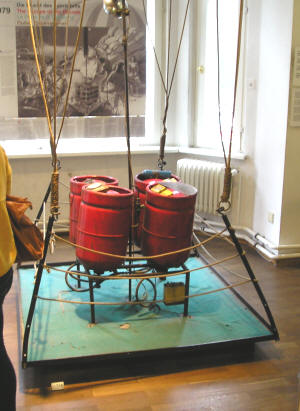
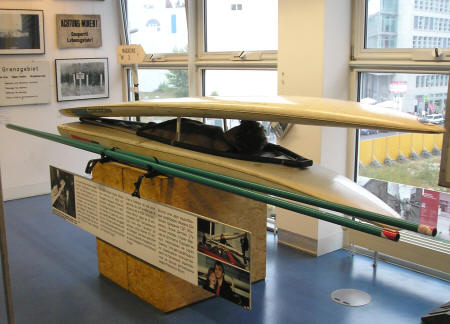
The permanent exhibit traces the history of the Berlin Wall.  On exhibit are some of the various deceptive means of escape including hot air balloons, escape cars, suitcases, homemade mini-subs, and even a cleverly hollowed out surfboard.

The human rights exhibit entitled From Gandhi to Walesa: Non-Violent Struggle for Human Rights Worldwide, features a diary and wooden sandals of Mahatma Gandhi as well as other artifacts. They also have the typewriter used to draft Charta 77, the hectograph from the illegal periodical Umweltblatter, and Elena Bonner's ‘death mask’ of partner Andrei Sacharov.

2012 also marks the opening of the new permanent NATO exhibit which charts the creation of NATO in 1949.

Originally opened in 1962 by Dr. Hildebrandt in two-and-a-half rooms to protest the newly erected Berlin Wall in 1961, its popularity outgrew its original location and it was moved to its present location at the Checkpoint Charlie border crossing in 1963.  Because of its location, the museum café became a popular meeting point to plan escapes.

Today the museum is run by Dr. Hildebrandt’s widow Alexandra following his death in 2004.  Although the Berlin Wall may have come down, many people in the world still face discrimination, persecution, and unlawful imprisonment, and the attention the museum draws to their cause is immeasurable.

Here are some excellent videos.  The first is narrated by Alexandra Hildebrandt called Checkpoint Charlie (2:08).  This one is a segment from travel guru Rick Steve's travel show on Berlin called Berlin, Germany: Checkpoint Charlie (1:21).  The third, Checkpoint Charlie Berlin (3:25), is also quite informative.

Wednesday, October 10, 2012

Budapest – Fisherman’s Bastion

Fisherman's Bastion
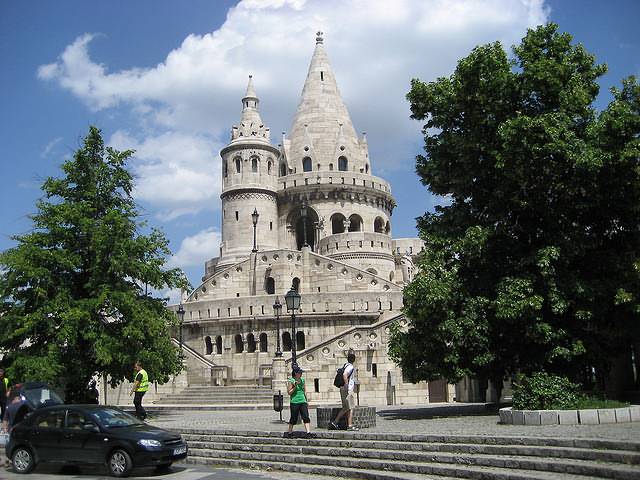
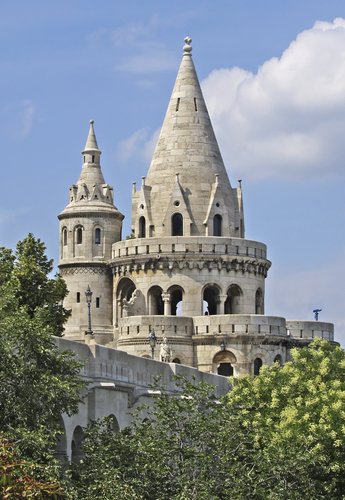
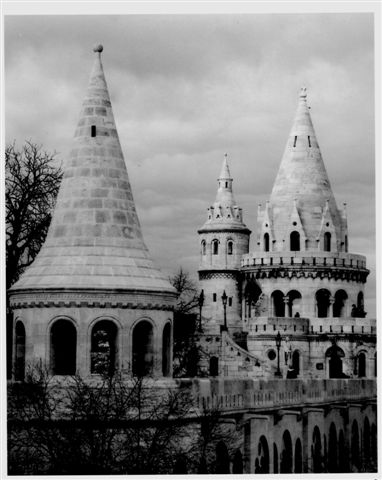
The great, white, fanciful building known as Fisherman’s Bastion (or Halaszbastya in Hungarian) is hard to miss while in Budapest, Hungary.  Even though the word “bastion” refers to a type of defense, this building was never used for that purpose.

Fisherman’s Bastion was built on Castle Hill (on the Buda side of the Danube River) around the turn of the 20th century by Frigyes Schulek in the neo-Gothic and neo-Romanesque style to celebrate the Hungarian millennium and is a relatively new building in terms of European architecture. 

Schulek’s son, Janos, performed the restoration of the building in 1947-48 after its near destruction in World War II.  Built of pale white stones, it is still a bright spot as time and smog have not taken its toll on the building and turned it black like so many older structures.

Built in a fanciful fairy tale castle design, it boasts seven turrets, each one representing one of the seven Magyar tribes that settled in the area in 896 AD.  The pointed turrets were designed to resemble the tents of the tribal leaders.

In medieval times, a fish market was nearby and legend says it was built on a spot where fishermen defended Castle Hill.

Today, Fisherman’s Bastion is a favorite lookout spot where visitors can look out over the Parliament, the Danube River and Pest (on the other side of the river).  The panoramic views are excellent on both the top and lower levels.

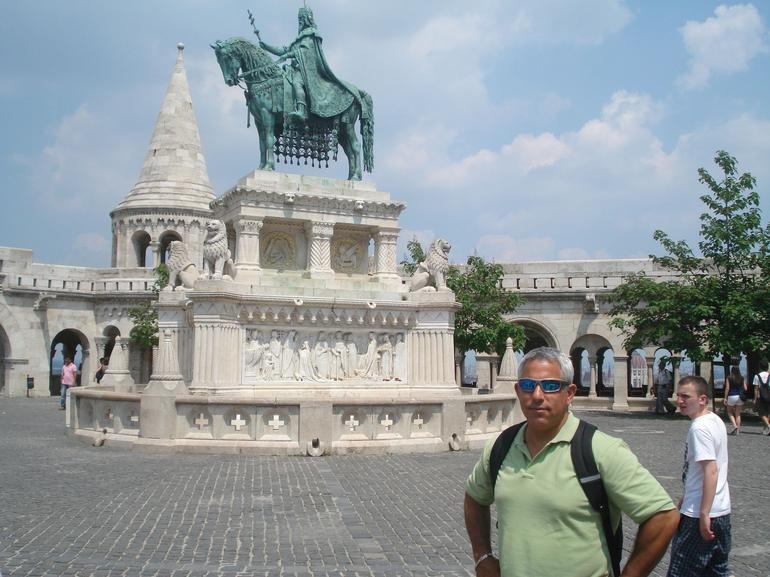
Located between Fisherman’s Bastion and Matthias Church is a mounted statue of King Stephen I, the first king of Hungary. He was declared a saint for bringing Christianity to Hungary.  He carries the apostolic cross with two crossbars – a symbol granted him by the Pope.

Fisherman’s Bastion was featured as a Pit Stop on the sixth season of The Amazing Race.

This short video Travel Hungary – Tour of Fisherman’s Bastion in Budapest (1:04) gives you a mini tour.

Friday, October 5, 2012

Tip – Buying a Digital Camera


Looking for a new digital camera?  It’s not as easy as just walking into the store and buying one.  There’s lots to consider – optical zoom, digital zoom, mega pixels, memory cards.  What does all this mean and which should make the most difference to me? 

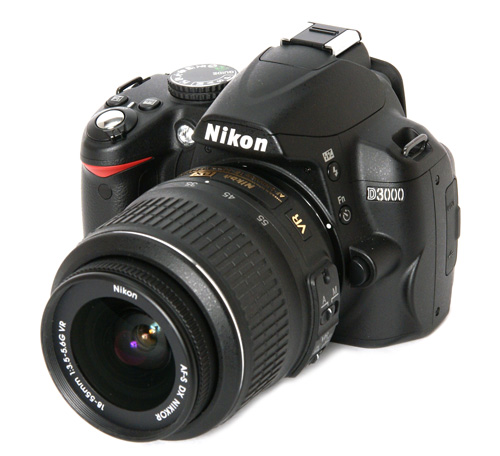
First I had to decide the type of camera I wanted: a point and shoot (does all the work for me and fits in my pocket) or digital SLR (a bulkier camera but you can interchange lenses to get very wide or extremely telephoto shots).  My criteria: compact, easy to use, point and shoot, affordable, and sharp clear photos. 

I discovered that mega pixels was a concern a few years ago, but now many point and shoots start at 10 mega pixels and go up to 16 mega pixels.  Mega pixels are all those little dots that make up a digital picture which determines resolution.  The fewer the dots and the larger the picture, the grainier the picture is. A 5mp to 8mp is good for the average shutterbug.

I found this helpful chart online that gives the minimum mega pixels for quality prints.

Max Print Size
Minimum MP
Resolution
4 x 6″
2 megapixels
1600 x 1200
5 x 7″
3 megapixels
2048 x 1536
8 x1 0″
5 megapixels
2560 x 1920
11 x 14″
6 megapixels
2816 x 2112
16 x 20″
8 megapixels
3264 x 2468
16 x 24″
12 megapixels
4200×2800

Next I discovered that the debate over digital zoom and optical zoom is unnecessary.  Ignore information about digital zoom in advertisements.  All it does is crop the image in the camera and you can do that yourself with your own software after the picture is taken.  Ask about how to turn off the digital zoom to maximize use of the optical zoom.

What you do want to pay attention to is the optical zoom which involves a physical lens magnification of the image you are photographing.  For example, 3x zoom will make your subject three times as big.  

Optical Zoom vs. Digital Zoom 
How much do you need?  2x-3x is good for photos of friends or family.  5x+ is best for outdoor scenery or architectural details.   7x+ may be needed for wildlife or sporting events.

Taking photos inside shadowy cathedrals or other low light locations is a concern for travelers so considering ISO (or light sensitivity rating) is important.  Look for an ISO that goes up to 1600.  Anything over that is unnecessary for most average photographers.

Other items to consider are the extras.  Check to see what kind of batteries the camera needs: regular AA, specialty, or rechargeable (and then a recharger is needed).  Also check to see what kind of memory card the camera uses - can you use the ones you already have, the price of replacements or size of cards, and whether or not they fit into your computer to upload photos.  My new laptop does not accept my old memory cards.

Also consider how your camera will upload photos to your computer – memory cards, USB cord, etc. 

A good web site to visit to compare various cameras is pricegrabber.com.  This is a good site to find the best deal on cameras (or on any item), and pay attention to the feedback ratings. 

Finally, if you are considering purchasing a new camera before our trip, don’t wait until the last minute.  Don’t let the trip be the first time you use your new camera.  You want to get it in plenty of time to practice with it extensively, learning all the little features, before we depart. 

You do not want to spend your trip trying to figure out what button to push or worse get discouraged and quit taking pictures altogether.  You will want to capture every memory.

Tip #1:  Here is a tip I’ve learned from personal experience.  I have found that the more times I transfer a photo, the lower the resolution or quality is when it finally gets printed.  For example, I take a photo with my camera, I transfer it to my computer, then I edit it in a software program, then I send it to Walgreens via the internet, and then they print it…the quality decreases with each transfer.

Now consider if the photo is taken on an iPhone, then goes through a text message, which gets saved onto another iPhone, that then gets put on FaceBook, then gets saved on someone’s iPad, and then emailed to the home computer to then edit in software, then sent online to a photo developer….whew!  Don’t laugh!  I’ve done this and been very disappointed with the end product.

Tip #2:  Many tourist spots, like the inside of cathedrals and museums, don’t allow inside photography.  Here are 3 possible solutions:  1) buy a postcard of the site as most are 4x6 size and fit right inside the photo album; 2) take pictures of postcards in the gift shop with camera’s macro setting; or 3) find the shot you are looking for on the internet, edit it for size in your software program, and print.  I’ve done all three and they all work great.

Tip #3: Planning to use your iPhone as your camera?  Here are some cool apps to enhance your photographs.  1) Photosynth (free) will stitch together your photos in a seamless panoramic image.  You can share 360 degree views with friends and family back home while you’re still enjoying the rest of your tour.  2) 100 Cameras in 1 ($1 or free for 20 effects) bundles filters, effects, and overlays.  3) Splice (free) allows you to take several still photos and videos and splice together to make one continuous video.