Showing posts with label palace. Show all posts

Tuesday, April 25, 2017

Drottningholm Palace -- Stockholm, Sweden

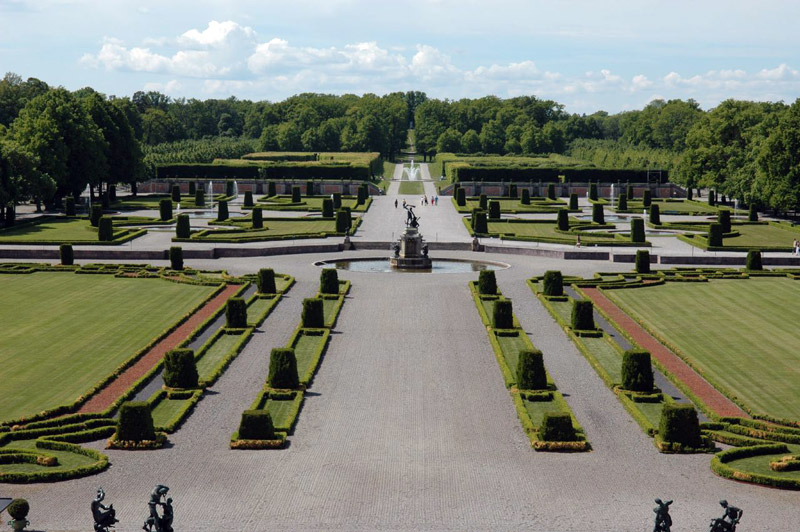
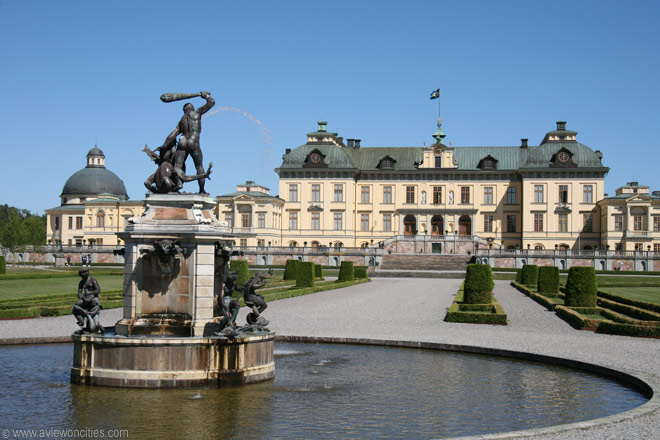
Drottningholm Palace is the private resident palace of the royal family of Sweden and a UNESCO’s World Heritage Site since 1991.  Built in the French style in the 1600s and patterned after Versailles, it is located on the island of Lovön in Drottningholm outside of Stockholm.
Drottningholm Palace

The rooms in the southern wing are reserved for Their Majesties the King and Queen, but the rest of the palace and grounds are open to the public year round.

The palace was built by architect Nidocemus Tessin the Elder for Queen Hedvig Eleonora, but succeeding monarchs have changed it to fit their own taste and style.  Notable rooms are the bedchamber of Queen Hedvig and others pictured on this site.

The Royal Chapel was inaugurated in May 1746 where royal events have been held for over 250 years.  The Museum de Vries, housed in the old dragoon stables, features original bronze statues from Dutch sculpture Adriaen de Vries, booty that was captured and brought to Sweden in the 1700s.

Although the palace was mostly abandoned during the 1800s, it received much restoration during the 20th century.

Drottningholm Park
The Palace Park, which has undergone many changes over the years, was established during the reign of Johan III, and at that time it was primarily a utility park where the parking lot is now.  The oldest, or baroque, garden, the one closest to the palace, dates from the time of Queen Hedvig and designed by architect Tessin and his son after French gardens which were strict and symmetrical.

At the center of the park stands the grand Hercules fountain with bronze sculptures by de Vries.  The seven cascades, a liberal free interpretation of the original Tessin cascades, lie on either side of the center avenue.

In the mid-1700s, the symmetrical design began to be abandoned for a more natural park design.  Large aviaries were built, but only one remains. Gustav III brought in this design patterned after English gardens.

The Chinese Pavilion and the Palace Theatre are separate buildings that may be seen as you stroll on the palace grounds, but require a separate admission fee to enter.

To reach the palace, cross Lake Mälaren on a century-old steamer.  Travel time is 50 minutes.  There is a restaurant on board the steamer, but riders must purchase food, not drinks only, to sit in there.  Sometimes the boat is crowded in peak season and there may not be enough seating for all passengers.  If the weather is pleasant, standing outdoors would make a memorable scenic journey.

Wednesday, March 16, 2011

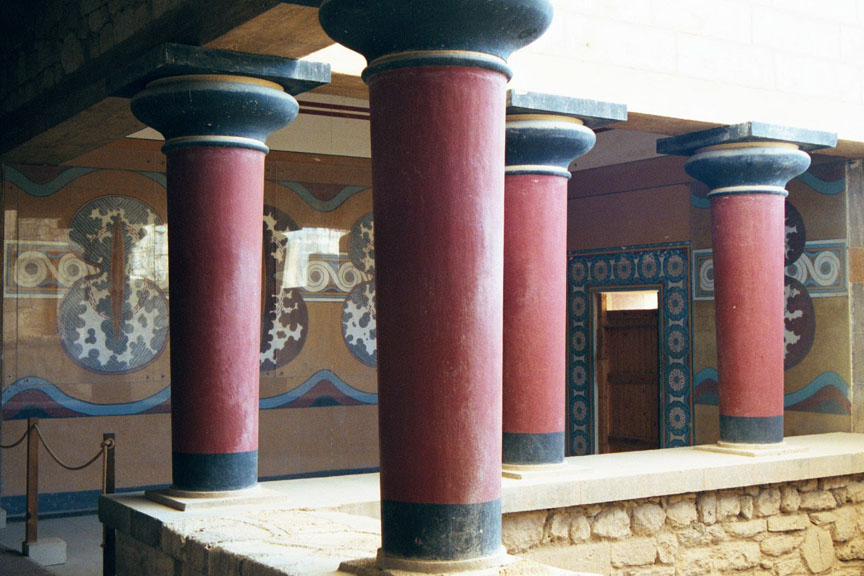
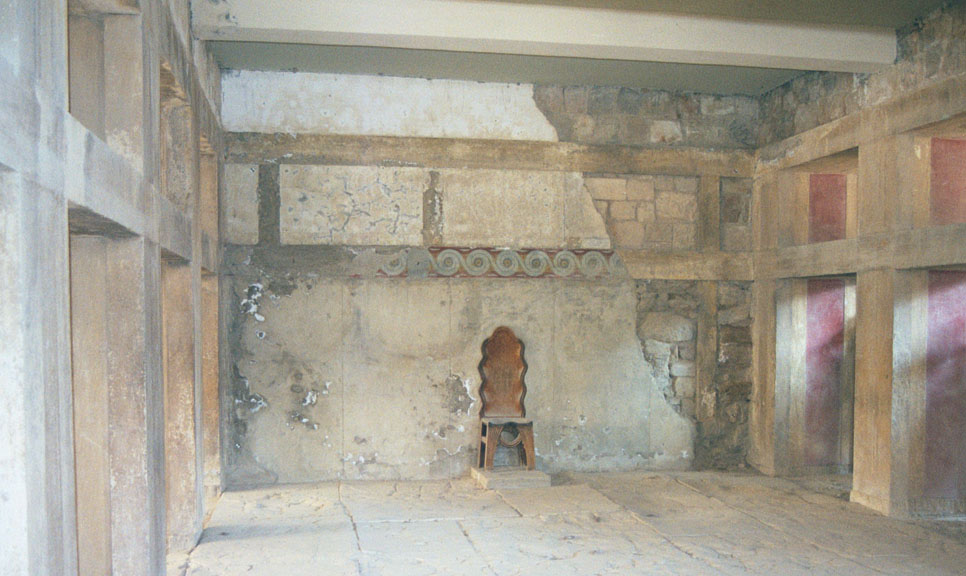
Palace of Knossos

One of the optional cruise excursions on Crete is a visit to the Palace of Knossos about 30 minutes from the city of Heraklion and lasts about 3 hours. We will be docked in Crete on Thursday from 7 a.m. until 11:30 a.m. The excursion costs around 56 Euros (subject to change).

Knossos was once the capital city of the prehistoric Minoan civilization and thought to be the basis for the original underground labyrinth housing the mythological Minotaur. This half-man, half-bull was born of King Minos’s wife, Pasiphae, and slain by Theseus. We will be able to visit a portion of the excavated and partially reconstructed Palace of King Minos and the surrounding area.

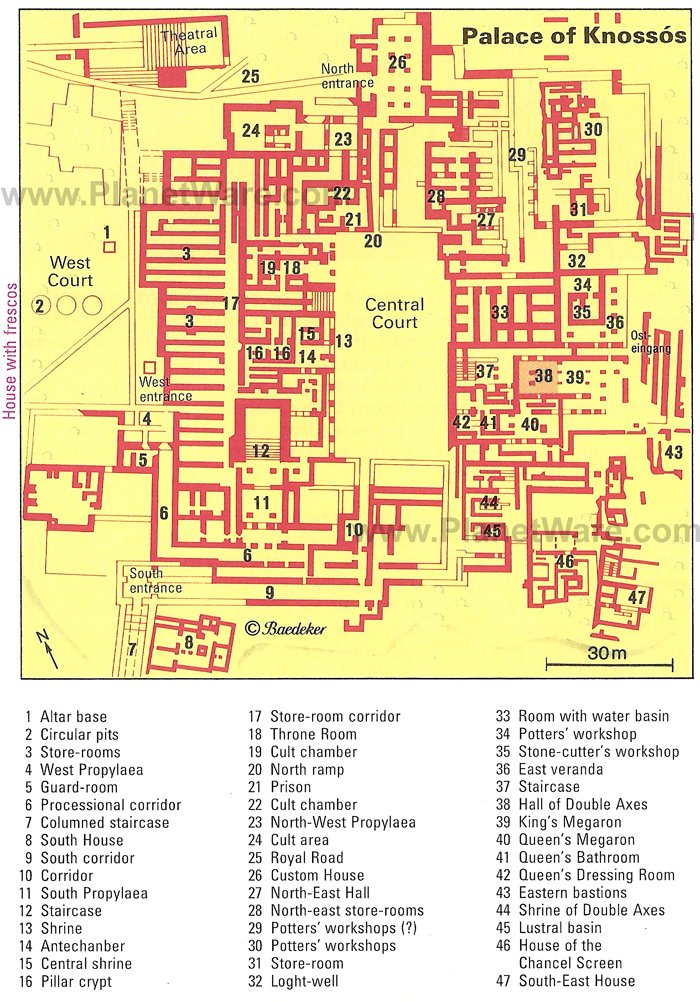
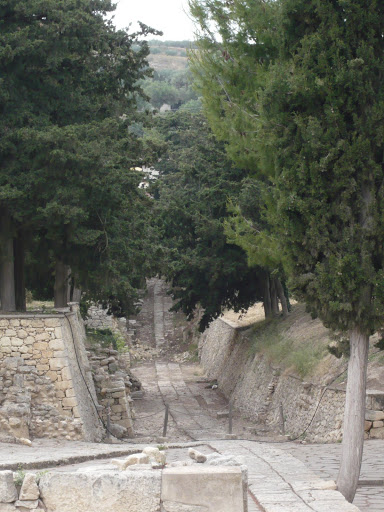
There are many palaces on the island of Crete, but Knossos is the largest and most sophisticated with over 1,000 rooms and an elaborate drainage system, flushing toilets, and paved roads. All the more amazing because this palace dates to around 1700 BC! The first palace, built around 1900 BC, was destroyed by an earthquake and these ruins date almost entirely from the rebuilding.

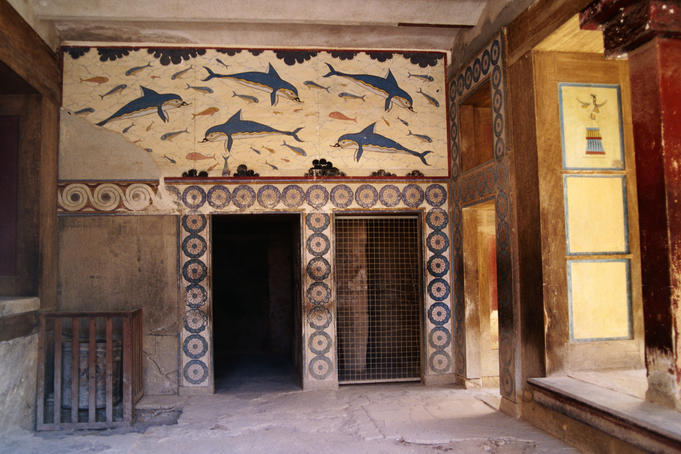
Unlike other Minoan sites, the Palace of Knossos was restored by Sir Arthur Evans between 1900 and 1929. Although his version of the reconstruction is controversial at best, it does give us an idea of life in the Minoan civilization.

The Palace houses the Hall of the Royal Guard decorated with frescoes and shields, the Hall of the Double Axes, the King’s Chamber housing the alabaster throne amid paintings of griffins and lilies, and the Queen’s Apartment adorned with murals of dolphins and spirals reminding us of the legend of the labyrinth. The original frescoes are in the Archaeological Museum in Heraklion.

The King’s Chamber and the Queen’s Apartment may be closed due to temporary restoration but can be viewed from above. Go here for a 3D virtual reality tour. Be sure to click inside each photo to scroll around for a 360-degree view.

This is an excellent introduction video to Knossos and the part Sir Arthur Evans played in its excavation and reconstruction.

The remaining time will be spent browsing in Heraklion. Since the museum is closed for restoration until 2012, a special exhibit of its most famous holdings is available, but the entrance fee is not included in the excursion price.

If you are game to try and visit Knossos on your own, here is a site that will give you some tips.

Wednesday, January 5, 2011

Rhodes Old Town

The decision to purchase optionals on the island of Rhodes is, of course, your choice, but my friend who took this cruise did not recommend spending money on any of them. He said that the town of Rhodes offers so much that he preferred using the time to explore it on his own.

So I’m going to provide you with some of the highlights of Rhodes Town so you can make a more informed decision. Rhodes Town is divided into Rhodes Old Town and Rhodes New Town. The more picturesque and interesting parts appear to be in Old Town.

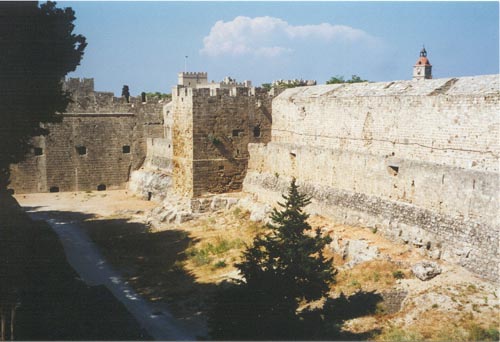
Occupied for over 2,400 years, The Knights of St. John arrived in 1309 and built their citadel over the ancient remains. The Knights medieval citadel, dominated by the towers of the Palace of the Grand Masters, forms the center of Old Town. New Town lies beyond the city walls.

Of the medieval walls’ 11 gates, Koskinou (St. John’s) gate has the best view of the city’s defenses. It leads into the Bourg quarter which has an impressive clock tower. The defensive walls date from 1330 and are 40 feet thick and 2.5 miles long.

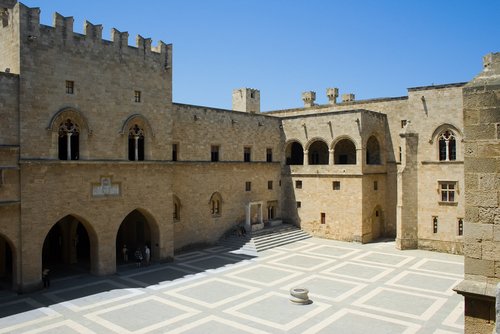
The Palace of the Grand Masters is one of the highlights of Old Town. Built in the 14th century it features some priceless mosaics, including the famous Gorgon Medusa Chamber. The central courtyard is paved with geometric tiles.

The palace’s main gate is an imposing structure built with twin horseshoe-shaped towers with swallowtail turrets. The palace is also home to two permanent museum exhibits of Medieval Rhodes and Ancient Rhodes. It is open Tuesday through Sunday; we’ll be visiting on Wednesday.

One of Rhodes Old Town’s most famous sites is the medieval Street of Knights that leads from the harbor to the palace. Also called Odos Ippoton, it is lined with the Inns of the Tongues, or nationalities, of the Order of St. John. The inns were used as meeting places for the knights.

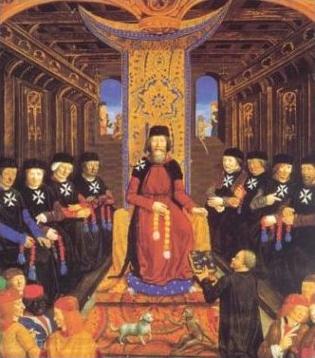
Founded in the 11th century by merchants from Amalfi, the Order of the Hopsitallers of the Knights of St. John guarded the Holy Sepulcher and tended Christian pilgrims in Jerusalem. When Jerusalem fell in 1291, they took refuge in Cyprus and then bought Rhodes in 1306.

A Grand Master was elected for life to govern the order which was divided into seven Tongues, or nationalities: France, Italy, England, Germany, Provence, Spain, and Auvergne. Each Tongue then protected an area of the city wall known as a Curtain.

Great pictures on this site! Here are a couple of videos to give you an idea of a walking tour of Rhodes Town. This video shows a lot of the inside of the Grand Palace.