Sunday, February 12, 2017

Iguazu Falls National Park -- Argentina and Brazil

Iguazu Falls National Park 
The Iguazú River, which means “big water” in Guaraní language, flows into the Paraná River. It is 1,500 meters wide (0.9 miles), and runs through islands and islets to finally fall from a lava cliff formed 120 million of years ago.  This creates one of the world’s most inspiring waterfalls.  Enjoy this Iguazu Falls overview video.

Now that you are totally immersed in this once in a lifetime experience, let’s learn more about the national parks surrounding the falls. There are actually two parks with the same name – one on the Argentinean side and one on the Brazilian side—that form the borders between the two countries.

The 167,340-acre Argentinean Parque Nacional Iguazú was created in 1934 and became a UNESCO National Park in 1984.  Iguazú is the Argentinean spelling. 

Its sister park on the Brazilian side is larger at 457,794 acres and was created in 1939.  It became a UNESCO World Heritage Site in 1986.  The Brazilian spelling is Parque Nacional Do Iguaçu, so if you have seen both spellings it is due to the country referring to it.  Remember…Argentina natives speak Spanish, while Portuguese is the national language of Brazil.

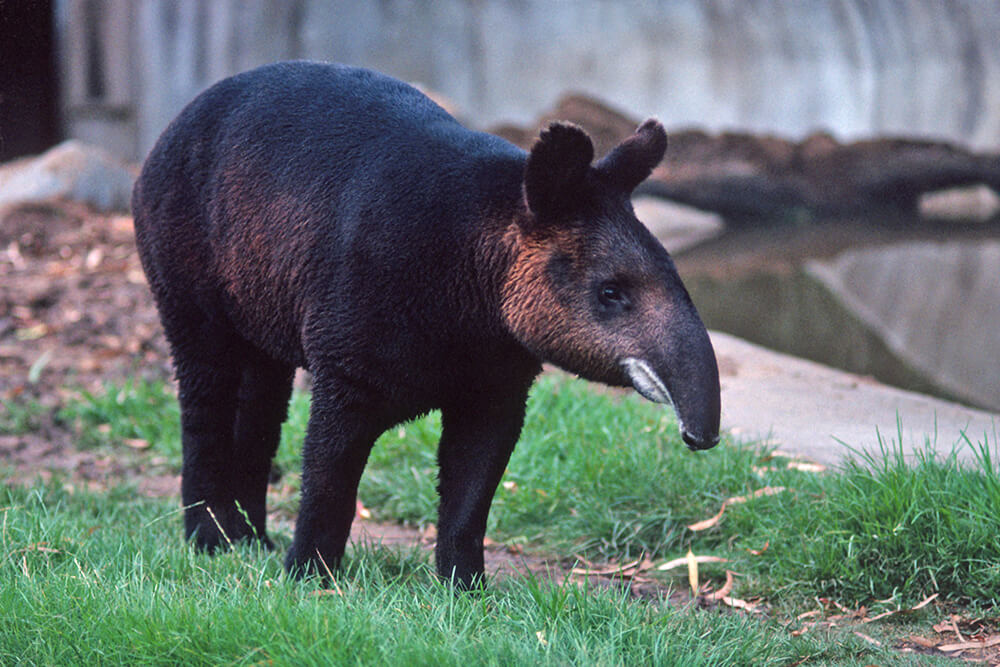
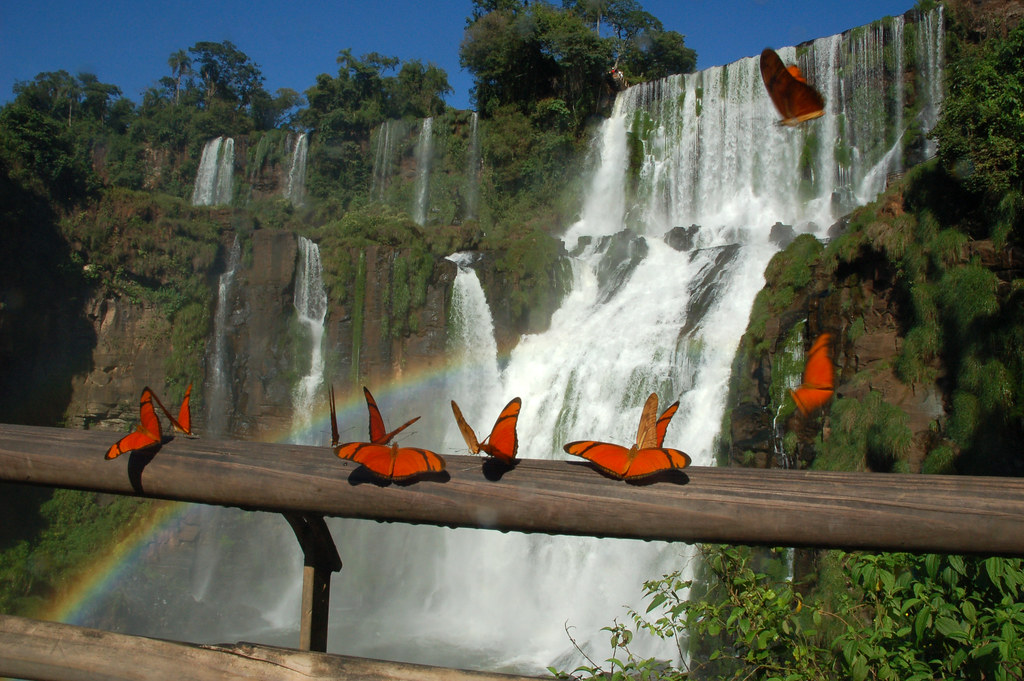
This combined area is home to many rare and endangered species of flora and fauna, and the mountain of mist created by the falls enables the lush vegetation to flourish.  The subtropical rainforest that surrounds the falls boasts over 2,000 plant species, 400 bird species including the harpy eagle and toucan,  and a wide variety of wildlife including tapirs, coatis, giant anteaters, howler monkeys, ocelots, jaguars, caimans…and a plethora of butterfly species. 

Coatis and Tourists!
We are not likely to run upon the dangerous ones, but don’t be surprised if you see a howler monkey or coati!!  An important rule to remember: no matter how much fun it looks, don’t feed the animals.

Iguazú (Iguaçu) parks and neighboring property comprise a significant remnant of the Atlantic Forest spanning Brazil, Argentina, and Paraguay.  It is one of the most threatened global conservation priorities as it now covers only 5% of its once one million square kilometers. 

Both the Iguazu park and the Iguaçu park have several walking trails of varying length and difficulty to reach the falls and explore the forest, as well as interpretive visitor centers.  In addition to walking, a jeep ride is included in our tour, along with the boat ride to the falls. 
There is also a train ride, but our tour does not list it.  Looking for tips on what to bring on this adventure, look here.

This video is really cool to show the falls from a tourist’s view…just what you’ll see.

Test your photography skill…bring along a selfie stick.  Watch how this guy films himself hiking along the falls!

The Iguazu Falls and park experience will be one to check off your bucket list!

Friday, January 20, 2017

Iguazu Falls -- Brazil and Argentina

Iguazu Falls
Named one of the New 7 Wonders of Nature in 2011, Iguazu Falls is the largest waterfalls system in the world.  Located on the border of the Brazilian state of Parana and the Argentina province of Misiones, its name means “big water.”  That’s easy to see as Iguazu Falls is made up of 275 waterfalls or cataracts spanning 2.7 kilometers. 

It is located on the Iguazu River within one of the few remaining inland rainforests in South America, the Atlantic rainforest, preserved as national parks by both Brazil and Argentina.  The parks were named UNESCO World Heritage Sites in 1984 and 1986, respectively .

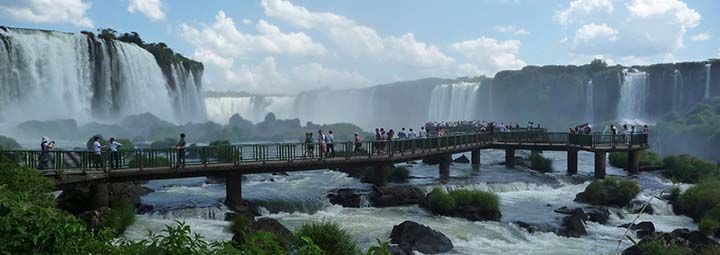
The Argentinean side, which features over two-thirds of the falls, offers visitors the opportunity to walk up close on a series of rustic-looking boardwalks, while the Brazilian side offers more panoramic views.

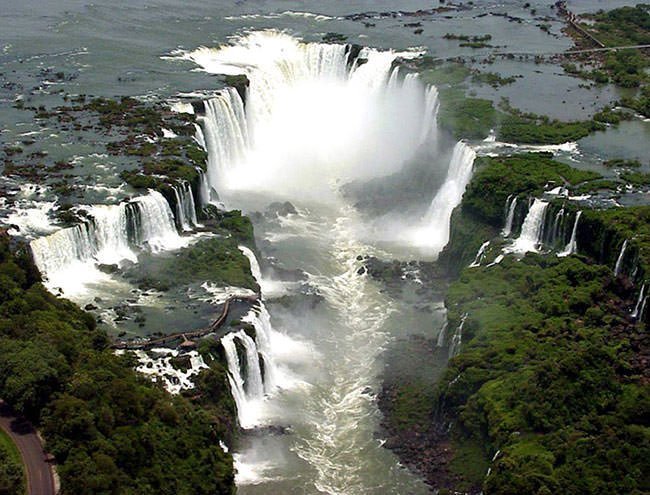
The tallest of the waterfalls is called Devil’s Throat and drops over 80 meters into a permanent cloud of mist.  Shaped like a horseshoe, it is the largest water curtain in the whole system and includes 14 waterfalls.

To put that into perspective, Iguazu Falls is nearly twice as tall as Niagara Falls and rivaled only by Zambia and Zimbabwe’s Victoria Falls, which are taller at 108 meters.
Iguazu Falls boardwalks

On average, 1,500 cubic meters of water flow every second.  In the rainy season between November and March, as much as 13,000 cubic meters of water flow every second – enough to fill five Olympic size swimming pools.  One of the highlights of touring the falls is the unforgettable “baptism” during a boat ride to the falls.

One legend says that a deity planned to marry a beautiful woman who fled with her mortal lover in a canoe on the Iguazu River.  In a rage, the deity sliced the river, creating the waterfalls and condemning the lovers to an eternal fall.

Iguazu Falls has been featured in many films including Moonraker (1979), Indiana Jones and the Kingdom of the Crystal Skull (2008), and Captain America: Civil War (2016).

Friday, November 25, 2016

Passports--How to renew or apply for new

You will need a valid passport for international travel that is good for 6 MONTHS after the trip returns to the U.S.  Six months means…6 MONTHS.  New travel regulations are getting more strict and require this extra leeway time in case of emergencies.

If you have never had a passport, then you need to start the process to apply for one.  If you already have a passport, check the expiration date carefully.  If it does not extend through December of 2017, then you need to apply to renew.

We recommend you start the process now.  It was ten years ago that the new passport law was passed that required everyone to have a passport book or card, even for Canada and Mexico travel.  Remember that nightmare?  All those people will be again renewing their passports this coming year.  In an attempt to avoid that hassle, again…start now.

First you need to take two passport quality photos.   Places like CVS, Walmart, or Office Depot can take passport photos. Walgreens can do this for $13.99 plus tax.  New regulations require that you do not wear glasses, do not smile, and pull your hair behind your ears.  Some photos and applications have been returned to applicants who did not comply.

Many post offices can accept passport applications for first time applicants on behalf of the U.S. Department of State.  You need to check this PO Locator to find a post office that offers these services.  Keep in mind that some post offices offer limited passport acceptance hours or require an appointment.

Applications can also be accepted at a district clerk’s office.  Here is the link to my home county with information on what is needed.  Check online for your home county’s district clerk.  Our district clerk charges a $25 execution fee (paid separately in cash in many places) plus the application fees of $110 for an adult.

If you are a first-time applicant, you will need to complete Form DS-11.  If you have a name change, data correction, or need limited passport replacement, complete Form DS-5504.  Do NOT sign your forms until you are in the presence of an official, which means that everyone must apply in person.  Use your name exactly as it is spelled on your birth certificate (even if it is misspelled like mine is!)

You must renew a passport by mail using Form DS-82 as you must submit your most recent passport with your application.   By mail, submit your passport, 2 photos, application, and fee by check or money order payable to U.S. Department of State.  Write your full name and date of birth on the front of the check, and mail it all in an envelope large enough not to bend the application.  Do not send cash.  The state department recommends a trackable delivery method.

Mail to: 
National Passport Processing Center
Post Office Box 90155
Philadelphia, PA 19190-0155

Routine passport processing time is 4-8 weeks.  Expedited service (with an extra fee of $60) is 2-4 weeks turnaround.

Here’s a video that explains it…again!

Tuesday, November 8, 2016

Get Ready to Samba in Rio!


The samba is a Brazilian music and dance style that actually originated in Africa and was brought to Latin America in the 16th century.  It has become a symbol around the world for Brazil and its Carnival.

If you are a fan of Dancing with the Stars and think there is just one style of samba…then think again!  There are a wide variety of styles of the music genre and just as wide a variety of dances.  And the ballroom samba is significantly different from all the others.

No partner is needed to dance the samba.  The Samba no pé is a common solo dance whenever samba music is played.  The basic movement involves a straight body and bending one knee at a time.  Another solo dance, Samba Axé, originated at the 1992 Brazilian Carnival and is designed to follow lyrics, so there is no set routine or steps.

One partner dance, Samba de Gafieira, appeared in the 1940s in urban nightclubs.  Another partner dance, Samba Pagode, has less acrobatic movements and tends to be more intimate. 

The most traditional Afro-Brazilian dance is the Samba de Roda brought to Latin America in the 17th century by Bantu slaves (also called Semba).  In the indigenous language, "samba" means roda de dança, or a circle to dance as the indigenous people danced in celebration on many occasions.

But it is the samba developed in the late 19th century and early 20th century that has become the musical expression of modern day urban Rio.  Portuguese Brazilian actress Carmen Miranda helped popularize the samba internationally.

Samba school performing in Rio Carnival
In Rio, samba schools are widely popular.  They are actually more like a dancing club or guild in a neighborhood or community, and they rehearse all year long to perform in the Carnival parade.

Rio is home to over 100 samba schools, with only 12 making it to the Elite or Special Group, a place of pride for many. These groups are what has made the Rio Carnival the biggest event on the planet with their incredible parades and lavish costumes. Many of the top samba schools have over four thousand participants with each one having a specific role to play in the samba parade.

Want to spend some time practicing?  Here are a series of samba dance steps for beginners.  Happy feet!

Thursday, September 29, 2016

Cruising the Guanabara Bay in Rio

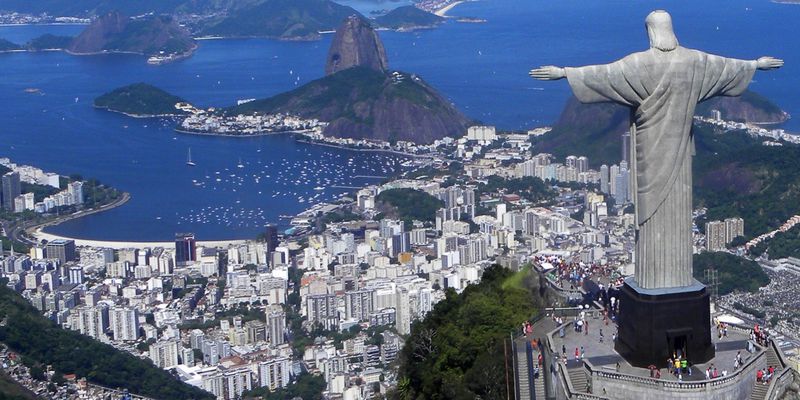
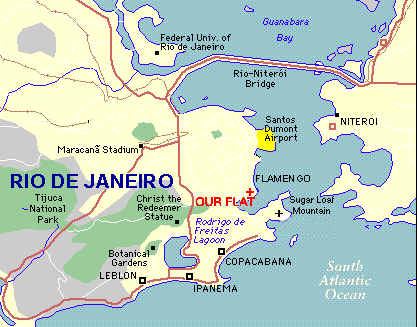
Get set to enjoy the famous icons of Rio de Janeiro…from the water!  Take in Rio’s most iconic sites and stunning coastline as you cruise around Guanabara Bay, the second largest bay in Brazil.  From the bay you will view Sugarloaf Mountain, Christ the Redeemer Statue, and the white sands of Copacabana Beach.

Guanabara Bay
From this unique perspective, you will also view the beaches of Niteroi, fortified walls of the seafront Santa Cruz de Barra fortress built in 1555, and admire the hillside fortress of São João.

The harbor of Rio de Janeiro, surrounded by majestic granite mountains, was named one of the seven natural wonders of the world.

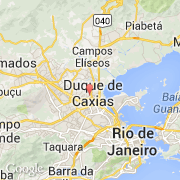
The cities of Rio de Janeiro and Duque de Caxias are located on the western shore of Guanabara Bay, while on its eastern shore lies the cities of Niterói and São Gonçalo.  Four other municipalities also line its shores.

The bay is 19 miles long and 17 miles wide at its maximum, and almost one mile wide at its mouth to the Atlantic Ocean.  The mouth is flanked on its eastern tip by Parrot’s Peak and Santa Cruz fortress and its western tip by Sugar Loaf and São João fortress.  In the entrance is the island-fort of Laje, temporary site of a Huguenot settlement in 1555. 

Guanabara Bay
The Portuguese were the first Europeans to arrive on its shores on 1 January 1502.  According to some historians, the bay was first called “Ria de Janeiro,” or January Sound.  But it seems there was some confusion between “ria,” meaning bay or sound, and “rio,” meaning river, as some thought the bay was the mouth to a large river.  In the confusion, the name became Rio de Janeiro, and the city was named after the bay.

The name Guanabara comes from the Tupi language and translates “bosom of the sea.” 

More than 130 islands dot the bay, which is crossed by the 8.26-mile long Rio-NiteróiBridge.  Numerous smaller bridges connect the mainland to the two largest islands of Fundão and Governador.

Saturday, September 3, 2016

Those Famous Beaches of Rio!

Why exactly are the beaches in Rio de Janeiro so well-known?  The answer is simple—there are just so darn many beautiful sun-drenched beaches all in one locale, in fact over 50 miles of beach shoreline—and the most famous are Copacabana Beach and Ipanema Beach.

Copacabana Beach is by far the most famous beach in the world.  (No doubt, Barry Manilow is singing his hit “Copacabana” in your head right now.)  The beach was named after the Copacabana Palace Hotel which caters to the rich and famous. And if you look at the lyrics, you’ll see the song is about the hotel, and not the beach!

Its white sands stretch long, wide, and crescent shaped and are perfect for sunbathing and swimming.  It sits anchored at one end by Sugarloaf Mountain and the old Copacabana Fort at the other end.

The bustling beach is noted for its wavy mosaic-covered promenade, Avenida Atlantica, making it an ideal place for strolling or people-watching.  It is also party-central 24/7 with a hubbub of activity.

Copacabana Beach
The 2.5-mile long beach was made famous in the 1950s lined by nightclubs, casinos, and hotels.  The beach is quite wide in places and flatter than neighboring Ipanema Beach, as well as having calmer waves.  In addition, it is the site of the world’s largest New Year’s Eve party, Revéillon, where thousands come dressed in white to watch the fireworks at midnight and party until dawn to watch the sunrise.

Ipanema Beach, on the other hand, is a narrower beach with rougher water.  (Ipanema is a native Indian word for “bad or dangerous water.”)  While Copacabana tends to be more popular with tourists, Ipanema attracts a more upscale crowd with its beach lined with high-end condos and expensive hotels.  It has been dubbed the world’s sexiest beach!

Ipanema Beach is part of one long beach flanked on the upper end by Arpoador Beach and on the lower end by Leblon Beach.

It will forever be associated with Tom Jobim's famous song “The Girl from Ipanema,” which he and the poet Vinícius de Moraes wrote while sitting in a bar watching “tall and tan and young and lovely” girls walking to the beach. (Go ahead…I know you’re humming it right now!)
Ipanema Beach

Arpoador Beach is the dividing line between Copacabana Beach and Ipanema Beach.  This 600-yard area is more family friendly.  It is most notable for the giant rock that juts out from the shore into the crashing waves.

The most recognizable beaches in photographs, however, are the Botafogo and Flamengo Beaches.  Botafogo Beach is the horseshoe shaped beach seen in aerial views that overlook the Christ of the Redeemer Statue looking toward Sugarloaf Mountain.  Flamengo Beach sits adjacent on Guanabara Bay and houses the Museum of Modern Art.

Barra da Tijuca Beach is actually the longest beach in Rio de Janeiro. It is one of the least crowded Brazil beaches you'll find in Rio and a favorite with surfers.  Other notable beaches around Rio include Sao Conrada Beach, popular with hang gliders; Vermelha Beach, at the foot of Sugarloaf Mountain where one might spot monkeys playing in the trees above; among many more.

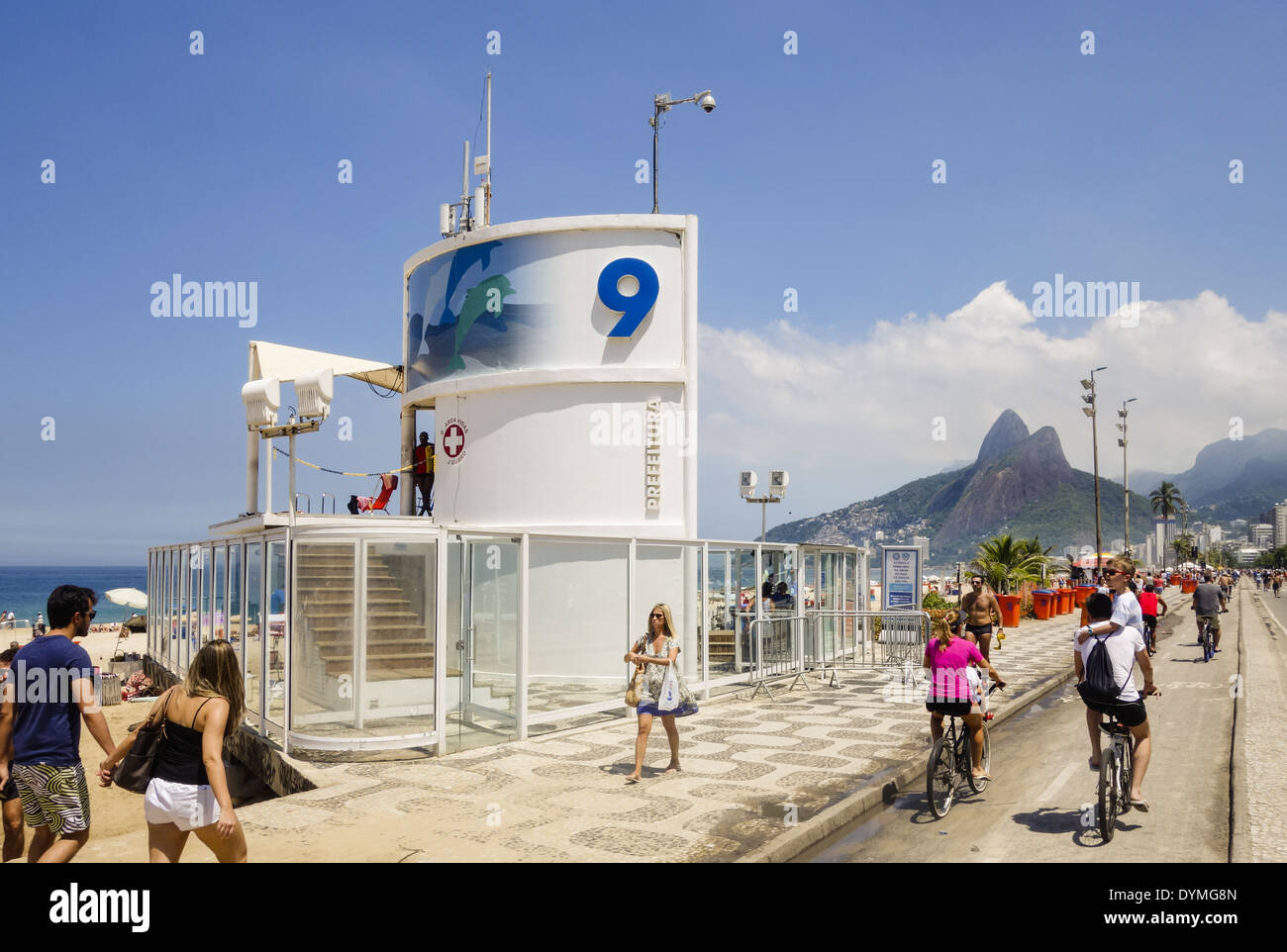
Along the beaches are numbered postos, or lifeguard stations, set every few hundred yards and are some of the most common landmarks along the beaches.  Sand sports are also common, especially futebol (soccer), vôlei (volleyball), and futevôlei (foot volleyball!).

And here, too, is the beach you’ve all heard about—Abrico Beach.  Located in the Grumari area in the far west of the city within a nature reserve, it is the one chosen by those who wish to swim and sunbathe in the nude.  In fact, this beach legally became a nudist beach in 2003.  Topless sunbathing is prohibited on all public beaches in Rio, except for Abrico Beach.

And last, but not least, there are some “unwritten” rules when visiting Rio beaches:
1. Never bring valuables to the beach.
2. Bring no food or drink with you.  You are expected to buy from the hundreds of beach vendors.  (As well as rent or buy anything else you may need.)
3. Wear your havaianas, Brazilian style flip flops.
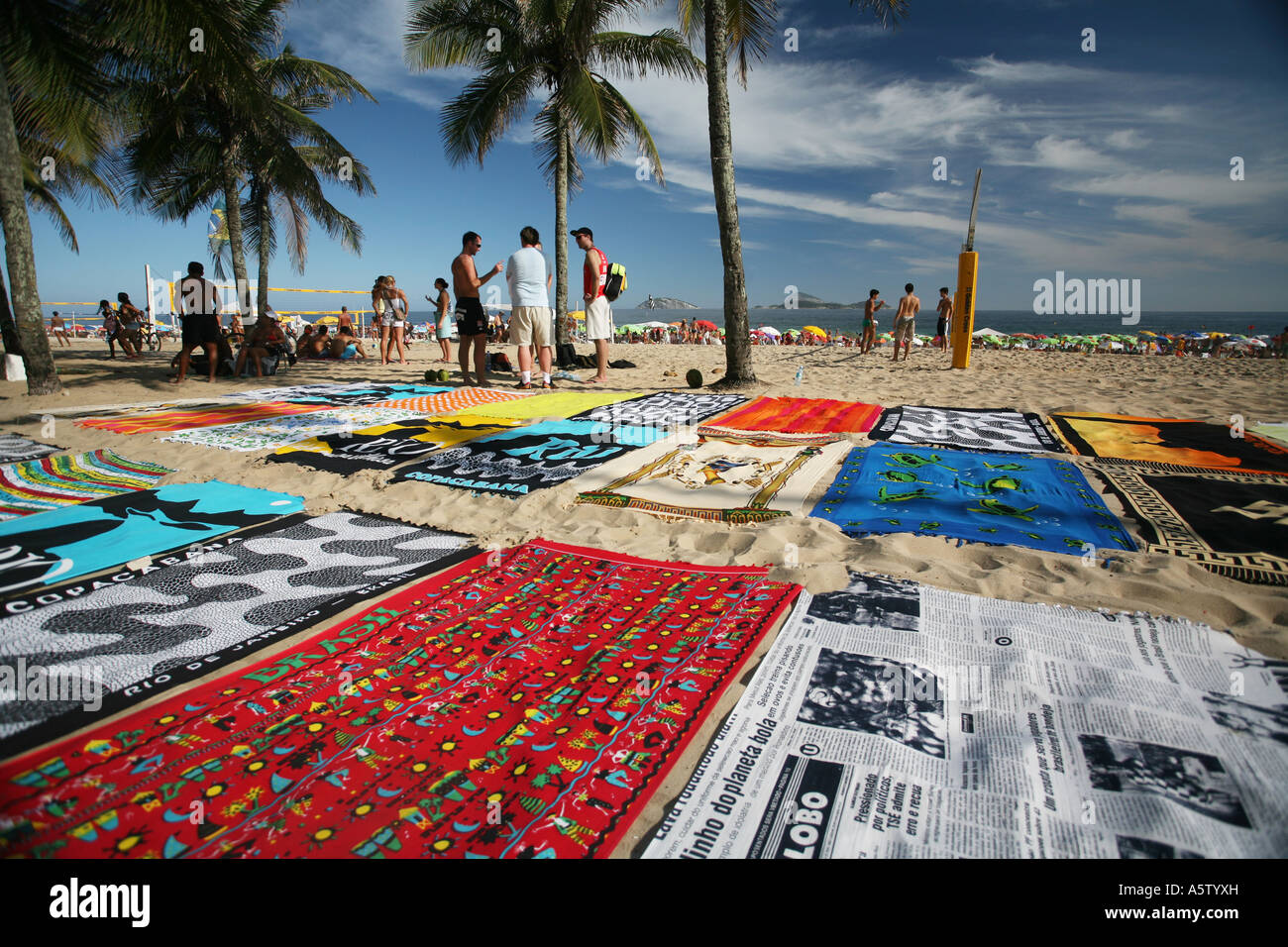
4. Absolutely no one uses a beach towel. They use a kanga, or sarong.
5. And everyone wears skimpy bikinis or Speedos, not bathing suits.

Seriously…would I lead you wrong?  You don’t want to be branded a gringo in Rio!

Friday, August 12, 2016

Sugarloaf Mountain in Rio

Sugarloaf Mountain on Guanabara Bay
If you are watching the Summer Olympics in Rio, in almost every aerial shot of the city is the Christ the Redeemer Statue, and just across Guanabara Bay you’ll see the iconic cone shaped hill that also defines Rio de JaneiroSugarloaf Mountain, or Pão de Açúcar in Portuguese.

Rising 1,299 feet, it sits at the mouth of the bay on a peninsula that juts out into the Atlantic Ocean overlooking the harbor.  It gets its name from the traditional shape of concentrated loaf sugar, a name coined by the Portuguese in the 16th century during the heyday of the sugar cane trade in Brazil.

Cable car ride up to Sugarloaf Mountain
It is known for its cable car ride to the summit and the majestic 360-degree views of Rio from the top.  The first aerial tram opened in 1912 and those wooden cars were used for 60 years.  In 1972 the tram system was upgraded to carry ten times the passengers, up to 65 people.

To reach the summit, passengers actually take two cable cars.  Sugarloaf is only one of many hills to rise along the water’s edge in Rio.  The first car rises from Praia Vermelha (Red Beach) to the shorter Morro da Urca for 722 feet, and the second ascends to Sugarloaf Mountain. 

The 360-degree views you'll enjoy along the ride and from the top of Morro da Urca and Sugarloaf Mountain encompass Rio beaches – Flamengo, Botafogo, Leme, Copacabana, Ipanema, Leblon – the Corcovado, Guanabara Bay, downtown Rio, the Santos Dumont Airport, the Rio-Niterói Bridge and Dedo de Deus (God's Finger), a peak which rises from Brazil's coastal range (Serra do Mar) in Teresópolis, RJ, about 50 miles from Rio.

Sunset at Sugarloaf Mountain
The entire ride in the bubble shaped cars takes about six minutes.  The cable cars run from 8 a.m. until 9 p.m. in 20-minute intervals.  Currently tickets are about $20.  One of the best times to visit is sunset for the spectacular views.

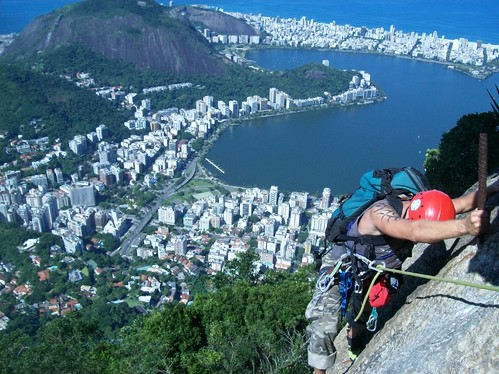
Visitors can watch rock climbers on Sugarloaf and neighboring Morro da Urca (Urca’s Mountain) and Morro da Babilônia (Babylon Mountain).  Together they make up one the world’s largest urban rock climbing locations. (And incidentally, you just learned your first word in Portuguese…morro = mountain!)

Sugarloaf Mountain has made its mark in cinema.  It was featured in the 1942 Bette Davis movie Now, Voyager.  In 1979, James Bond shot a fight scene for Moonraker in one of the cable cars.  And even The Simpsons cartoon featured the iconic mountain in an episode.

Watch this video and enjoy a virtual ride on the Sugarloaf Mountain cable car.