Tuesday, December 16, 2008

More Packing Tips

Here are a few suggestions for packing that will provide more space for your souvenirs on your return trip.
1. Collect old clothes throughout the year or clean out your closet before packing. Wear them on the trip and then leave them behind. It frees up space in your luggage as you go. Just leave behind a note for the maid as she might not be able to keep them if she can't prove you intended to leave them. You can do a good deed for someone in need and lighten your load. And no stinky laundry to tote around!
2. Pack a collapsible suitcase or duffel bag in your checked luggage. It doesn't take up much room and on the way home, pack the dirty laundry in it then pack your fragile souvenirs in your sturdier luggage. Or you could pack everything in a medium suitcase which then fits inside a larger suitcase. Either way, you have 2 suitcases for the return trip.
3. If you are a reader, take along old paperbacks that you don't really care about keeping. Just leave them behind as you finish reading and your luggage lightens as you go...and frees up more space.
4. Roll your clothes when you pack. They say it takes up less space in your luggage and helps prevent wrinkling. Just smooth out all the wrinkles as you roll them up.
5. Put things in other things. Stuff socks in shoes which also helps to hold the shoe in shape. Stuff underwear in nooks and crannies. Fill up up outside pockets with extra items.
6. Wear your heaviest and bulkiest items onto the plane.
7. Pack only travel size toiletries and make use of those free hotel toiletries you've collected. They are small and disposable. And bring only the essential toiletries. Some things you CAN live without for a few days!
8. Consider vacuum bags that take the air out and compress the items or use oversize ziploc bags and squeeze out excess air.
9. Leave behind anything unnecessary. Travel with the minimum. After all, you are only going to be gone just over a week!
Take a look at this Ultimate Packing List. It has some handy tips and is designed for using only a carry-on bag. Perhaps you'd like to try that this trip!
Thursday, November 6, 2008
The Louvre

The Louvre is easily one of the most famous museums in the world. Located in the heart of Paris, it features the distinctive Glass Pyramid entrance in the courtyard and houses some of the world's greatest recognizable masterpieces.

Of course, everyone must see the three great ladies — the Venus de Milo, the Victory of Samothrace, and Mona Lisa (which is THE most crowded spot in the museum!). Go here to take a tour of ten of the museum's most famous works.

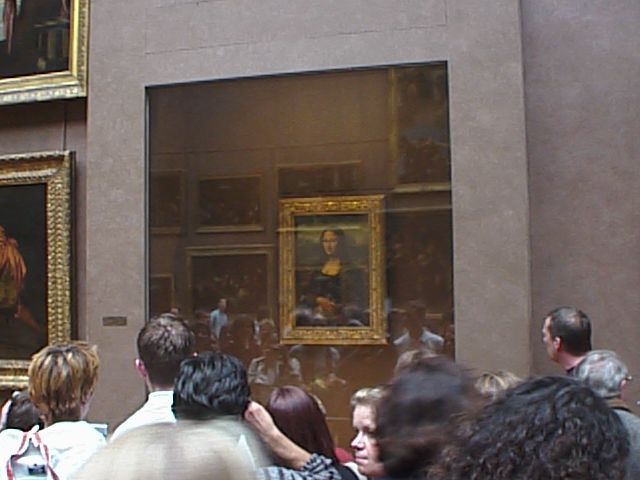
The Louvre opened in 1793 and houses over 35,000 works of art in eight departments - Near Eastern Antiquities; Egyptian Antiquities; Greek, Etruscan, and Roman Antiquities; Islamic Art; Sculptures; Decorative Arts; Paintings; and Prints and Drawings. Discover the highlights of each collection by visiting An Overview of the Departments or take a Virtual Tour.
Go here for a floor plan of the Louvre and then click on individual floors to print your own map and chart your tour. Go here for awesome 360 degree tours of eight rooms in the Louvre.
And try your hand at pronouncing Louvre! Just click the arrow.
If you haven't read Dan Brown's popular novel The Da Vinci Code, you might want to before the trip. The murder mystery starts at the Louvre.

First Aid for Travelers

Every traveler should pack a simple first aid kit that includes items that might be needed immediately when a pharmacy is not available. Avoid packing a first aid kit that takes up too much space in your luggage. Be on the lookout for travel sizes. Consider these items to include:
1. Neosporin - helps prevent infection.
2. Dramamine - helps prevent motion sickness if taken at least 30 minutes before traveling.
3. Advil - ibuprofen in Advil helps reduce pain and fever as well as relieves inflammation in muscles after a full day of walking. Tylenol does not do this.
4. Pepcid Complete - relieves heartburn by combining a stomach-acid reducer with an antacid.
5. Cortaid - soothes rashes and bug bites
6. Benadryl - for relief of hay fever symptoms as well as treatment of hives and itchy nose and throat from food allergies.
7. Insect repellent - higher concentrations of deet last longer.
8. Imodium A-D - stops symptoms of diarrhea in 30 minutes. Pepto-Bismol could take up to six hours.
9. Sunscreen - preferably SPF 15 or greater
10. Aloe gel - for sunburns
11. Antihistamine or decongestant - to relieve allergies and inflammation
12. Cough suppressant and throat lozenges
13. Mild laxative
14. Basic first-aid items (adhesive bandages, gauze, ace wrap, tweezers, round tip scissors, cotton-tipped applicators, safety pins, antiseptic wipes)
For pre-existing conditions such as diabetes or allergies, consider wearing an alert bracelet/neck tag and make sure this information is on a card in your wallet with your other documents.
Personal prescription medications need to travel in their original container and bring a copy of the prescription from your doctor in case the medication is lost. Also bring at least 50 percent more than you need. And always put prescription medication in your carry-on.
A final reminder: a first aid kit is useful only if it is available. It should be carried with the traveler at all times...in carry-on baggage when allowable and on excursions. With heightened airline security, sharp objects and some liquids and gels will have to remain in checked luggage.
London Extension
Some of you have asked about extending your stay in London. Wimbledon is going on while we are there, and others are just interested in seeing more of Europe's largest city.
If you are interested, this is the procedure. A STAR (Special Travel ARrangements form) must be completed and submitted to Passports at least 120 days prior to departure, accompanied by $425 non-refundable fee ($225 processing fee and $200 additional airfare.)
Additional airfare may apply. Please note that the exact cost, along with your flight schedule, will be determined within 30 days of departure. You will be notified 90 days prior to departure if Passports is unable to honor your request.
Passports does not make any individual travel arrangements other than changing the return flight and the airline is at the sole discretion of Passports. Specific airline/routing requests cannot be accepted.
Please let me know if you are interested and I will send you a STAR form. If you have any additional questions about an extended stay in London, then email me.
If you are interested, this is the procedure. A STAR (Special Travel ARrangements form) must be completed and submitted to Passports at least 120 days prior to departure, accompanied by $425 non-refundable fee ($225 processing fee and $200 additional airfare.)
Additional airfare may apply. Please note that the exact cost, along with your flight schedule, will be determined within 30 days of departure. You will be notified 90 days prior to departure if Passports is unable to honor your request.
Passports does not make any individual travel arrangements other than changing the return flight and the airline is at the sole discretion of Passports. Specific airline/routing requests cannot be accepted.
Please let me know if you are interested and I will send you a STAR form. If you have any additional questions about an extended stay in London, then email me.
Tuesday, October 7, 2008
Stonehenge
 Stonehenge, located in southern England on the Salisbury Plain about 90 miles southwest of London, is one of the most famous prehistoric sites in the world. The giant ring of standing stones was erected over 4,000 years ago, but a circular earthbank and ditch surrounding the stones is even older...over 5,000 years old!
There are actually two mysteries surrounding Stonehenge. One is how 30 enormous sarsen stones were moved from their original location, arranged upright in a circle, with a ring of 30 additional lintel stones placed on top. Each of these stones is about 13 feet high and weighs about 25 tons! Within this circle are additional stones forming a horseshoe shape.
Mystery number two...exactly what did the ancients use Stonehenge for? Several theories have been proposed including an astronomical observatory for the summer solstice, the longest day of the year (which is 21 June 2009...the day before our visit). This event brings thousands to the site for the annual celebration to watch the sunrise. (Hopefully, they will be partied out by the time we arrive!)
Another theory is that Stonehenge was used as a religious site...hence the horde of "Druids" that descend on the area during summer solstice.
Most recently it is believed to have been a burial site and/or healing site as cremated remains dating back to 3,000 B.C. were unearthed there in May 2008.
In answer to the most asked question: No, we will not be able to walk among the stones, but we will be able to walk around it. But if you'd like a virtual tour inside the stones, go here for a 360 degree view from the inside by moving your cursor around inside the picture. For more information, see the official Stonehenge web site.
Travel Tips from Passports #1

Note: The following is a reprint of a few tips from the Travel Tips section from Passports. It can viewed in its entirety at Passports and typing in your username and password or the group preview code farmer09 (that's a zero and nine). I will periodically post some of their tips on our travel blog for your convenience.
*Travel light, especially if you are visiting several cities! Take one SMALL carry-on bag and one medium-sized piece of baggage (wheels are essential) to be checked. We recommend that you bring only the necessities. Once you have packed your bags, pick them up and carry them for a few yards then ask yourself if you are prepared to spend the next week or so doing the same. If not, then you have over-packed! Do not lock your suitcase before a flight. Security agents may need to look inside, and may break your lock in order to do so.
*Be prepared for any kind of weather. Always pack a sweater, sweatshirt or other light, long-sleeved outerwear in case of cool evenings or cloudy days when you are traveling in the summer.
*Layers are the tops! Take a couple of close-fitting tank tops to wear under your shirts/tops, if you get a bit chilly. They will take up hardly any room in your suitcase but that extra layer will keep you cozy. Even on warm days, nights can be cold, and it's always cooler on oceans or rivers.
*Always wear a pair of broken-in, comfortable walking shoes or sneakers during the tour and on the airplane. Never take new shoes on tour.
Subscribe to:
Posts (Atom)