Showing posts with label lake. Show all posts

Friday, April 24, 2015

Glendalough -- Ireland

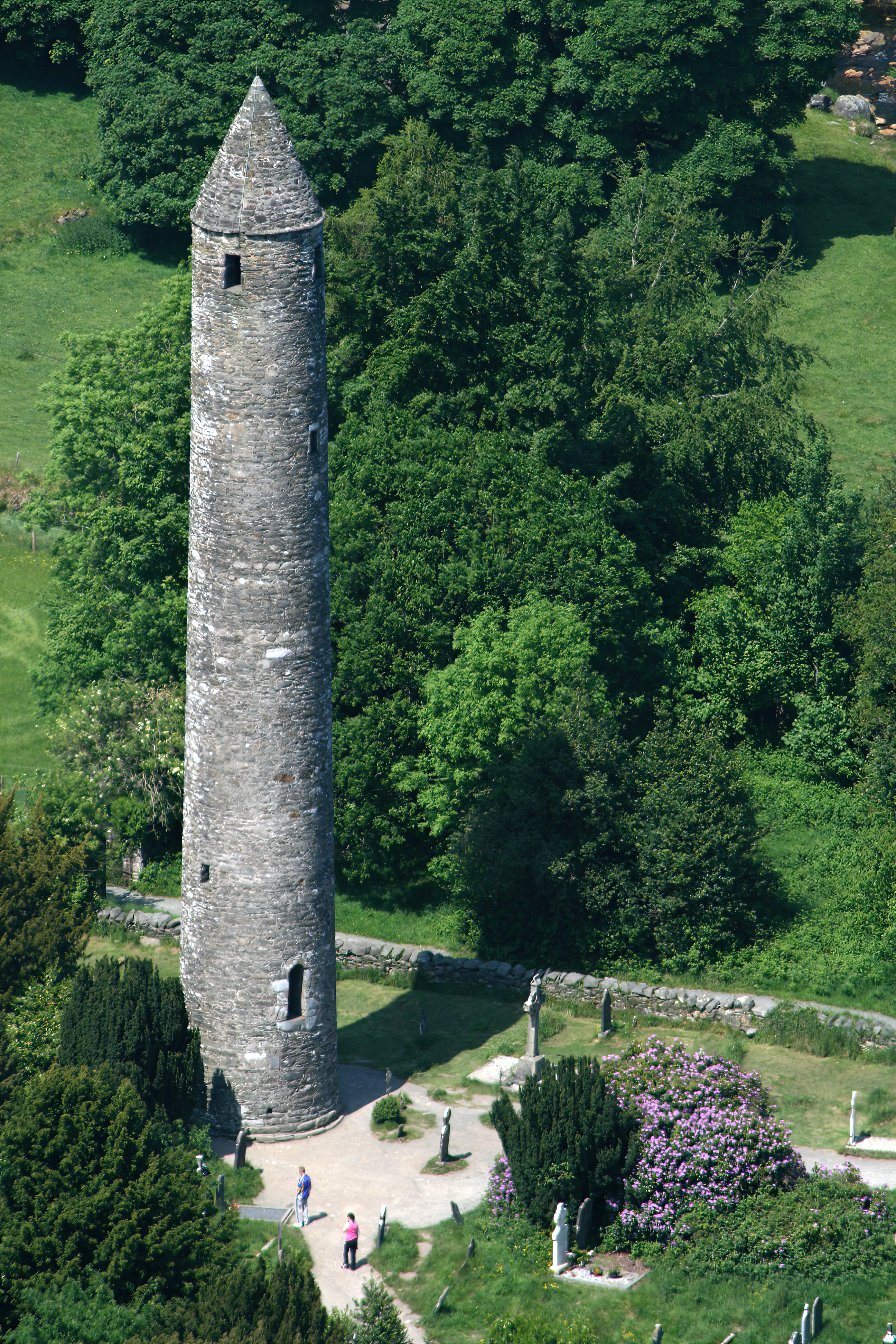
Glendalough Round Tower
Glendalough represents iconic Irish countryside.  Nestled in a glaciated valley in the heart of County Wicklow, this serene valley boasts two lakes, monastic remains with a superb round tower, stone churches, and decorated crosses in an historical graveyard. Literally the name, Gleann Dá Loch, means “Valley of the Two Lakes.”

History
The early Christian ecclesiastical settlement was founded in the 6th century by St. Kevin, a hermit monk who died about 618 A.D.  A descendant of one of the ruling families of Leinster, he came to live at Glendalough (pronounced ‘glenda-lock’) as a young man.  According to legend, he lived a life of sleeping on stones, wearing animal skins, barely eating, and making friends with birds and animals.

By the 9th century, Glendalough rivaled only Clonmacnoise as one of the leading monastic cities in Ireland.  In its heyday, the settlement not only featured a monastery and monk cells, but also an infirmary, workshops, areas for manuscript writing and copying, guesthouses, farm buildings and houses.  Most of what survives today is from the 10th-12th centuries.

In 1214, the dioceses of Glendalough and Dublin were combined and the settlement fell into ruin destroyed by English forces in 1398.  The Feast of St. Kevin is celebrated on June 3.

Glendalough is currently a titular see in the Catholic Church.  It is used for bishops who hold no ordinary power of their own and thus are titular bishops.

Visiting Glendalough
Upper Lake at Glendalough
The two lakes at Glendalough are known as Upper Lake and Lower Lake, where the main entrance from the parking area, a visitor centre, the main monastic dwellings, and a hotel are located.  Walking trails connect the two lakes and other monastic sites.

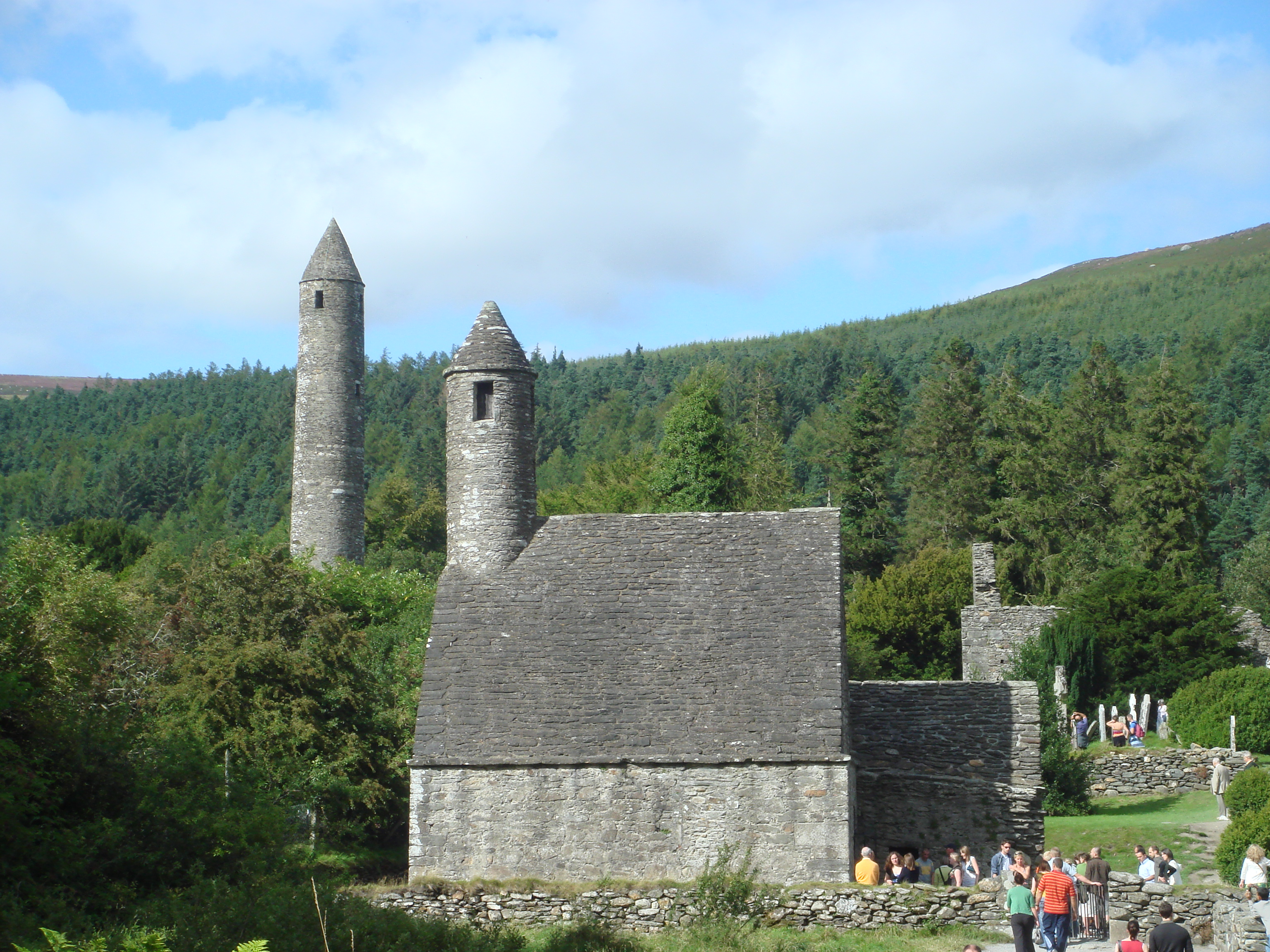
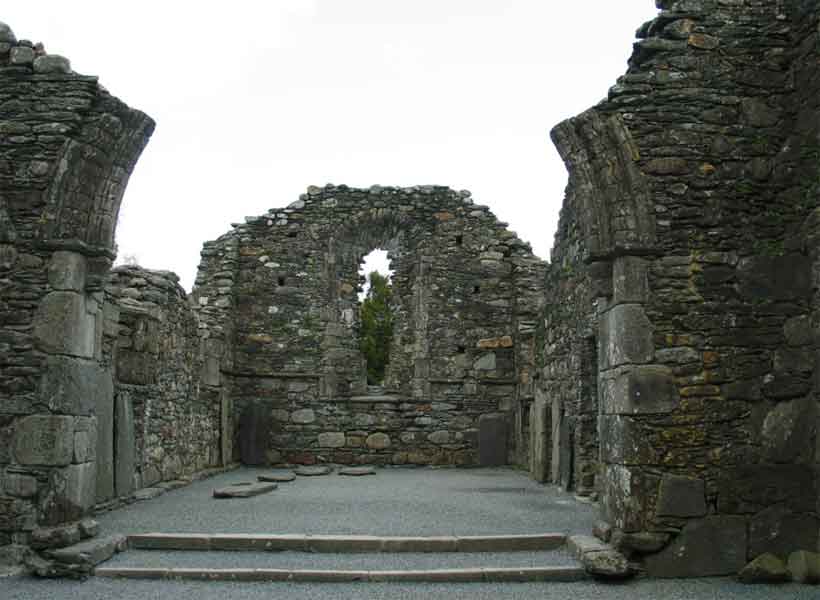
Visible at Lower Lake are the double-arched medieval gateway; the Cathedral, the largest building; St. Kevin’s Cross with an unpierced ring; the reconstructed priests’ house; St. Kevin’s Church (or Kitchen) with its distinctive round belfry; foundations of St. Kieran’s Church; and the iconic round tower.

The round tower possibly served as a belltower, a place of refuge when under attack, and/or a storage facility.  It originally had six timber-floored stories with the doorway to the tower 3-1/2 meters above ground to protect those inside from intruders.

Small windows at the top face the four points of the compass, and stories were accessed by internal wooden ladders.  The conical roof was replaced in 1876 from original stones.

Additional monastic structures – St. Mary’s Church, the Caher,  Reefert Church, and St. Savior’s Church – can be visited on the hike to Upper Lake. Temple-na-Skellig and St. Kevin’s Bed, a cave, are only accessible via boat.

Crosses of Glendalough
There are nine marked walkingtrails in Wicklow Mountains National Park ranging from a short half hour walk to a four-hour hillwalk.  The park is host to a wide diversity of wildlife including red deer, sika deer, fallow deer, feral goat, red fox, mink, and over 100 species of birds.  The common lizard is the only reptile in the park, as there are no snakes in Ireland.

The visitor center located nearby hosts an interesting exhibit and a 17-minute film entitled “Ireland of the Monasteries.”


Join Rick Steves in this video: “Glendalough, Ireland: Exploring the Wicklow Mountains.”  (Watch only the first 1:55 minutes.)
For a unique birds eye view, enjoy this video: “Glendalough.” (3:40)


Tuesday, July 15, 2014

Loch Lomond, Scotland

Ever hear that familiar tune…but not quite sure of the song lyrics or the origin of the song?  Well, take a listen here.  Hummmm… “the bonnie, bonnie banks of Loch Lomond.”

This traditional Scottish song was first published in 1841 in Vocal Melodies of Scotland (Roud No. 9598).  Although the original author of the song is unknown, one of the many interpretations of the lyrics alludes to the Jacobite Uprising in 1745.  Perhaps a prisoner awaiting death (the low road) is writing to a friend who lives (the high road). An old Celtic belief is that a person who dies outside his country will return in death (And Ah'll be in Scotlan' afore ye).

Regardless of the meaning, the song has been sung by numerous artists over the years, and the familiar tune has been used countless times. Even the University of Notre Dame Marching Band’s baritone horn section plays the song at the beginning of every home game.

By yon bonnie banks an' by yon bonnie braes
Whaur the sun shines bright on Loch Lomond
Whaur me an' my true love will ne'er meet again
On the bonnie, bonnie banks o' Loch Lomon'.
Chorus:
O ye'll tak' the high road, and Ah'll tak' the low road
And Ah'll be in Scotlan' afore ye
Fir me an' my true love will ne'er meet again
On the bonnie, bonnie banks o' Loch Lomon'.
'Twas there that we perted in yon shady glen
On the steep, steep sides o' Ben Lomon'
Whaur in (soft) purple hue, the hielan hills we view
An' the moon comin' oot in the gloamin’.
Chorus
The wee birdies sing an' the wild flouers spring
An' in sunshine the waters are sleeping
But the broken heart it kens, nae second spring again
Tho' the waeful may cease frae their weeping.
Chorus

Loch Lomond
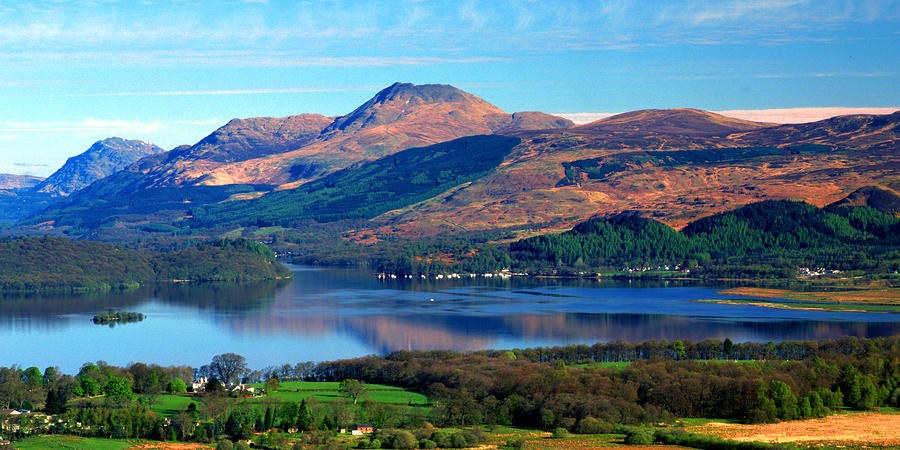
“Loch Lomond” in the song refers to Loch (or Lake) Lomond, a majestic freshwater lake in Scotland that crosses the Highland Boundary Fault.  It is the largest inland stretch of water in Great Britain and is part of the Loch Lomond and the Trossachs National Park system.

The 25-mile long lake is narrow and deep at its northern stretch and bound by steep-sided mountains including Ben Lomond. Its southern end widens up to reveal an island-studded panorama.

The lake has over thirty islands, depending on the water level.  Inchmurrin is the largest, and Inchconnachan is home to a colony of wallabies.  Several of the islands appear to be crannogs, artificial islands built in prehistoric periods.

The Trossachs refers to the wooded glens that surround the lochs found in the area.  Sir Walter Scott’s 1810 poem The Lady of the Lake popularized the area with tourists by including several place names in the poem.  Shortly after, he wrote his 1817 historical novel Rob Roy, whose exploits in the Trossachs led to the area being called “Rob Roy Country.”
Village of Luss, Scotland
 And speaking of the “bonnie banks” of the lake, look for the beautiful little village of Luss on the western shore of Loch Lomond.  A village has been in this location since medieval times and the pretty little sandstone and slate cottages complete with roses rambling up the sides of each one makes for a “bonnie” sight indeed.

Now if you’d like to see the big screen version of the song combined with stunning images of Loch Lomond, watch Legend of Loch Lomond which retells the story behind the song.  Originally set for IMAX, this short film (38 minutes) can be seen for free on Hulu (although it has several commercial breaks.)   It is also available on Netflix.