Tuesday, July 15, 2014

Loch Lomond, Scotland

Ever hear that familiar tune…but not quite sure of the song lyrics or the origin of the song?  Well, take a listen here.  Hummmm… “the bonnie, bonnie banks of Loch Lomond.”

This traditional Scottish song was first published in 1841 in Vocal Melodies of Scotland (Roud No. 9598).  Although the original author of the song is unknown, one of the many interpretations of the lyrics alludes to the Jacobite Uprising in 1745.  Perhaps a prisoner awaiting death (the low road) is writing to a friend who lives (the high road). An old Celtic belief is that a person who dies outside his country will return in death (And Ah'll be in Scotlan' afore ye).

Regardless of the meaning, the song has been sung by numerous artists over the years, and the familiar tune has been used countless times. Even the University of Notre Dame Marching Band’s baritone horn section plays the song at the beginning of every home game.

By yon bonnie banks an' by yon bonnie braes
Whaur the sun shines bright on Loch Lomond
Whaur me an' my true love will ne'er meet again
On the bonnie, bonnie banks o' Loch Lomon'.
Chorus:
O ye'll tak' the high road, and Ah'll tak' the low road
And Ah'll be in Scotlan' afore ye
Fir me an' my true love will ne'er meet again
On the bonnie, bonnie banks o' Loch Lomon'.
'Twas there that we perted in yon shady glen
On the steep, steep sides o' Ben Lomon'
Whaur in (soft) purple hue, the hielan hills we view
An' the moon comin' oot in the gloamin’.
Chorus
The wee birdies sing an' the wild flouers spring
An' in sunshine the waters are sleeping
But the broken heart it kens, nae second spring again
Tho' the waeful may cease frae their weeping.
Chorus

Loch Lomond
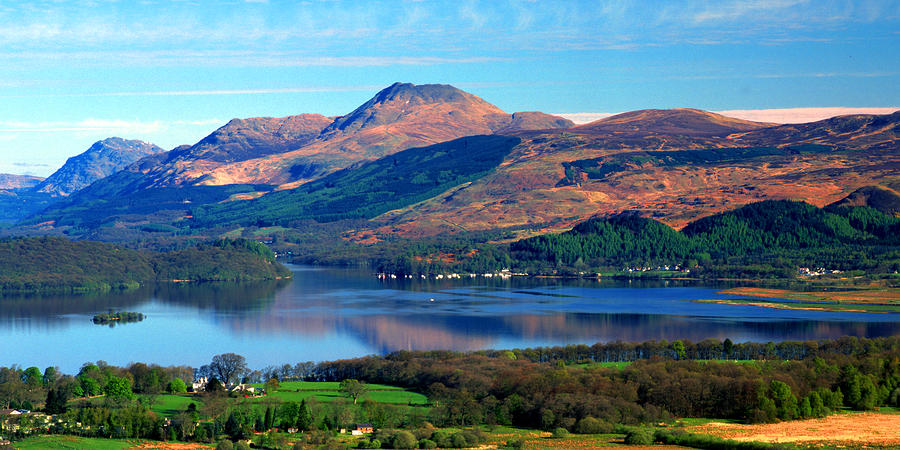
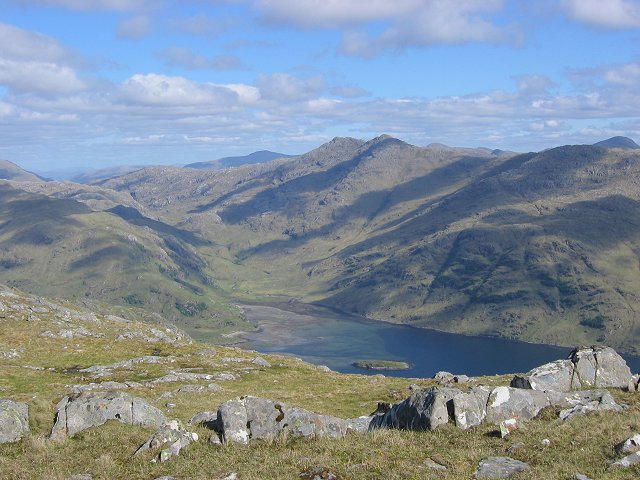
Loch Lomond” in the song refers to Loch (or Lake) Lomond, a majestic freshwater lake in Scotland that crosses the Highland Boundary Fault.  It is the largest inland stretch of water in Great Britain and is part of the Loch Lomond and the Trossachs National Park system.

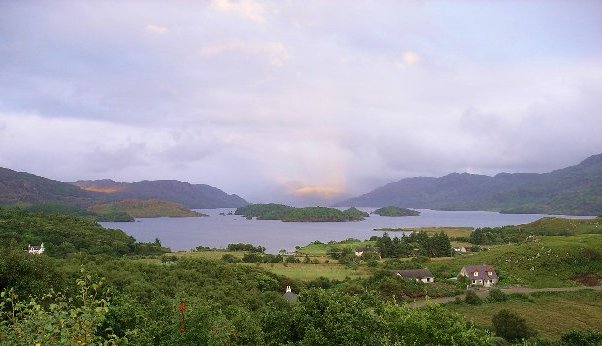
The 25-mile long lake is narrow and deep at its northern stretch and bound by steep-sided mountains including Ben Lomond. Its southern end widens up to reveal an island-studded panorama.

The lake has over thirty islands, depending on the water level.  Inchmurrin is the largest, and Inchconnachan is home to a colony of wallabies.  Several of the islands appear to be crannogs, artificial islands built in prehistoric periods.

The Trossachs refers to the wooded glens that surround the lochs found in the area.  Sir Walter Scott’s 1810 poem The Lady of the Lake popularized the area with tourists by including several place names in the poem.  Shortly after, he wrote his 1817 historical novel Rob Roy, whose exploits in the Trossachs led to the area being called “Rob Roy Country.”
Village of Luss, Scotland
 And speaking of the “bonnie banks” of the lake, look for the beautiful little village of Luss on the western shore of Loch Lomond.  A village has been in this location since medieval times and the pretty little sandstone and slate cottages complete with roses rambling up the sides of each one makes for a “bonnie” sight indeed.

Now if you’d like to see the big screen version of the song combined with stunning images of Loch Lomond, watch Legend of Loch Lomond which retells the story behind the song.  Originally set for IMAX, this short film (38 minutes) can be seen for free on Hulu (although it has several commercial breaks.)   It is also available on Netflix. 


Wednesday, July 2, 2014

Is Scottish Ancestry in Your Background?

Ever wondered if your ancestors came from Scotland…and if so, to what clan did they belong?  Family surnames passed from father to son to grandson were introduced in Scotland in the 1100s by the Normans, but the general use of a common surname passed down through the generations was not prevalent until the 16th century, and even then they were not common in the Highlands and the isles until well into the 18th century.

Some names were associated with a geographical place or occupation, some on some unique quality or physical feature, and others were patronymic—derived from a given name or family relationship.  Mac or Mc is a common Scottish surname prefix as it means “son of.” 

These were the types of names that might change from generation to generation depending on the father’s name.  Adopting a common family surname was not popular until the 15th and 16th centuries.

To find out if you have a Scottish heritage, talk to relatives and consult family genealogies to compile a list of family surnames.  Then search this Alphabetical List of Scottish Names Associated with Clans and Families and Behind the Name – Scottish Surnames

You can also search through this massive list of Scottish surnames at Family Education Name Lab or simply type in the name in the search box to get information on name meaning and origin.

Scottish clan comes from the Gaelic clann meaning “family” and was usually all the people who lived in particular geographic area under the protection of a clan chief, who was officially registered in the court of Lord Lyon King of Arms who controlled heraldry and the Coats of Arms registration in Scotland.  Therefore, everyone in a clan was not necessarily related nor did they all have the same surnames.

Clan Tartans

The tartan has long been associated with Scotland, especially the Highlanders.  The woven patterns of interlocking stripes originally were not associated with any particular clan until the 18th century, and it was not until Wilson’s Key Pattern Book of 1819 that some were even given a name.

At the Scottish Register of Tartans, you can search by your clan name or Scottish surname.  Use the standard search box here, where you can get a broad search result by typing clan or surname in the tartan name box. 

There are several web-based “tartan finders,” but the majority are commercial and are simply trying to sell you a tartan.  So when you do a search…take the results with a grain of salt as most don’t agree on a specific design for a name. 

Coats of Arms

Likewise many Scottish clans and surnames are associated with heraldry, or coats of arms.  These too have been registered through the Court of the Lord Lyon since 1672.  Interestingly, Coats of Arms may only belong to a single person at a time and not an entire family and are passed down only to the heirs of that person.

Coats of Arms were originally used by the military to identify knights in battle, therefore no two persons could have the exact same design for identification purposes.

When you are ready to start searching Scotland’s records, then try Scotland’sPeople.  Set up a free registration to obtain a username and password, and start your free search.  (Only include information in the registration that is required.)

This official site will allow you to search and view Coats of Arms and Wills and Testaments results for free, but there is a fee to view the actual record and also a fee to view result listings of birth, marriage, death, and baptism records.

If you want further searching tips, consult the National Library of Scotland.

Postscript: My Scottish Family Research

The surname for one branch of my husband’s family is McCaig.  With the surname prefix “Mc,” I was pretty certain we had a Scottish name in our lineage.  Turns out the name is associated with the clans Farquharson and McLeod.  It is an anglicized form of the Gaelic MacThaidhg, meaning “son of Tadhg.”  It also means poet or philosopher. 

Then I ran across this web article on MacCaig with tons of information on family history, coats of arms, and tartans…until I got to the bottom and read “Purchase Customized Products.”  As I said…grain of salt!

Happy hunting…

P.S.S. I did locate the McCaig Tower in Oban, Scotland.  The unfinished prominent tower (looking much like the Roman Colosseum) was built on a hillside overlooking the city by a wealthy, philanthropic banker named John Stuart McCaig between 1897 and 1902.  (Note: still looking for a family tree branch to him!)
McCaig Tower in Oban, Scotland

Tuesday, June 24, 2014

Glencoe, Scotland

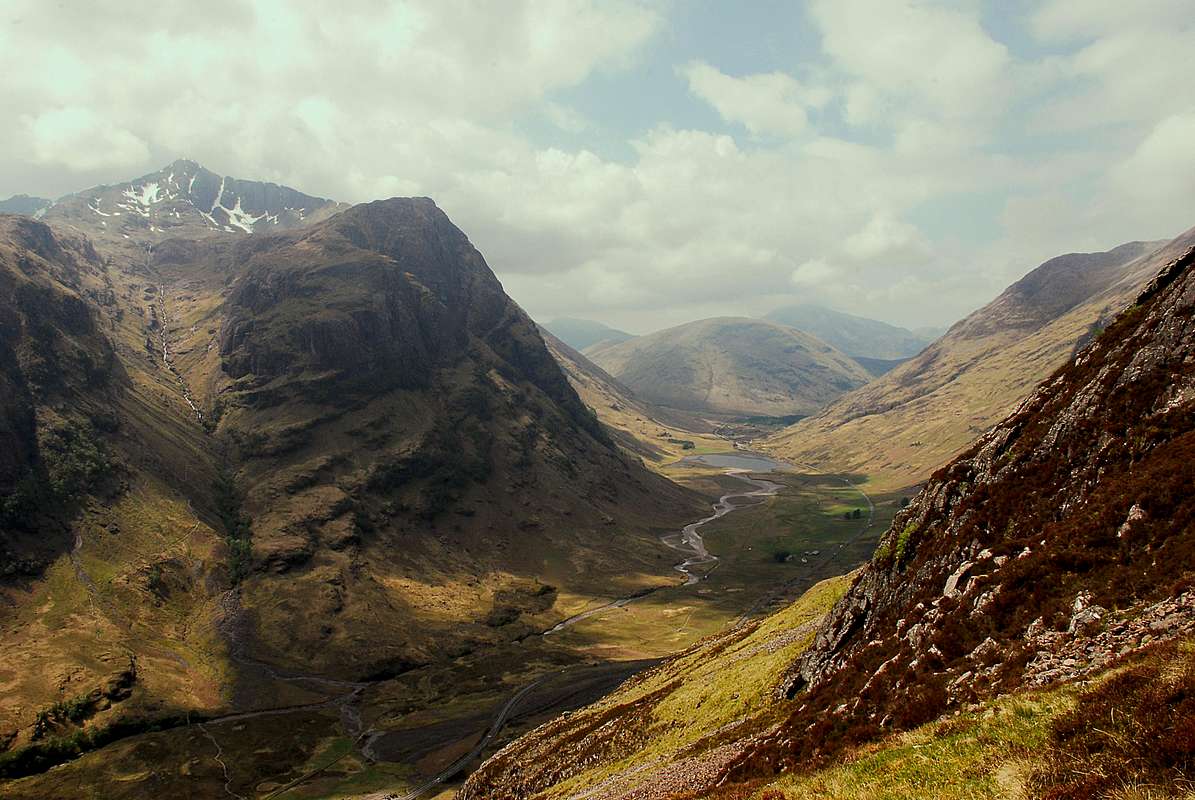
Renowned as one of the most famous and beautiful glens in Scotland, Glencoe is also notoriously well-known as one of Scotland’s battlegrounds—site of the tragic massacre of the MacDonald clan 13 February 1692 by forces representing King William III following the Glorious Revolution.

History

Officially called GlenCoe (the glen through which runs the River Coe), the lands were owned by the Clans MacDonald since the 14th century when they supported King Robert the Bruce.  But when King William came to the throne, many of the highlanders still swore allegiance to the deposed Scottish King James VII.  These highlanders were known as Jacobites.

Glencoe Massacre
Memorial
All the Scottish clan chiefs were ordered by the Secretary of State John Dalrymple to swear allegiance to the English crown by 1 January 1692.  The MacDonalds, who still supported the return of King James, held out, but eventually, with time running out on the deadline, received news from James in exile in France to honor the new order only days before the deadline.

As luck would have it, a terrible winter storm kept the clan chieftain from reaching Fort William until December 31, only one day short of the deadline.  Here he was told that the oath must be taken by a sheriff 60 miles away, and a series of unfortunate events hindered him even further.

Unbeknownst to the MacDonald clan, their fate had already been sealed by Dalrymple, who orchestrated the coming massacre.  Soldiers from the Campbell clan arrived in Glencoe as friends seeking shelter, but had been instructed by Dalrymple to slaughter all MacDonalds under age 70.

Inscription on Memorial
Honoring the Highland code, the MacDonalds gave shelter in their homes to the Campbells for 12 days, until the wee hours of February 13 when the systematic massacre began.  By morning 38 men, women, and children lay dead including the clan chief.  Many of those who escaped died of exposure from the winter weather in the mountains.  A few of the Campbell soldiers gave warning to their host families and broke their swords, refusing to participate in the atrocity. 

The Jacobites in Edinburgh were enraged, an inquiry was held and declared the affair an act of murder forcing Dalrymple to resign, but not until 1695…and the event passed into legend in Scottish history.

For an in-depth 7-part video series on the massacre, watch “The Murder of Clan MacDonald of Glencoe.” Here is Part 1 (9:48).  Simply search YouTube for this title and select the remaining parts to view.  Each segment is about 9 minutes long.

In poetry, enjoy T.S. Elliot’s Rannoch, by Glencoe or Douglas Alexander Stewart’s Glencoe.  The 300-year-old document still exists that mandated the massacre and is housed in the National Library of Scotland.  Hear the chilling document read here.

Natural Beauty

Today, few people inhabit the glen except for those in the village of Glencoe which sits at the western entrance to the glen and features a visitor center maintained by the National Trust for Scotland hosting a 15-minute video highlighting the 1692 massacre, as well as exhibits on the natural beauty, wildlife, and history of the area. 
Glencoe, Scotland 
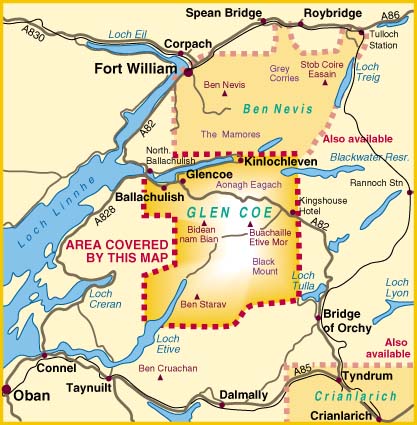
The u-shaped glen was formed by an ice age glacier and is surrounded by spectacular mountains which are a haven for hikers, walkers and rock/ice climbers.  The valley is 10 miles long but less than a half mile wide as mountains rise sharply on all sides up to 3,000 feet such Buchaille Etive Mor, the huge mountain seen as you enter the glen from the bleak expanse of Rannoch Moor.

The magnificent scenic drive through the area will feature high mountain peaks, ridges, rushing rivers, lochs, and mystical waterfalls.  Of note is the Devil’s Staircase, the Three Sisters, the Aonach Eagach, and 8 Munros.

Enjoy this scenic video journey through “Beautiful Scotland - Glencoe” (8:29).

Modern Culture

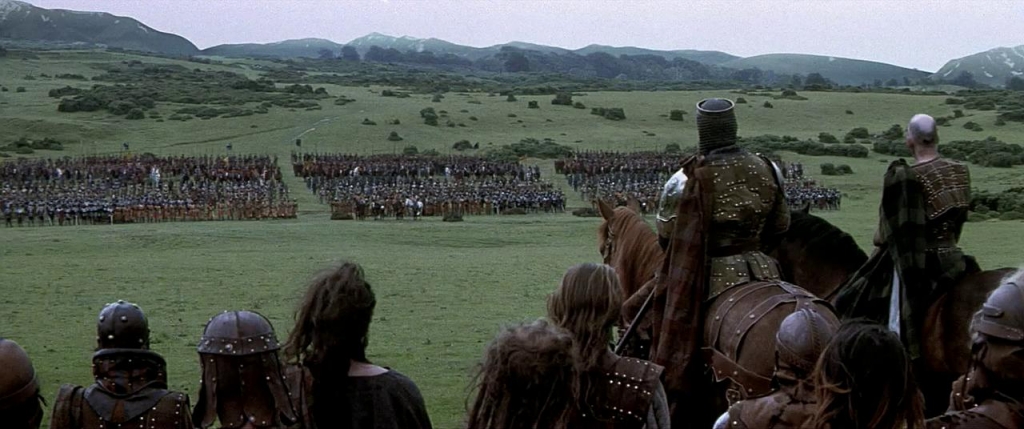
The pristine beauty and unpolluted air of Glencoe has been a draw to film makers for over 70 years.  Many scenes from Braveheart and Rob Roy were filmed in Glencoe.

The area was used as the home of Hagrid in the filming of Harry Potter and the Prisoner of Azkaban and in the James Bond movie Skyfall.  It is noted in the Ian Fleming novels as the birthplace of James Bond’s father, Andrew Bond.
Hagrid's hut from Harry Potter and the Prisoner of Azkaban

Wednesday, June 4, 2014

Jacobite Steam Train

Dubbed one of the greatest steam railway journeys in the world, the Jacobite Steam Train (tour day 3) is an 84-mile round trip through some of the most scenic country in Scotland as we travel through the Western Highlands.

The Jacobite Steam in the Scottish Western Highlands
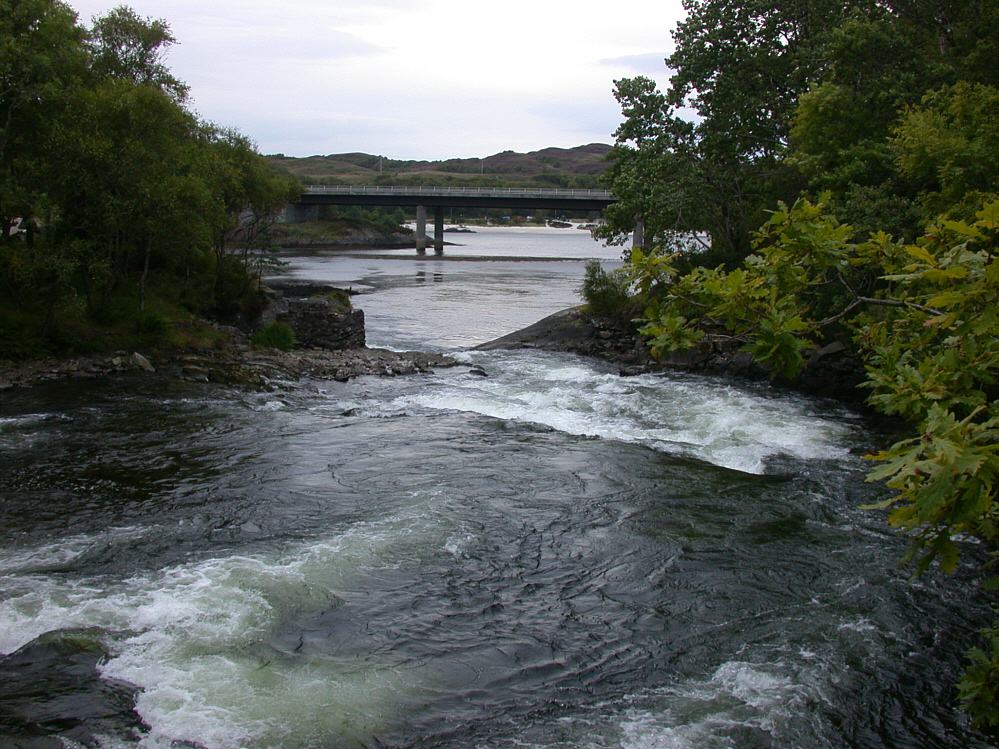
Our journey begins in Fort William at the base of Ben Nevis, Britain’s highest peak, and ends at Mallaig, 41 miles away on the western coast near the deepest deep seawater loch in Europe, Loch Nevis.  In between, the train passes close to the deepest fresh water loch in Britain, Loch Morar, and the shortest river in Britain, River Morar…truly a journey of extremes!

The area around Fort William, known as Glen Nevis, has been featured in several movies including Braveheart, Rob Roy, Highlander, and the Harry Potter films.  The Quidditch match in Harry Potter and the Sorcerer’s Stone was filmed against the background of Glen Nevis.

As the train departs Fort William, it skirts the shores of Loch Eil.  On leaving the Banavie station, the train crosses the Caledonian Canal, and on the right, you can see Neptune’s Staircase, a series of locks to raise boats to a higher level.

Perhaps the Jacobite Steam Train is best known as the train Harry Potter and his friends ride to school, the Hogwarts Express.  Owner West Coast Railways allowed the Harry Potter movies to film the railway and several of the individual cars.

The Jacobite Steam Train subbed for the Hogwarts Express in the Harry Potter movies.
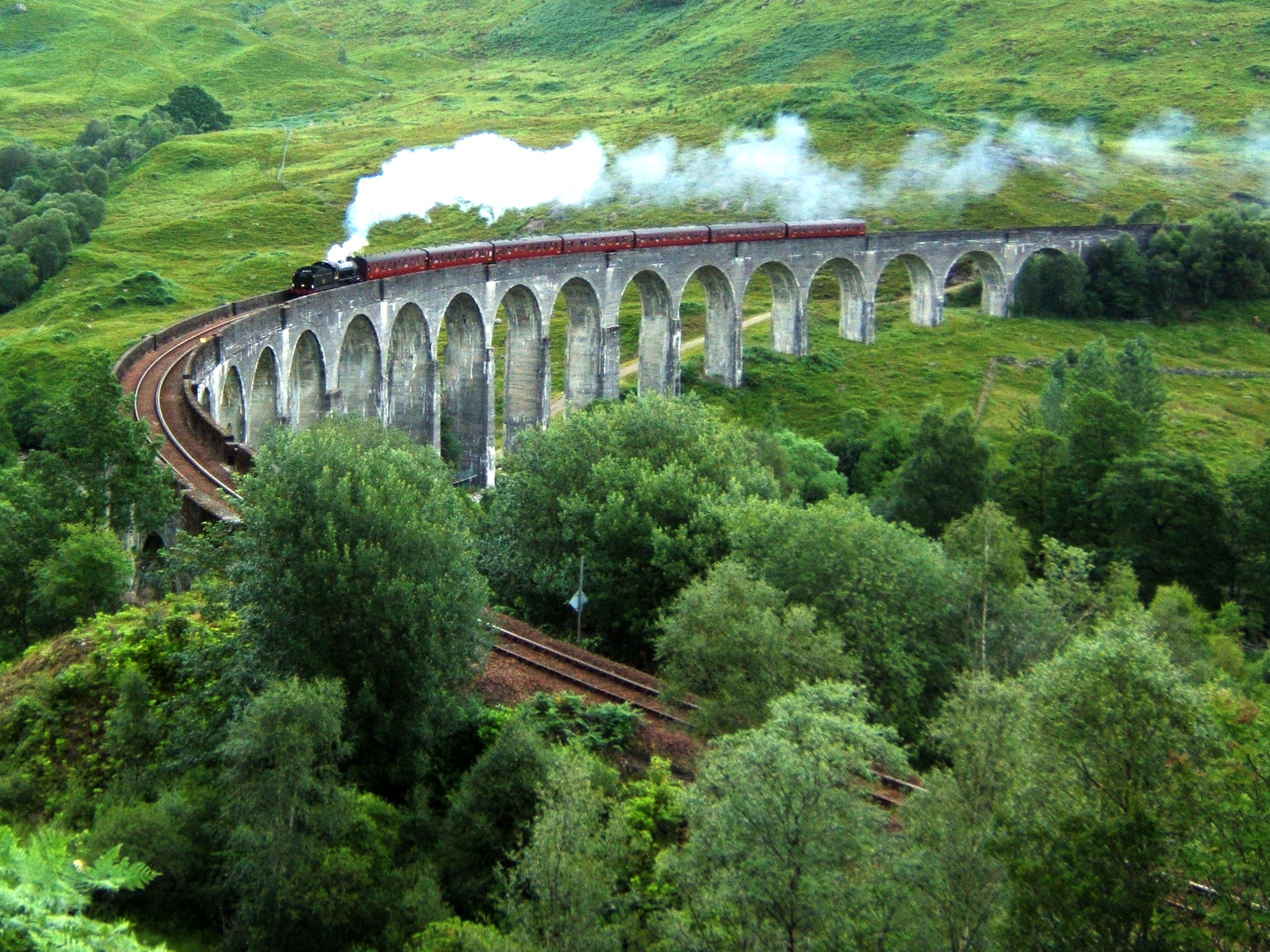
The highlight of the journey is when the train crosses the iconic Glenfinnan Viaduct where passengers get a stunning view toward the Glenfinnan Monument and Loch Shiel.  The crossing takes place at 10:54 a.m., according to the train’s timetable, and slows down as it passes over the viaduct.

Built by Robert McAlpine in 1901, it was one of the first rail viaducts to be built of concrete with over 21 arches supporting 416 yards of raised track

The curved viaduct is a recognizable feature in the Harry Potter films.  When Harry and Ron miss the train in Harry Potter and the Chamber of Secrets, they fly to Hogwarts in a car that zooms around and through some of the viaduct’s 100-foot high arches.

If possible, sit on the left side of the train leaving Fort William; you will have a better view of the viaduct rounding the curve and the engine passing over the viaduct.

The Jacobite makes a regular stop in the village of Glenfinnan along the shores of Loch Shiel where stands a monument to Bonnie Prince Charles who raised his standard here at the beginning of the 1745 Jacobite Rebellion.  The stop gives you time to stretch your legs and visit the museum in the station buildings.

Before the train reaches Glenfinnan, it travels through splendid scenery along the shores of Loch Eilt, possibly one of the most picturesque lakes along the route dotted with several tree covered islands where Hagrid (of the Harry Potter movies) is seen skimming stones across the lake. 

Here you will see the Eilt pines, an example of the ancient Caledonian pine forest.  The best views here are on the right side of the train.

Just after Glenfinnan and the Lochailort station, the train passes the Church of Our Lady of the Braes.  Church services here ceased in 1964, but the building was featured in the 1983 movie Local Hero.  [The full movie is available here. (1:51:29)]

At Arisaig and Morar, you can glimpse the sea on the left hand side of the train. Arisaig is Britain’s most westerly railway station.  Morar provides superb coastline views across a turquoise sea to the Isles of Eigg, Rum, and further north to Skye.

The train runs from Fort William to Mallaig on the coast.
The train departs Fort William at 10:15 a.m. and arrives in the fishing port of Mallaig at 12:25p.m.  Here we will have an hour and half for a leisurely lunch break to enjoy fresh fish and chips at a number of restaurants.  It is recommended to have lunch first and then take a stroll afterwards to see the sites including the 8-foot tall fisherman statue at the end of the harbor wall. 

Mallaig offers views of the western isles and provides ferry service to the Isle of Skye.  Some visitors have reported seeing seals in the harbor. The return from Mallaig departs at 2:10 p.m. arriving back in Fort William at 4 p.m.

Mallaig may be our destination, but traveling is as much a part of the experience as the destination, and there’s no better way to enjoy the Western Highlands of Scotland than this spectacular railway journey.

Enjoy these videos of this once in a lifetime journey by rail!
“Jacobite” Highlights – The World Famous Steam-hauled Train to Fort William (6:30)

Saturday, September 21, 2013

2015 Slide Show of Tour Highlights

Experience Ireland and the Scottish Highlands

We are planning our next tour and it will be to beautiful Ireland and the Scottish Highlands.  The 10-day tour is June 22-July 1, 2015.

This is a one-of-kind customized tour combining some unique sites not found in many tours to Ireland and Scotland.  Highlights of the tour include: a train ride through the Scottish Highlands, the Giant’s Causeway in Northern Ireland, and the Cliffs of Moher on the Atlantic shores of Ireland.

If your heritage traces back to Ireland, then you’ll be able to step back in time at the Ulster American Folk Park and see just how your ancestors lived before immigrating to the New World.  And if nature is what you prefer, there will be no end to the diversity you’ll enjoy!

To get a closer look at what you will experience on the tour, then watch the slide show below that highlights these locations and many more.  Simply click on this link, or click in the box below.  (Note: I’ve found it works best when viewing with the Google Chrome browser. Also it uses Flash Player so may not play on iPads or iPhones, so use link above.)


Click on the forward button in the middle of the screen to start the show.  To advance the slides, click on the forward button at the bottom left to view this size.  To view full screen, click on the square in the lower right corner of the slide show and simply click your mouse on the screen to advance the slide show.  Enjoy!

2015 Detailed Itinerary

Experience Ireland and the Scottish Highlands
EF Customized Tour
June 22-July 1, 2015

DAY 1
Board your overnight flight to Glasgow, Scotland!

DAY 2
Arrive in Glasgow and Transfer to Fort William via Glencoe and Loch Lomond (time permitting)
Visit Glencoe, site of the notorious 1692 massacre of the MacDonald clan. Here, the fusion of natural beauty and historical preservation offer some of the most magnificent views in Scotland. Continue past the ‘‘Bonnie, Bonnie Banks of Loch Lomond’’ to Fort William, second largest settlement in the Highlands.

Overnight in Fort William

DAY 3
Ride the Jacobite Steam Train
Enjoy this full day excursion in Harry Potter-style train carriages. You will pass by Loch Morar, the deepest freshwater loch in Britain, as well as Loch Nevis, the deepest seawater loch in Europe! Your route also includes the Glenfinnan viaduct, made famous in the Harry Potter films. After a stop to stretch your legs at Glennfinnan station you will continue through Arisaig to Mallaig, where you will have approximately an hour and a half to explore and enjoy lunch on your own before returning to Fort William.

Overnight in Fort William

DAY 4
Transfer to Cairnyan, Scotland for Ferry to Belfast, Northern Ireland
View some of Scotland’s most beautiful scenery in the Western Highlands as you travel south from Fort William to board a ferry in Cairnyan that will take you to the capital of Northern Ireland, Belfast.

Visit Titanic Belfast
The newly opened Titanic Belfast is a must-visit in any tour of Northern Ireland. It is located in the heart of Belfast, on the slipways where RMS Titanic was built, and offers over nine galleries including special effects, dark rides, full-scale reconstructions and innovative interactive features to explore the Titanic story in a fresh and insightful way. The museum traces the lifespan of the RMS Titanic from her conception in Belfast in the early 1900s, through her construction and launch, and finally to her infamous maiden voyage and catastrophic demise.

Overnight in Belfast

DAY 5
Excursion to the Carrick-a-Rede Bridge
Take a walk on the exhilarating rope bridge to Carrick-a-Rede Island and enjoy a truly cliff-top experience. This 30-metre deep and 20-metre wide chasm is traversed by a rope bridge traditionally erected by salmon fishermen. Visitors bold enough to cross to the rocky island are rewarded with fantastic views.

Visit Giant’s Causeway
Journey to Ireland’s northernmost point to view the amazing Giant’s Causeway. This fascinating geological phenomenon comprises thousands of 55-million-year-old hexagonal basalt columns that form a honeycomb pathway into the sea. Explore rock formations including the Wishing Chair, the Punchbowl, and the Giant’s Granny, and learn the legend of Finn MacCool, the Irish giant said to have built the columns so that his true love could cross the water from Scotland. Near here, the Spanish Armada’s flagship Girona sank in 1588.

Visit Dunluce Castle
Rebuilt during the Anglo-Norman period on a much older fort site, Dunluce Castle is a magnificent site to behold. Crowning a rocky outcrop and joined to the mainland by an arched walkway, the castle looks out to sea and underneath lies the 'Mermaid's Cave'. Close by is the ancient church ruins of St. Cuthbert's named after a Northumbrian monk and the (possible) burial site of sailors and noblemen from the Spanish Armada. On a clear day you can look over an expanse of ocean from here to Donegal and round to Islay, a view which has remained unchanged for centuries. It was within this view that the tragedy of the emigrant ship, the Exmouth, took place in April, 1857. Bound for Quebec, she spent almost three days in horrendous sea conditions before finally breaking up on rocks off Islay with the loss of 240 lives.

Overnight in Belfast

Day 6
Transfer to Galway via a Visit to Ulster-American Folk Park
Travel to Galway via the Ulster-American Folk Park, an outdoor museum that tells the story of Irish emigration to America. Costumed guides representing Irish villagers welcome you into their replicated 19th-century homes and businesses, including a weaver’s cottage, a meeting house, a post office, and a blacksmith’s forge. Continuing the story of their emigration, you’ll be able to enter the Brig Union, a reconstruction of the 19th-century ship on which many of them sailed to the U.S. (a journey of three weeks in cramped and often perilous quarters). Disembark from the ship onto American Street for a glimpse at the New World they found when they arrived.

Arrive in Galway
Today Galway is the cultural and artistic capital of the west of Ireland-as well as one of the best places to hear traditional music. Originally known as a center for fishing, the industry still plays a part in everyday life here.

Overnight in Galway

Day 7
Visit the Cliffs of Moher
Enjoy an excursion to the Cliffs of Moher, which tower an imperious 750 feet above the Atlantic. This region is considered to have some of the most haunting and stunning beauty in a country filled with natural wonders.

Visit The Burren and Visitor Centre
From the Gaelic An Boireann, meaning ‘a stony place’, The Burren is a sweeping rock-strewn landscape rich in historical and archaeological sites. Ancient megalithic tombs, ring forts and rock formations are strewn across rolling hills of stone and grass. Take a moment to marvel at the natural beauty as you continue on your journey. As you drive through the Burren, stop to admire the Corcomroe Abbey and admired the detailed stone carvings as you imagine the abbey in its former glory.

Overnight in Galway

DAY 8
Transfer to Dublin via the Kildare National Stud Farm
Today, visit one of Ireland’s most famous places when you stop to see the Kildare National Stud Farm. You will see where Ireland has bred some of the world’s best race horses. Walk around the 958-acre grounds and see the steeds being groomed and exercised.  Also here are the Japanese Gardens, considered the most renowned in Europe; the natural beauty of St. Fiachra’s monastic garden; and the Horse Museum.

Visit Glendalough
Travel to scenic Glendalough. Located at the center of County Wicklow, this pastoral valley offers bewitching views of Ireland’s topographical splendor, including lakes, forest and waterfalls. Glendalough also contains the country’s best-preserved ruins of early monastic settlements.

Arrive in Dublin
Arrive in literary Dublin, one-time home of James Joyce, George Bernard Shaw, Samuel Beckett, and W. B. Yeats! Dublin is also the setting for Joyce’s Ulysses, one of the 20th century’s greatest literary works. In recent years Dublin has also developed as one of Europe’s busiest entertainment centers.

Overnight in Dublin

DAY 9
Guided Sightseeing of Dublin
Begin your tour of the Irish capital by viewing some of Dublin’s celebrated Georgian squares. From here you will visit St. Patrick’s Cathedral to see the beautiful interior. You will then head past the Post Office, site of the 1916 rebellion, before continuing along the banks of the River Liffey. Continue your visit in Phoenix Park which houses the residence of the President of Ireland. Your tour of Dublin concludes with a visit to the city’s renowned Trinity College, established by Queen Elizabeth I in 1592. Here you will view the illuminated 8th century Book of Kells, written by Irish monks and found buried in the ground in 1007.

Visit the Guinness Storehouse
Founded in 1759, it is one of the world’s largest breweries. You will see how the dark brown stout is made and, of course, taste a glass as well!

Visit Dublin Castle

Journey back to the 13th century, as you visit Dublin Castle. Originally the center of British control, it was taken over in 1922 by the new Irish Republic. Today it offers some of the oldest architecture in the city.

Overnight in Dublin

DAY 10
Transfer to the Airport for Your Return Flight
Your tour director assists with your transfer to the airport, where you’ll check in for your return flight home.


2015 General Tour Information

Experience Ireland and the Scottish Highlands

--We are traveling with EF Educational Tours
--This is a 10-day private customized tour June 22-July 1, 2015 especially for our adult group. We will not be combined with any other groups.
--The current all-inclusive tour price is $4,474 per adult.  This includes the $95 enrollment fee, departure fees, program price, private bus, adult supplement, 8 overnight stays in double rooms with private baths, roundtrip airfare from DFW, all breakfasts and dinners, train and ferry transportation, 15 entrances to sites, guided sightseeing and walking tours, and full-time EF tour director.
--Those who have previously traveled with EF will receive an additional $100 discount (the enrollment fee).  This will be reflected on your account when previous travel has been verified by EF.
--EF now offers the EF Price Guarantee.  Once you enroll on the tour, your price will never change.  This is a new feature with EF.  NO MORE INCREASING DEPARTURE FEES after you enroll!
--The optional $155 All-Inclusive Insurance Plan covers medical and accident, baggage and property, flight delay, 24-hour emergency assistance, and tour cancellation and interruption.  The insurance is not required, but I do recommend it as many U.S. insurance companies do not provide adequate insurance for travel abroad.  I would recommend contacting your insurance company to make sure.  If you do not want it, you can decline it during enrollment.  You can, however, add the all-inclusive coverage plan up to 70 days prior to departure.
--This tour requires at least 30 participants for the private bus at this price.  If there are fewer, the fee will increase slightly.
--Each participant must have a roommate or will be subject to a single supplement charge.
--The minimum amount required at the time of enrollment is $95.  This will lock you into the current price.
--Enrollment options:
1.       Internet: enroll online quickly and easily at the EF enrollment site.  Our tour number is 1472106ED.
2.       Phone: call 1-877-205-9909.
3.       Mail: send in the enrollment form in the prepaid envelope provided (I have these).
4.       Fax: complete the enrollment form and fax to 1-800-318-3732.
--Payment options:
1.       Manual Payment Plan: pay $95 with enrollment and lock in the current price, required $500 due in 30 days, and the rest you may pay as you please as long as the balance is paid 110 days prior to departure (about March 1, 2015).
2.       Monthly Payment Plan: pay $95 with enrollment and lock in current price, then the balance is automatically divided into small, manageable monthly payments deducted monthly from your checking account or credit card.  With this plan you have 2 more months (until May 22, 2015) to make payments (30 days prior to departure) and you do not have to worry about late fees. 
--When registering, you MUST put your name on the application EXACTLY as it is on your passport or birth certificate.  This is the same name that will be put on your airplane tickets (and passport if you don’t have one yet) and the names MUST match.  Married women use your married name.  EF requires you to include a middle name (or maiden name if that is on your passport) for enrollment.
--You will need a passport to travel abroad.  If you have one, make sure it will be valid at least six months after our return in 2015.  Adult passports are good for 10 years; children’s passports are good for five years.  If you do not have a passport, then wait until about 6 months prior to departure to apply.
--Once we have organized our traveling group, I will keep you informed of everything you need to know.  I will have a meeting a month prior to departure.  Until then I will keep you informed on sites we will see, what to expect, what to pack, how to obtain currency, where to shop, how to get passports, inform you of airline flights and hotels…everything you need to know through my travel blog at http://luv2go.blogspot.com

Right now you just need to decide if you want to join us…and we hope you do!