Showing posts with label goddesses. Show all posts

Wednesday, September 8, 2010

Delphi

Now that a visit to Delphi is included in our itinerary (Yoo-hoo! -see previous blog!), let’s take a look at what we will get to see…and why it is so well-known. Many people visit the site without actually understanding its significance.

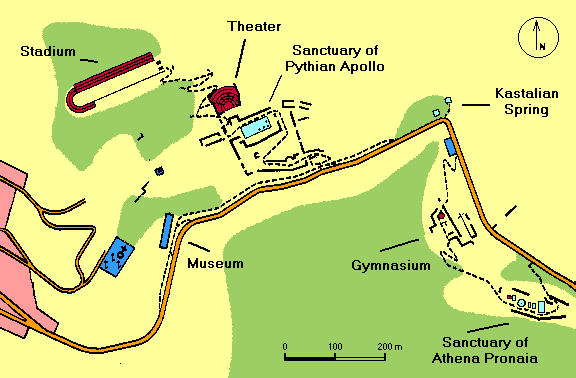
Delphi, one of the most popular ancient sites in Greece, is located about 100 miles northwest of Athens on the forested slopes and rocky crags of the south side of Mount Parnassus. It takes about 2 ½-3 hours to drive there. Most of the ruins that survive today date from the most intense period of activity at the site in the 6th century BC.

In ancient times Delphi was considered the center of the known world, the place where heaven and earth met. Here Greek mythology says Zeus released two eagles from opposite ends of the earth and they met in the sky above Delphi. Impaling one another with their beaks, they fell to the ground on the very center of the world. The site was marked by the sacred Omphalos, or "navel stone."

Later, Apollo killed the serpent Python (son of Mother Earth), guardian of Delphi's sacred Castalian Spring. The sun god then established an oracle at the spring, promising to provide counsel to all who needed it. Located at the navel of the world and personally blessed by Apollo, Delphi was the holiest site in the world for the ancient Greeks.

The oracle of Delphi was a religious center, most famous for its accurate predictions of the future. The oracles were given by Pythia, the priestess who muttered incomprehensible sounds in a state of trance, which in turn were translated in comprehensible language and given to those who made the pilgrimage in search of answers.

The Temple of Apollo, where sat the famous oracle, appears today in a ruinous state in the center of the sanctuary. Only a few of its Doric columns remain standing, but its imposing foundations are a visible reminder of the Temple’s splendor in ancient times. The present ruins of the temple date back to the 4th century BC.

At the entrance to the ruins are the reconstructed treasuries. These were built by the various Greek city states — those overseas as well as those on the mainland — to commemorate victories and to thank the oracle for her advice, which was thought to have contributed to those victories.

Delphi is famous for its many preserved athletic statues. It is known that Olympia originally housed far more of these statues, but time brought ruin to many of them, leaving Delphi as the main site of athletic statues now housed in the archaeological museum.

The ancient theatre at Delphi was built further up the hill from the Temple of Apollo giving spectators a view of the entire sanctuary and the valley below. It was originally built in the 4th century BC but was remodeled on several occasions since. Its 35 rows can seat 5,000 spectators.
The stadium is located further up the hill, beyond the Sacred Way and the theatre. It was originally built in the 5th century BC but was altered in later centuries. It could seat 6,500 spectators. Here the Pythian Games took place every four years to honor Apollo, and hosted poetry and music competitions besides the staple of athletic events.

At the base of these ruins lies the Sanctuary of Athena. The Tholos is probably the most widely recognized building on the site because of the color of the marble and the fact that it is a round temple. Strangely enough what the temple was used for and who it commemorates is not known. It was built between 380 and 360 BC, and only three of its original twenty Doric columns remain standing today.

Since, the location of Delphi is on the slope of a mountain one can enjoy the view of the whole valley below all the way to the Gulf of Corinth. However be ready for a strenuous climb to see the ruins.

And don't forget to Google "Delphi, Greece" and click on videos. You'll get some professional and some amateur views of the site. Sometimes the amateur ones give us a more realistic view of what we'll see.

Wednesday, July 28, 2010

Greek Gods and Goddesses

One cannot truly understand Ancient Greece culture without having a basic understanding of the religion and beliefs of the people of the period. So here is a brief background of the primary Greek gods and goddesses associated with many of the sites we will visit. The Romans, who came later, adopted many of the Greek deities, but changed the names. The only name they did not change was Apollo.

In Greek mythology, twelve gods and goddesses ruled the universe from atop Greece's Mount Olympus. These Olympians had come to power after their leader, Zeus, overthrew his father, Kronos, leader of the Titans. All the Olympians are related to one another.

The following well done videos give a good explanation of gods and goddesses. You can also access the Greek Gods video at this link and the Greek Goddesses video at this link. Once you've seen the videos and read the family tree below, then test your knowledge with the ThinkQuest interactive test at the bottom of this post.

The Ancient Greek Gods


Rod Stewart MySpace Video


The Ancient Greek Goddesses


Rod Stewart MySpace Video


Zeus (Roman name: Jupiter)

The most powerful of all, Zeus was god of the sky and the king of Olympus. His temper affected the weather, and he threw thunderbolts when he was unhappy. He was married to Hera but had many other lovers. His symbols include the oak and the thunderbolt.

Hera (Roman name: Juno)

Hera was goddess of marriage and the queen of Olympus. She was Zeus's wife and sister; many myths tell of how she sought revenge when Zeus betrayed her with his lovers. Her symbols include the peacock and the cow.

Poseidon (Roman name: Neptune)

Poseidon was god of the sea. He was the most powerful god except for his brother, Zeus. He lived in a beautiful palace under the sea and caused earthquakes when he was in a temper. His symbols include the horse and the trident (a three-pronged pitchfork).

Hades (Roman name: Pluto)

Hades was king of the dead. He lived in the underworld, the heavily guarded land where he ruled over the dead. He was the brother of Zeus and the husband of Persephone, Demeter's daughter, whom he kidnapped.

Aphrodite (Roman name: Venus)

Aphrodite was the goddess of love and beauty, and the protector of sailors. She may have been the daughter of Zeus and the Titan Dione, or she may have risen from the sea on a shell. Her symbols include the myrtle tree and the dove.

Apollo

Apollo was the god of music and healing. He was also an archer, and hunted with a silver bow. Apollo was the son of Zeus and the Titan Leto, and the twin of Artemis. His symbols include the laurel tree, the crow, and the dolphin.

Ares (Roman name: Mars)

Ares was the god of war. He was both cruel and a coward. Ares was the son of Zeus and Hera, but neither of his parents liked him. His symbols include the vulture and the dog, and he often carried a bloody spear.

Artemis (Roman name: Diana)

Artemis was the goddess of the hunt and the protector of women in childbirth. She hunted with silver arrows and loved all wild animals. Artemis was the daughter of Zeus and Leto, and the twin of Apollo. Her symbols include the cypress tree and the deer.

Athena (Roman name: Minerva)

Athena was the goddess of wisdom. She was also skilled in the art of war, and helped heroes such as Odysseus and Hercules. Athena sprang full-grown from the forehead of Zeus, and became his favorite child. Her symbols include the owl and the olive tree.

Hephaestus (Roman name: Vulcan)

Hephaestus was the god of fire and the forge (a furnace in which metal is heated). Although he made armor and weapons for the gods, he loved peace. He was the son of Zeus and Hera and married Aphrodite. His symbols include the anvil and the forge.

Hestia (Roman name: Vesta)

Hestia was the goddess of the hearth (a fireplace at the center of the home). She was the most gentle of the gods, and does not play a role in many myths. Hestia was the sister of Zeus and the oldest of the Olympians. Fire is among her symbols.


Hermes (Roman name: Mercury)


Hermes was the messenger god, a trickster, and a friend to thieves. He was said to have invented boxing and gymnastics. He was the son of Zeus and the constellation Maia. The speediest of all, he wore winged sandals and a winged hat and carried a magic wand.

…also sometimes included:
Demeter (Roman name: Ceres)

Demeter was the goddess of the harvest. The word “cereal” comes from her Roman name. She was the sister of Zeus. Her daughter, Persephone, was forced to live with Hades each winter; at this time Demeter let no crops grow. Her symbols include wheat.

Dionysus (Roman name: Bacchus)

Dionysus was the god of wine, which he invented. In ancient Greece Dionysus was honored with springtime festivals that centered on theater. Dionysus was the son of Zeus and Semele, a mortal. His symbols include ivy, the snake, and grapes.


(be patient as it may take a little while to load...but worth it!)
Requires Java